Whales are the largest mammals on earth. Amongst whales, those with the largest body size are a group of baleen whales called Rorquals that includes the blue whale, fin whale, and humpback whale. The defining feature of this group is a series of longitudinal skin folds that run from the chin to the stomach; these folds stretch like an accordion when the whales gulp huge volumes of water. Rorqual whales consume small creatures suspended in the water (i.e. small fish, krill, copepods). Instead of individually capturing prey items and consuming them one-by-one they capture and consume innumerable small prey all at once. This is quite a profound shift compared to the way most predators capture and consume prey, and the ability to exploit this abundant food source en masse is undoubtedly a major factor allowing them to obtain exceptionally large size. The feeding technique used by these whales is referred to as lunge feeding. This has been described as: “a sequential two-step process that begins with the engulfment of a discrete but large volume of prey-laden water during a high-velocity lunge, and ends with the purging and filtration of the water out of the distended buccal cavity” (Goldbogen et al. 2017). It is one thing to describe the technique with words and another to see it in action.
Pelicans also engage in lunge feeding. These birds frequently dive into schools of fish while opening their bill and expanding their throat pouch, thereby trapping fish alongside a large quantity of water.
Finally, American Alligators can now be added to the list of species that perform lunge feeding. During a few week period in the spring of 2025 at La Chua trail in Gainesville, Florida I observed adult alligators perform lunge feeding to capture and consume schools of small fish. Specifically, they repeatedly submerged and then rapidly burst out of the water while opening their mouths, engulfing water and small fish. They then expelled water through closed teeth, and made subtle head movements indicating swallowing. This was often repeated numerous times in the same spot. It looked like alligators engaged in this behavior were preying upon small fish, but it happened so quickly and the fish were so small that it was only after reviewing my photos and videos in slow motion that I could clearly see numerous small fish scattering at the water surface to avoid being engulfed. I published these observations as a natural history note in the journal Reptiles and Amphibians.
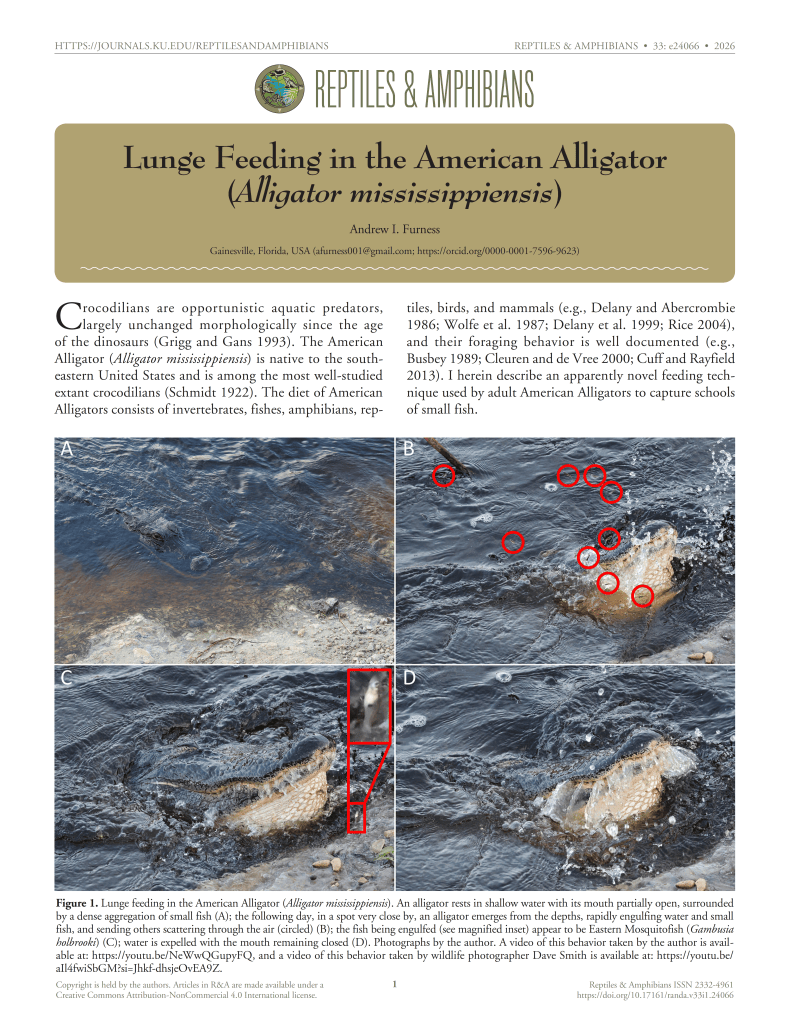
The best video of alligators employing this hunting technique was taken by wildlife photographer Dave Smith.
The fish being consumed appeared to be Eastern Mosquitofish. This is a live-bearing species of fish native to Florida. They are in the same family (Poeciliidae) as guppies. They are probably the most abundant fish species in Florida, and are very small in size (i.e. 1 – 5 cm). Studies of alligator diet found 6 Mosquitofish amongst their stomach contents (n=769 alligators across 11 Florida lakes). So, although this is a known diet item it appears to be rare. I suggest that it is only nutritionally profitable for alligators to target Mosquitofish when they form very dense aggregations. That is, these fish are so small that they are probably not worth directly targeting as prey (by adult American Alligators) unless they are so concentrated that lots of individuals can be captured and consumed at once. That appears to be the exact circumstances in which lunge feeding behavior was observed. I only observed lunge feeding during a short period during the dry season when small fish were densely aggregated. Below is a photo I took at La Chua trail very near to where alligators were engaging in lunge feeding. You can see the incredible density of small fish surrounding the alligator. The fish are so dense that they actually make the water appear black.
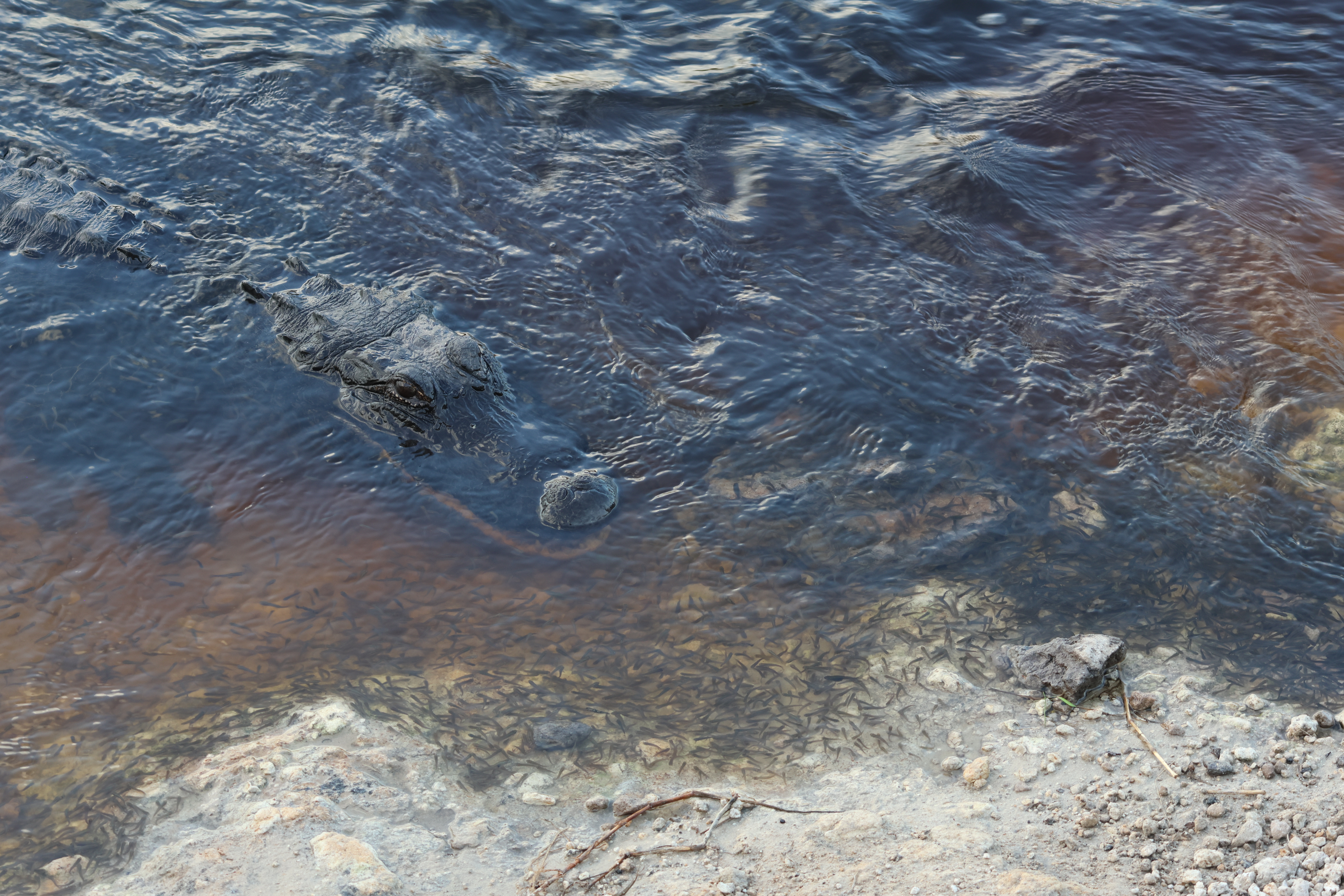
An alligator resting in shallow water with its mouth partially open, surrounded by a dense aggregation of small fish. Click to enlarge photo.
The only other time I observed an alligator feeding upon poeciliid fishes was in a drying pool in the Florida Everglades – another situation where small fish are concentrated in space. These observations suggest that for certain alligator populations, given the right circumstances, even very small fishes are worth pursuing using a specialized hunting technique (lunge feeding).
What I think makes these observations interesting (and worth writing up as a natural history note) is that it is an example of a convergent feeding technique found in completely different taxa. Whales, pelicans, and alligators are in different taxonomic groups (i.e., mammal, bird, reptile) and the anatomical and behavioral means by which lunge feeding occurs are quite distinct in these groups. Yet, despite these superficial differences there is a clear similarity of underlying function: the technique is designed to capture and consume numerous small prey items at once.

