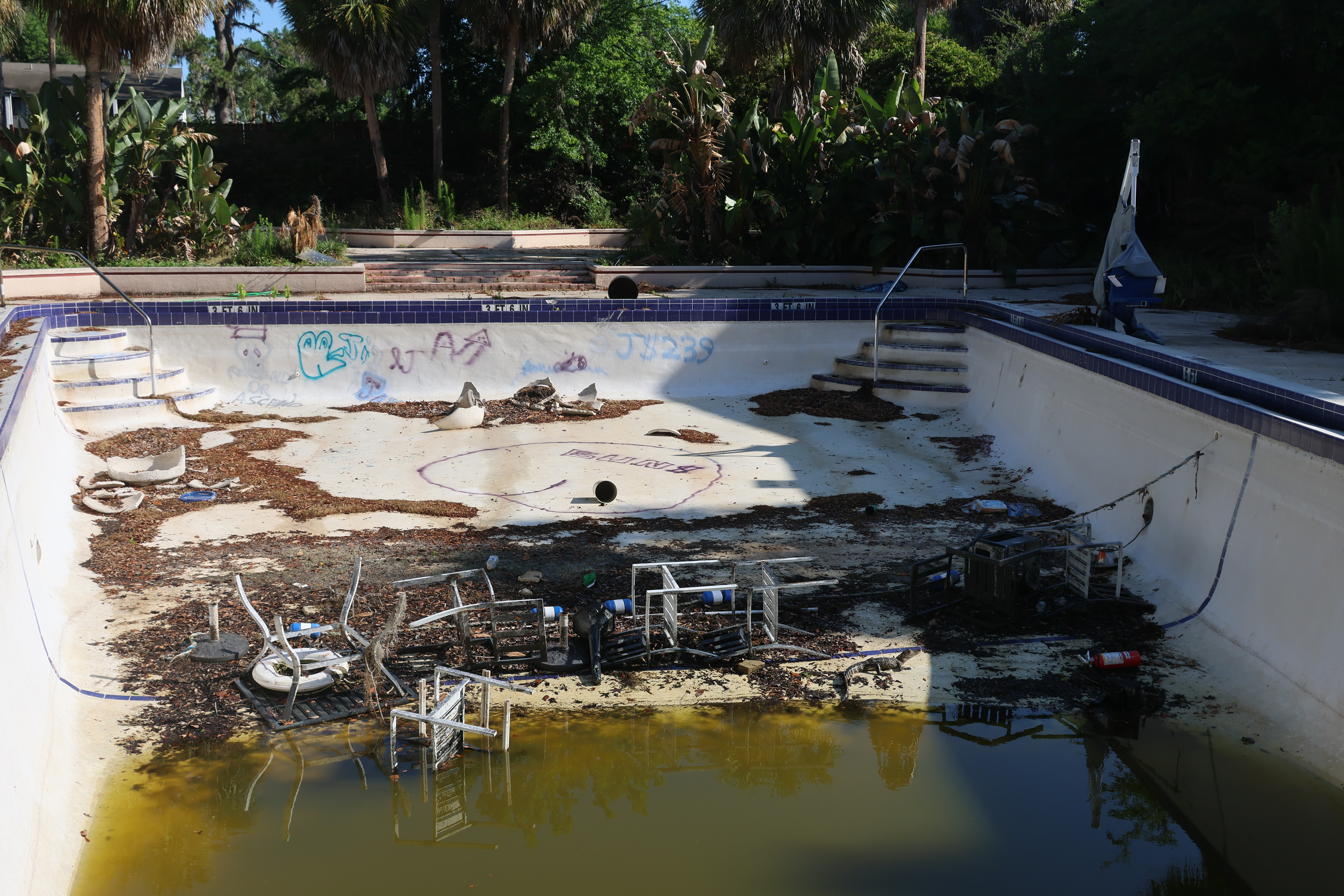
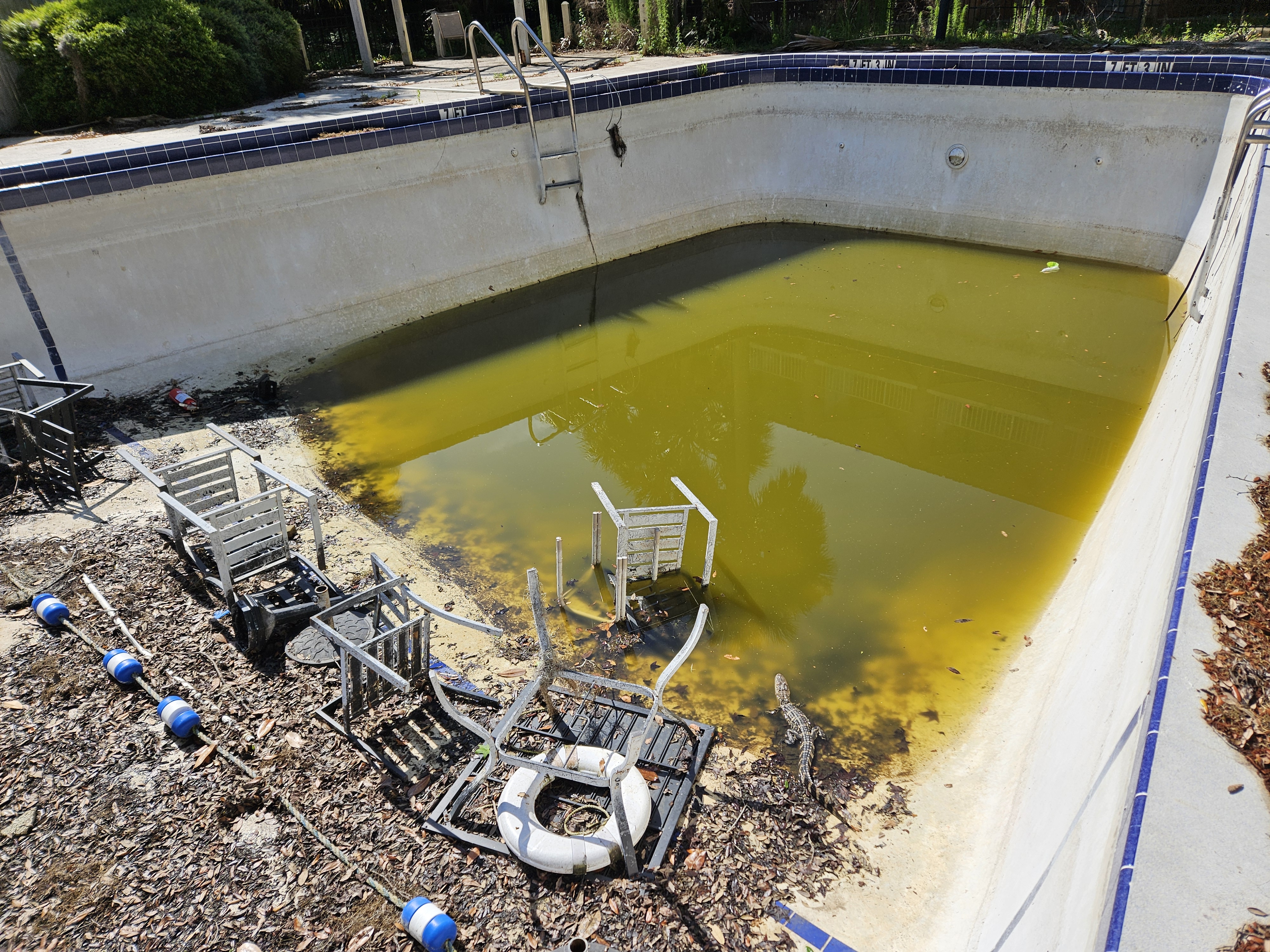
It is springtime in north central Florida and that means female turtles are moving about on land looking for nesting sites, and alligators are active. A week ago, I was walking along the edge of a lake, past a long-ago shuttered hotel. Out of curiosity, I took a look in the abandoned and partially filled outdoor swimming pool. To my surprise, I spotted the head of a Florida softshell turtle (Apalone ferox) sticking out of the dark brown water. It was clear the turtle was trapped in the pool with no way of escape. As I circled the pool, I also spotted a small alligator hiding amongst lawn chairs that had been thrown (or blown) in. I decided I would attempt to rescue these animals and release them into the lake which is less than 50 yards from the swimming pool. What follows is an account of this process, which took place over the following week and was more involved than I originally anticipated.
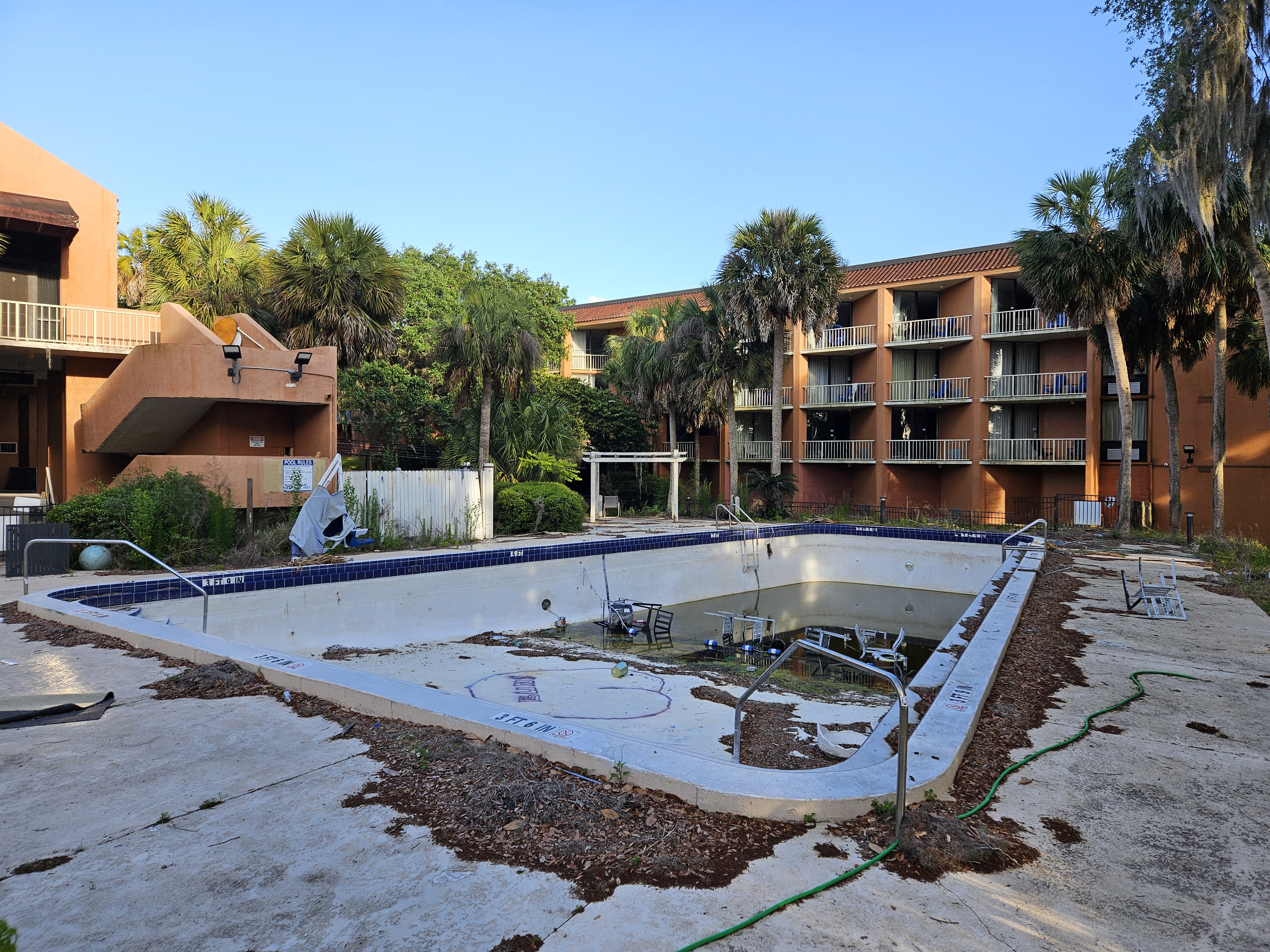
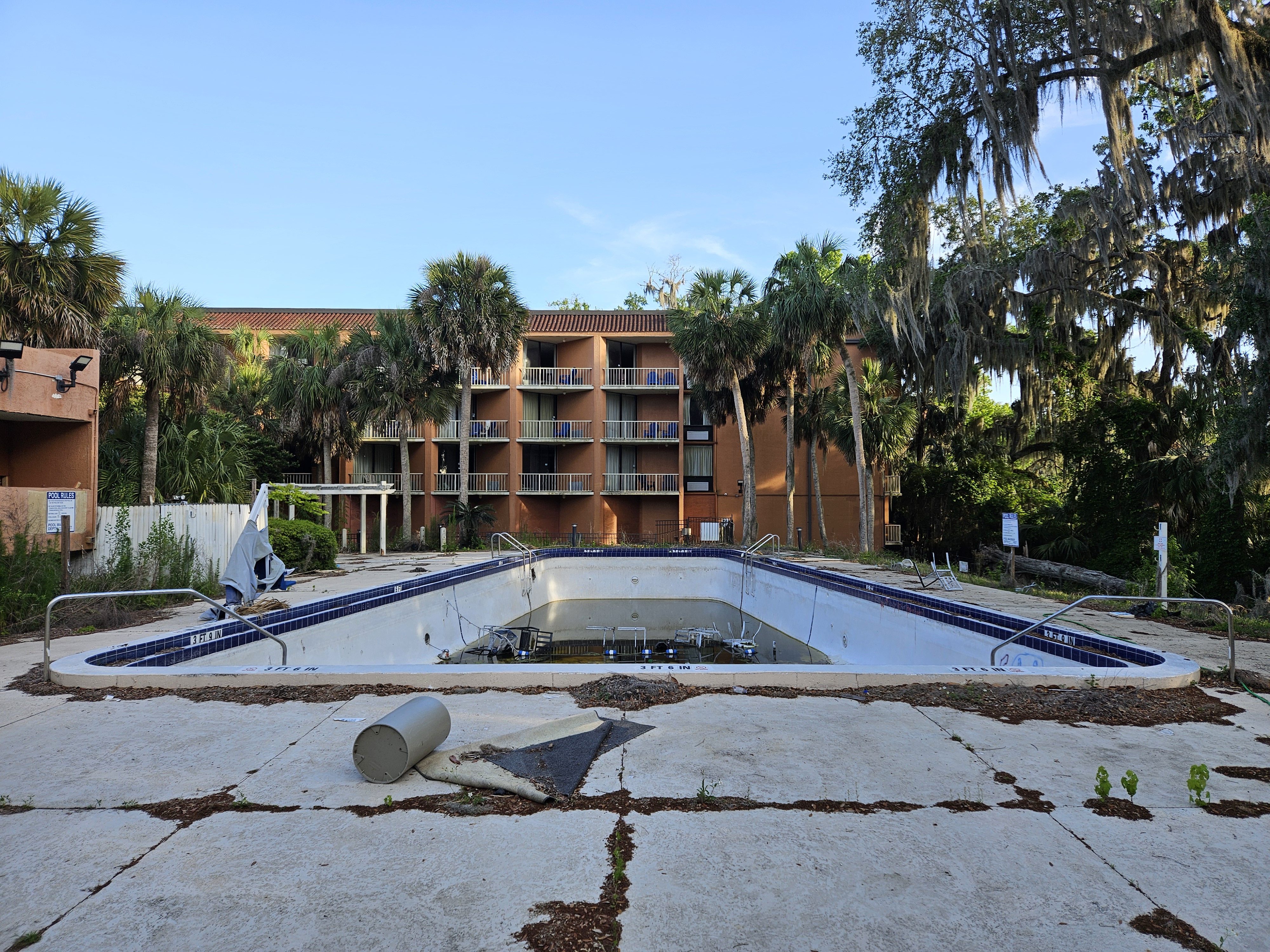
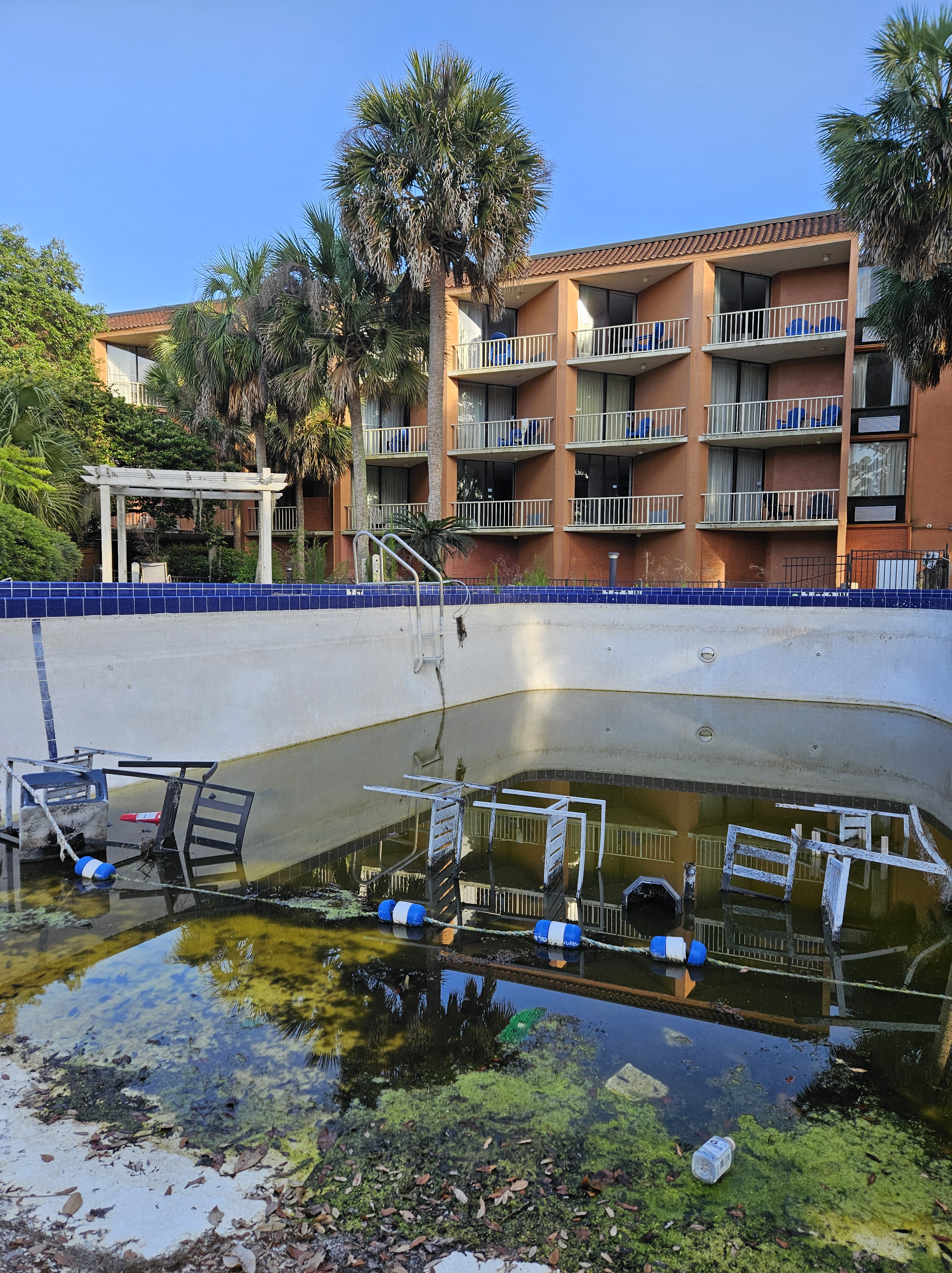
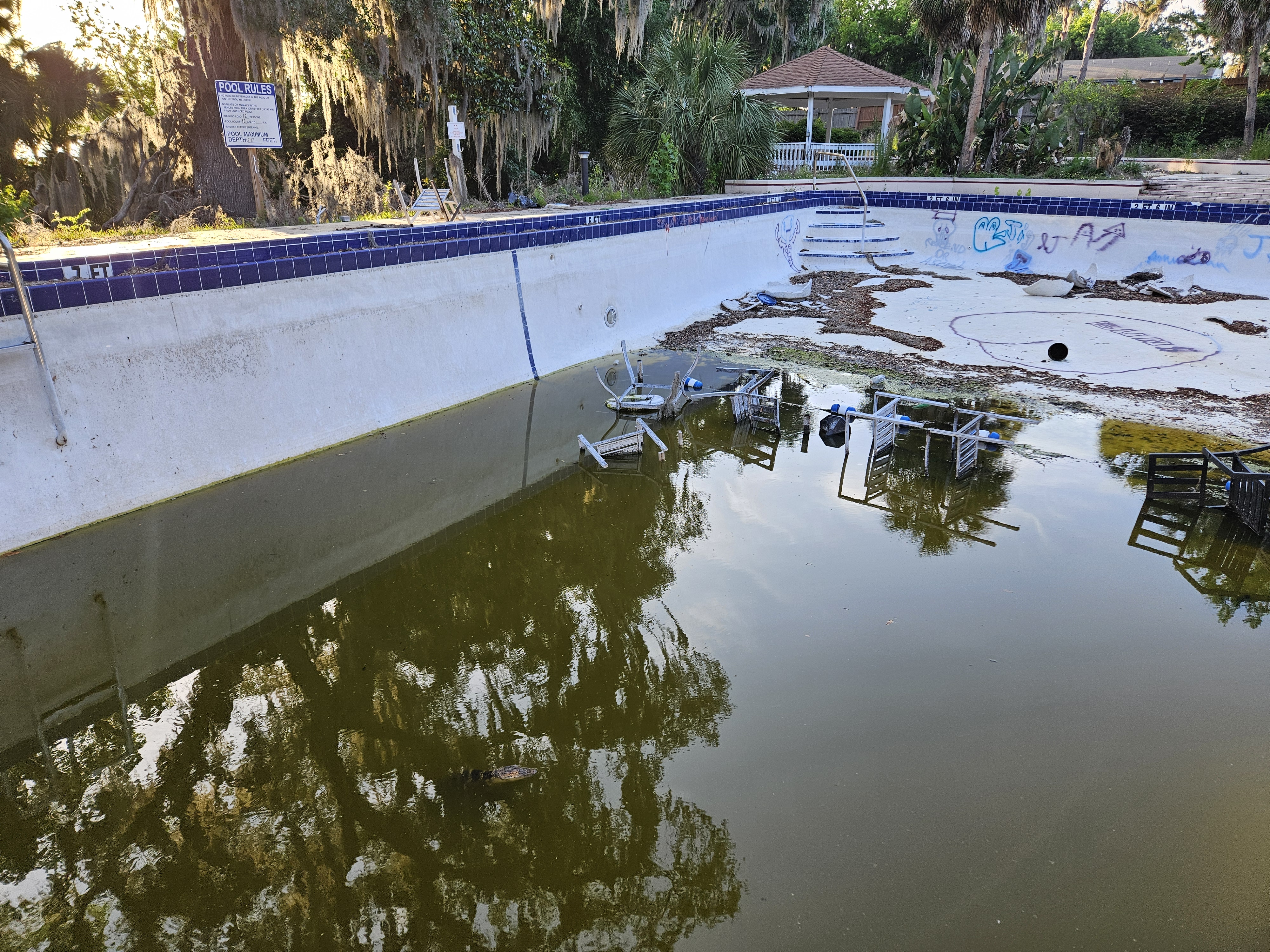
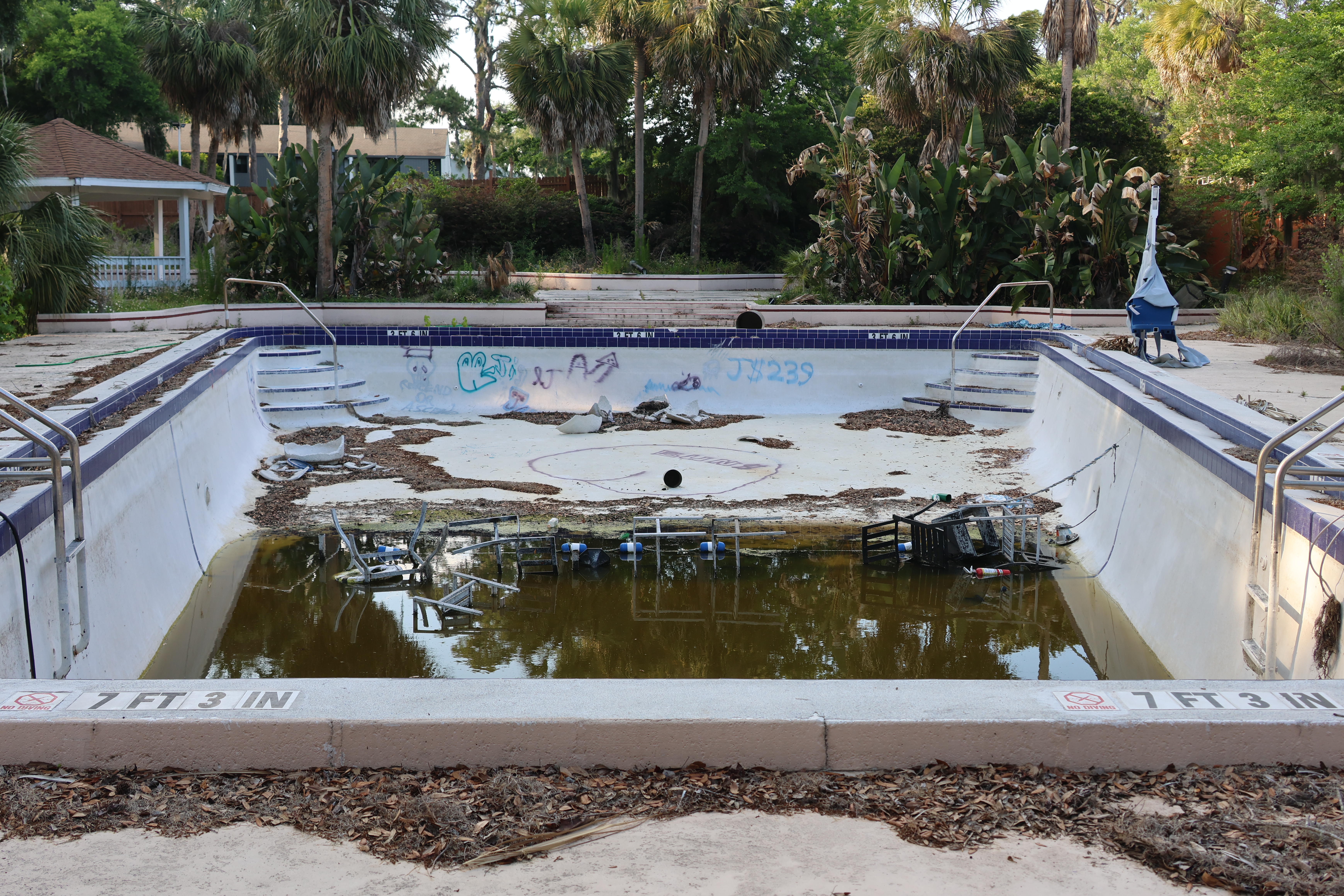
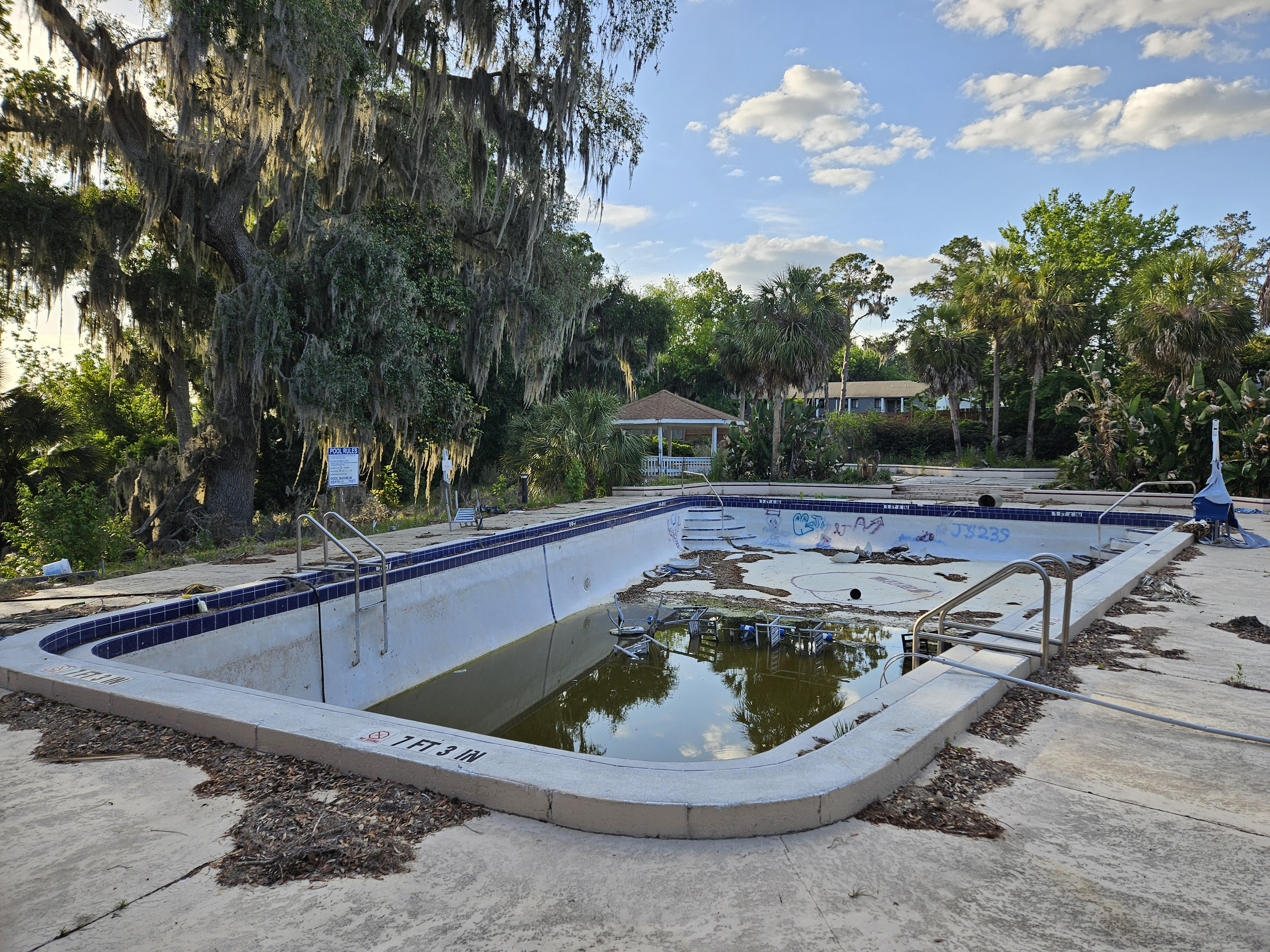
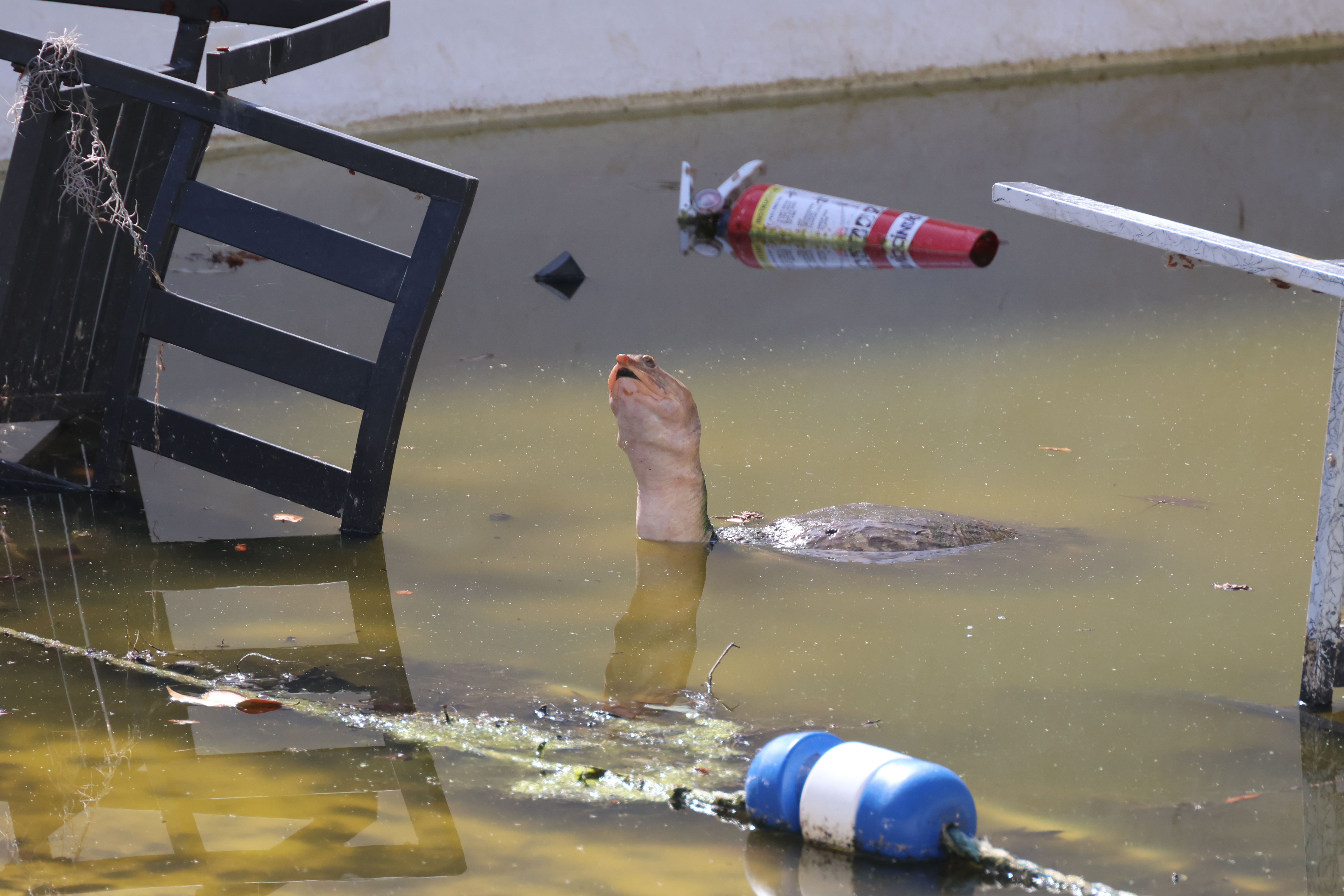
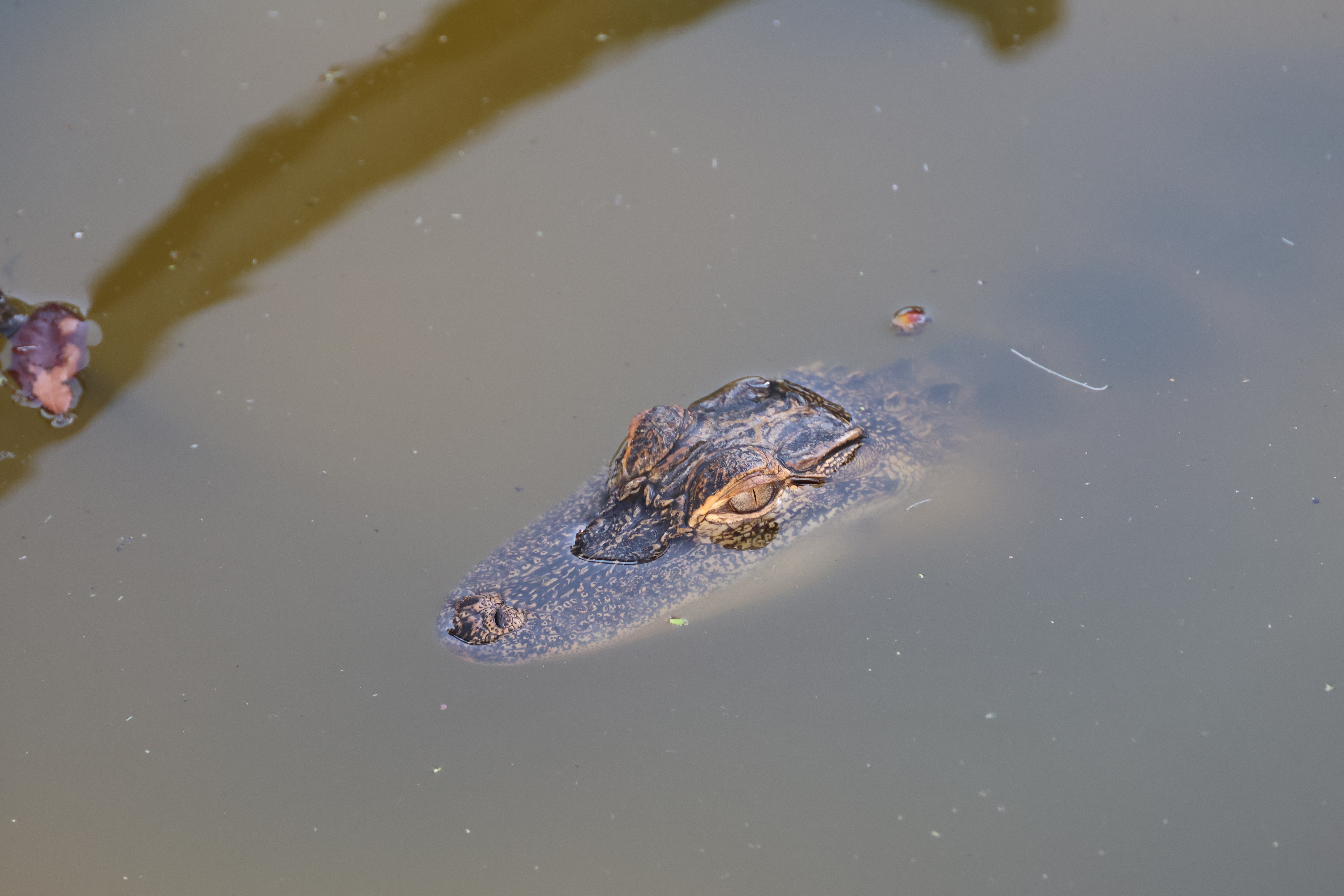
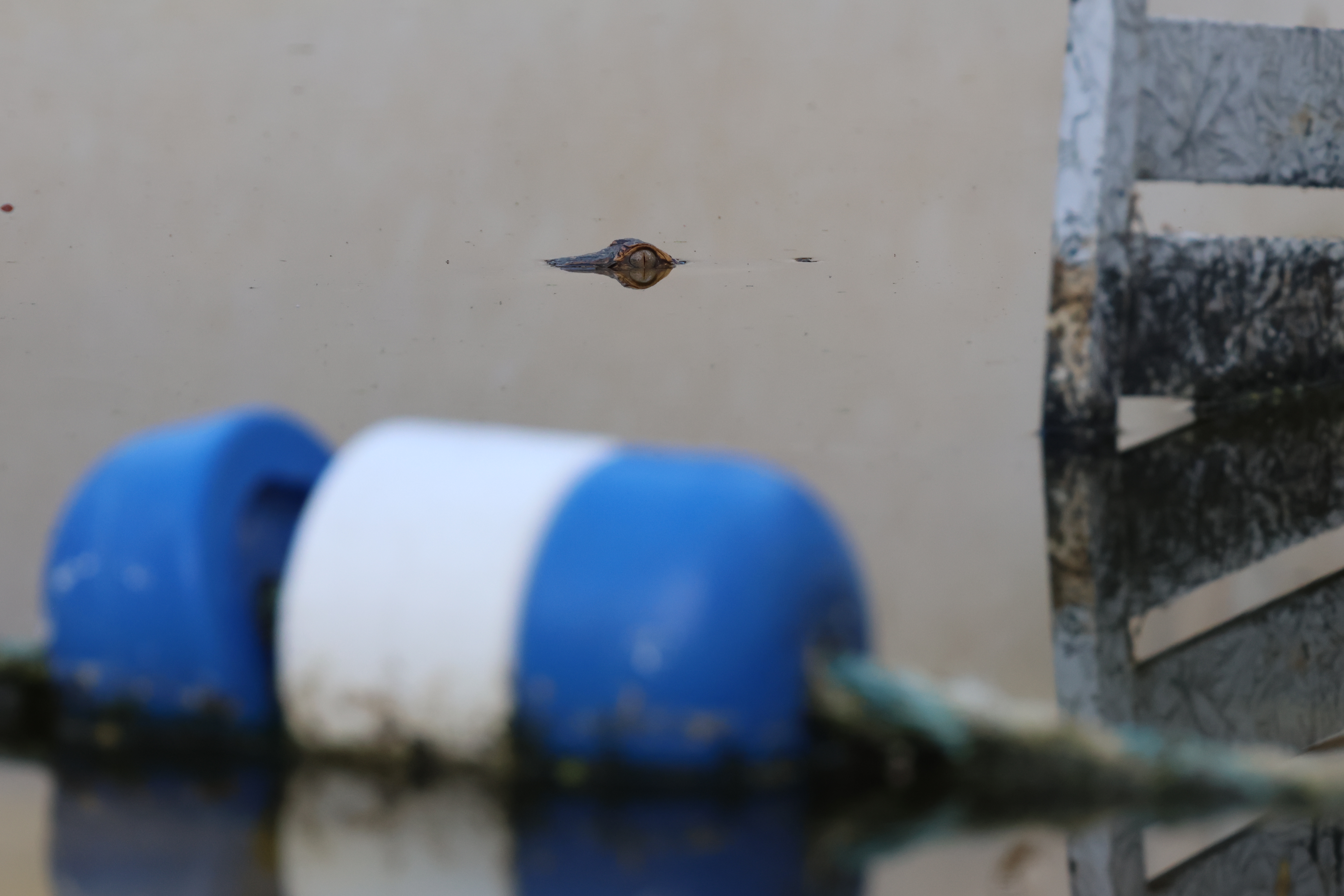
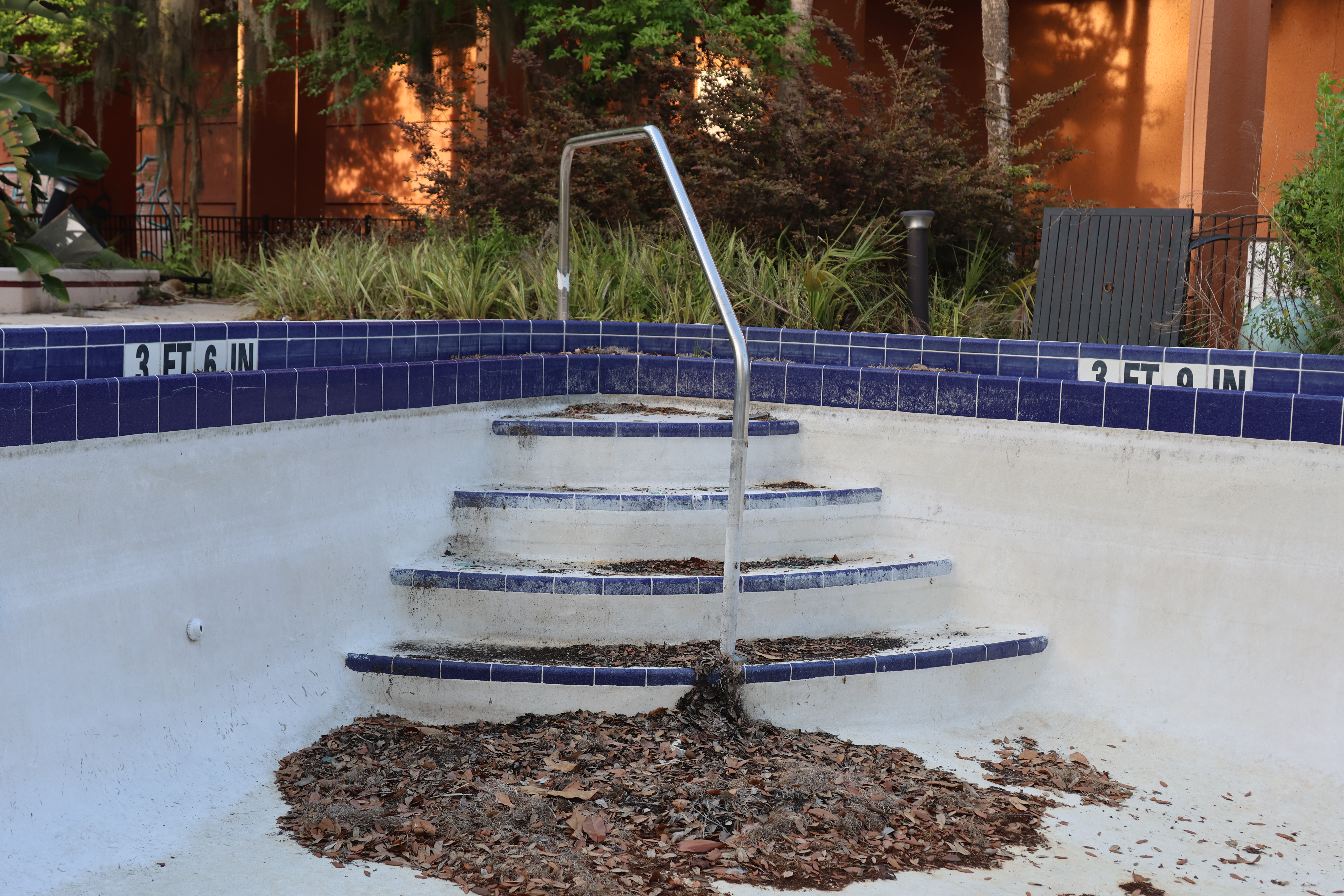
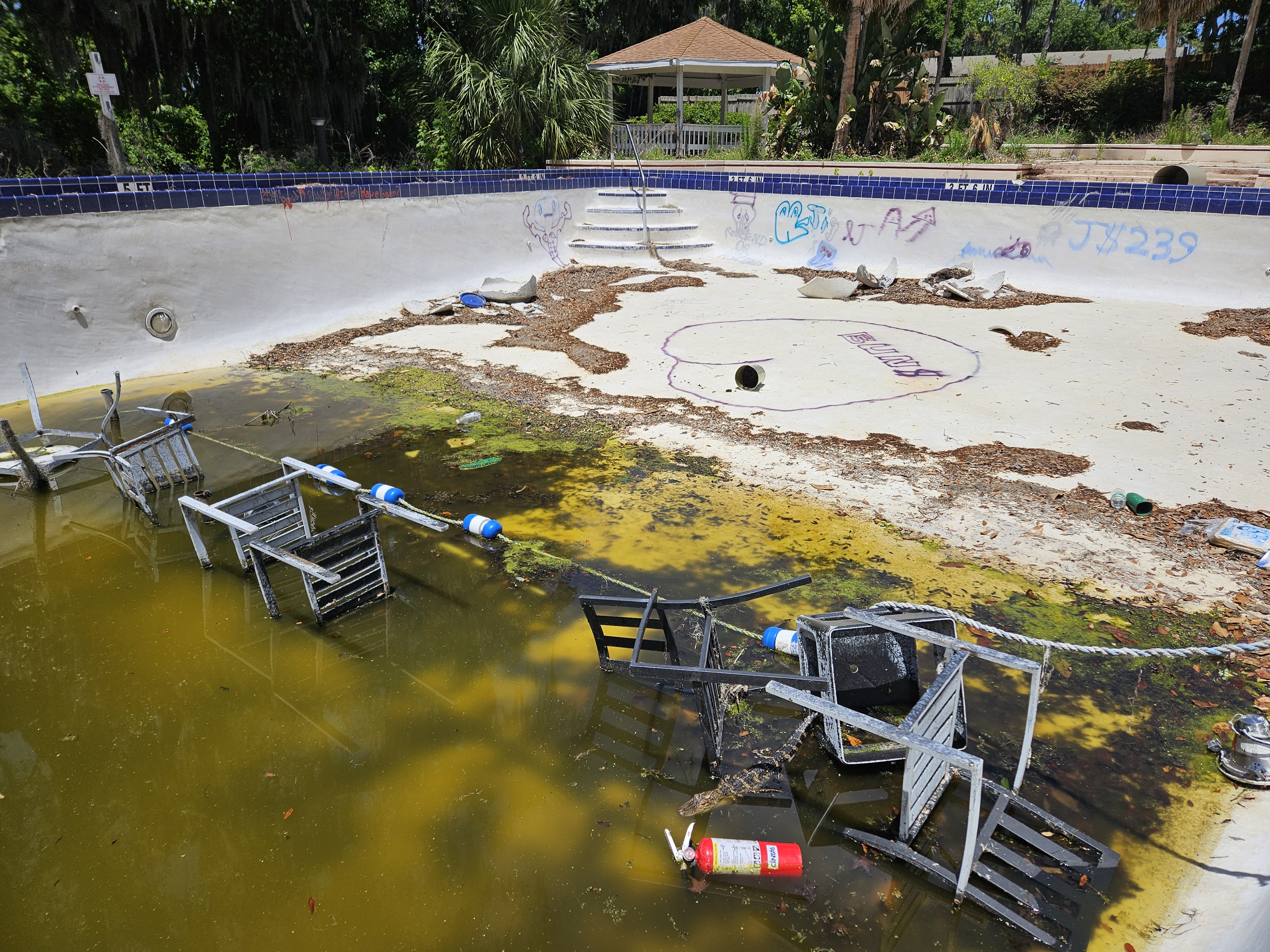
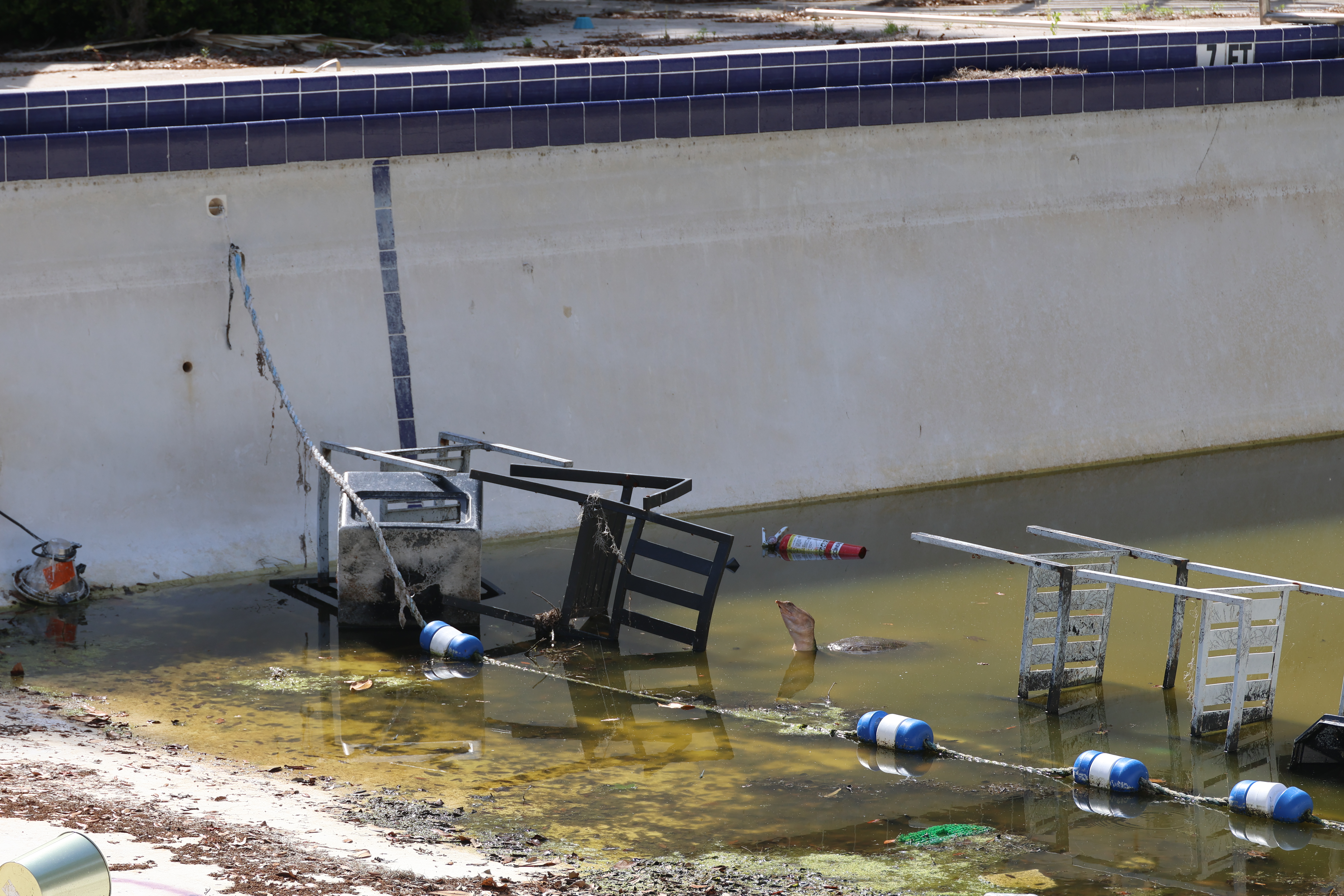
Photos of the site. The swimming pool of an abandoned hotel, directly adjacent to a lake, contained a trapped Florida softshell turtle and small alligator. Click to enlarge photos and open gallery view.
Important Note: In Florida you are not supposed to capture, harass, possess, or hunt alligators without a permit. If you have a problem with a nuisance alligator that is >4 feet or one, of any size, turns up where it shouldn’t be (i.e. your swimming pool) you are told to call the Statewide Nuisance Alligator Program (SNAP) hotline and they will send out a contracted alligator trapper to remove the animal. The contractors relocate alligators under 4 feet and kill nuisance alligators longer than 4 feet (ref). The SNAP website states: “Complainants must be able to grant legal access to the property on which the alligator is located. SNAP does not permit the removal of nuisance alligators from private or publicly managed property without first obtaining permission from the property owner or management authority.” After consideration of this, I decided to rescue the alligator myself because i) this alligator was clearly under 4 feet and therefore posed little risk, ii) I wouldn’t be harassing or keeping the animal but simply quickly transferring it to the lake from which it clearly came (and which was less than 50 yards away) and this seems within the spirit of the law which is designed to protect alligators, and most importantly, iii) it was found in an abandoned hotel pool for which I could not, even if I wanted, provide permission to access. I am not sure who is responsible for managing the hotel property but it doesn’t seem as if anyone is currently doing so. As can be seen in the pictures, the property is in a state of disrepair with graffiti and signs of homeless encampments in the area.
Strategy and Gear
The pool is quite large and in the deep end (8-foot depth) there was about 3 feet of water. I estimated the water depth using a pole that was next to the pool. Due to the very dark water, I could only see the bottom in the very shallow end. Furthermore, the softshell turtle and small alligator were only visible when they were at the surface. They seemed to be fairly skittish when I approached the pool edge (particularly the turtle) and would readily disappear into the depths. So, I decided trying to scoop around blindly with a net, either while wading in the water or from the edge of the pool, would be a waste of time. The best and safest option seemed to be to lower the water level substantially and then simply scoop them up with a large net.
There was a pump in the deep end of the pool but it was one which you must plug in with an electrical cord. There were no power outlets nearby. The nearest outlet was about 50 yards away on the exterior of the hotel and, unsurprisingly given the state of the hotel, it was not working (nor were any others on the exterior of the hotel). The presence of the pump indicates that at some point someone was likely draining the pool. However, it is the dry season in Florida and given that the pool had 3 feet of water in the deep end suggests it hadn’t been drained for quite a while (perhaps since the end of last summer). With a generator or portable power bank you could plug in this pump, and perhaps that is what the person who previously drained the pool used. However, I didn’t have either of these and one powerful enough to operate such a large pump would be quite expensive. So, I instead opted to order a (rechargeable) battery operated pump. The specs on the pump seemed adequate for purpose (max 1100 gallons per hour and a max lift of 16 feet). They only question was how long the battery would last before it needed recharging. I also went to the store and bought a large hand net.
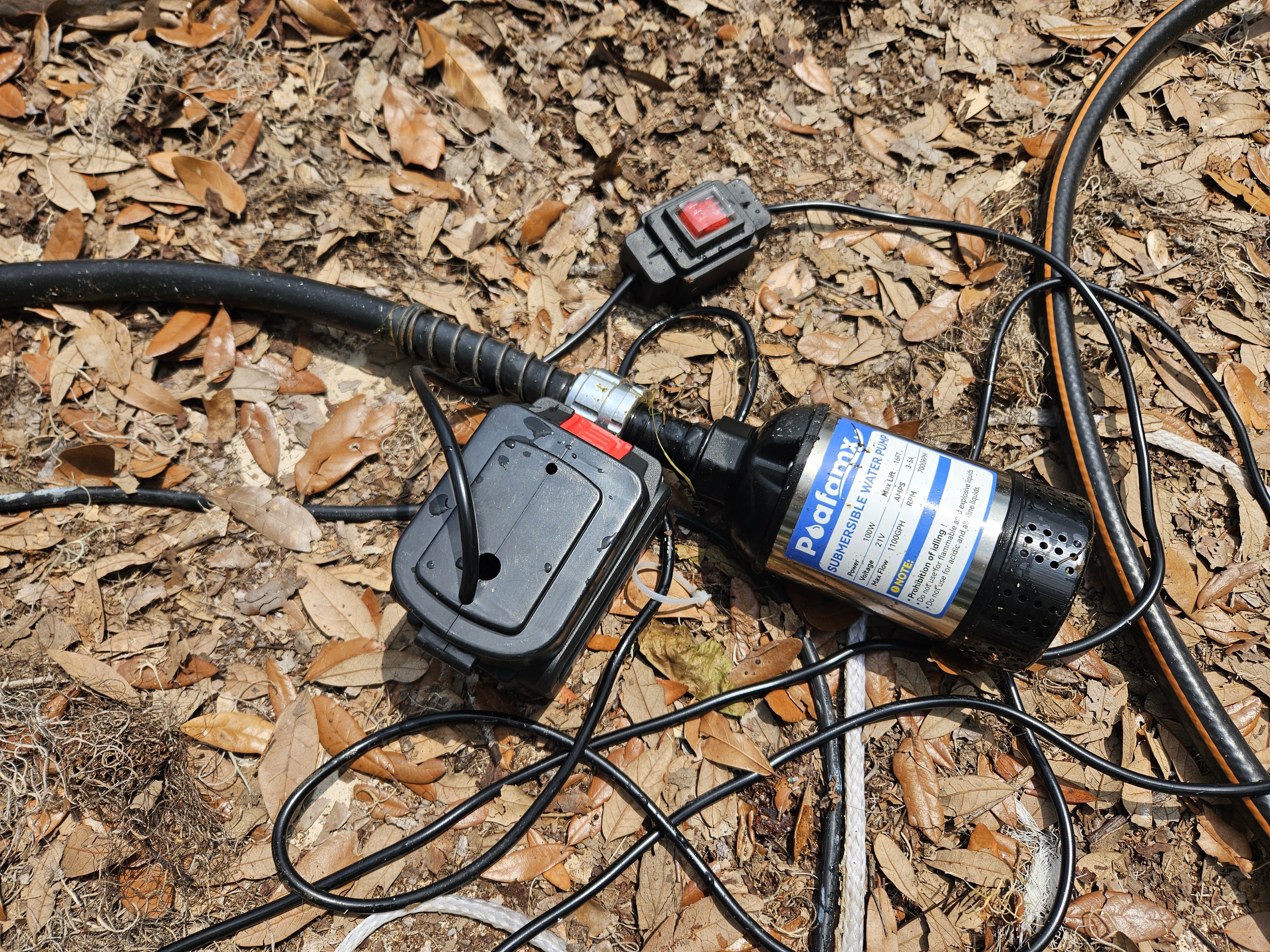
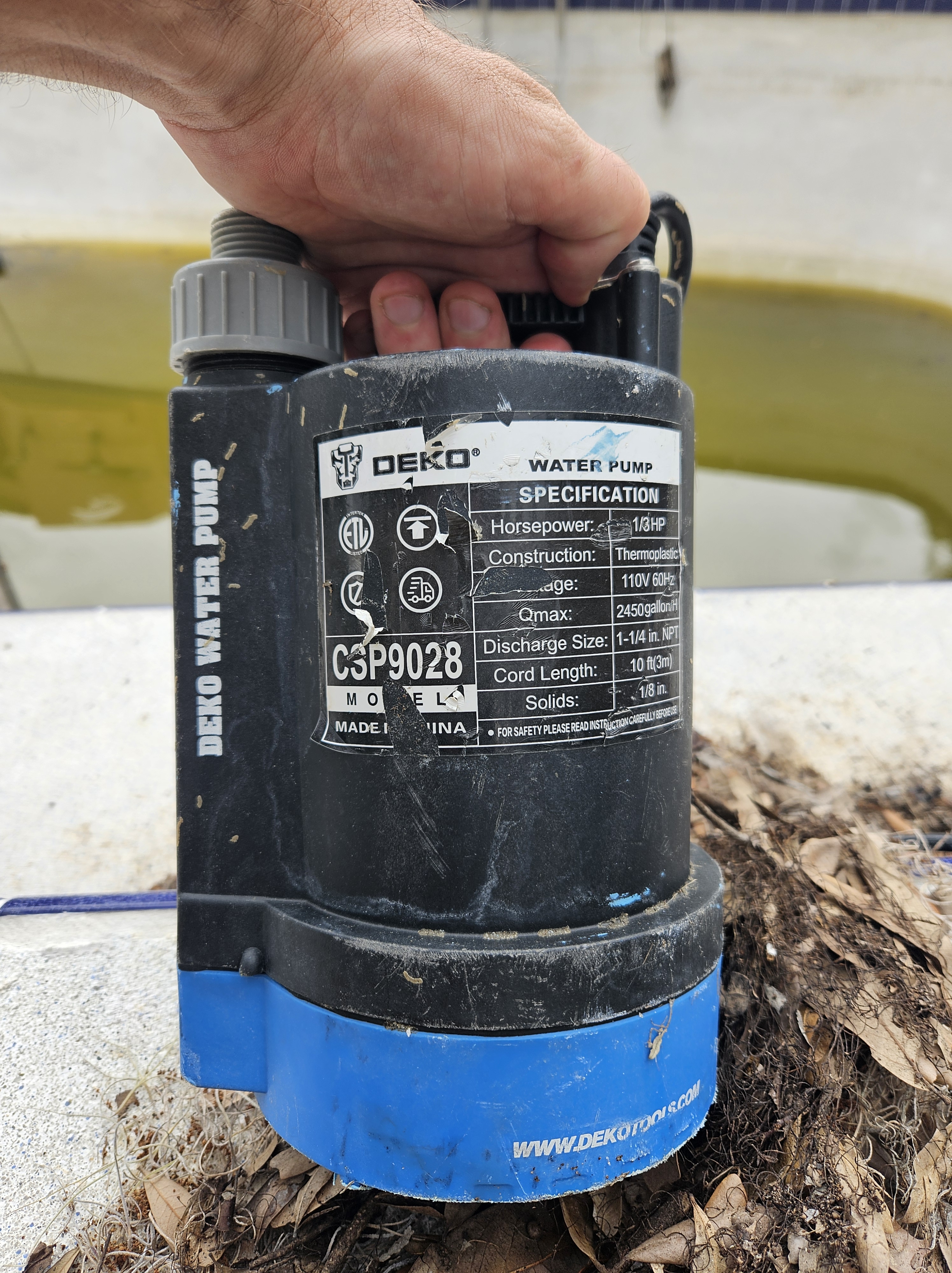
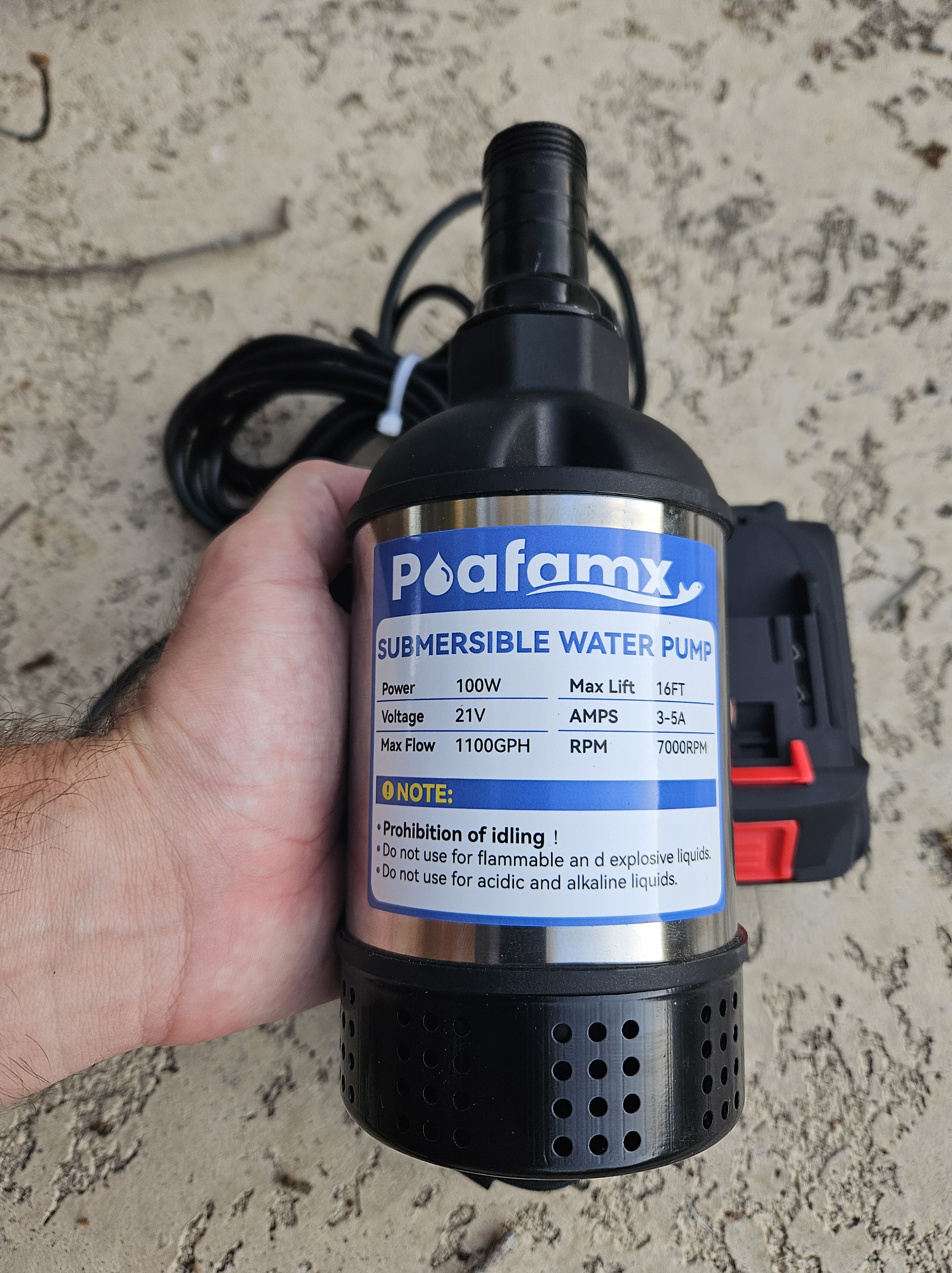
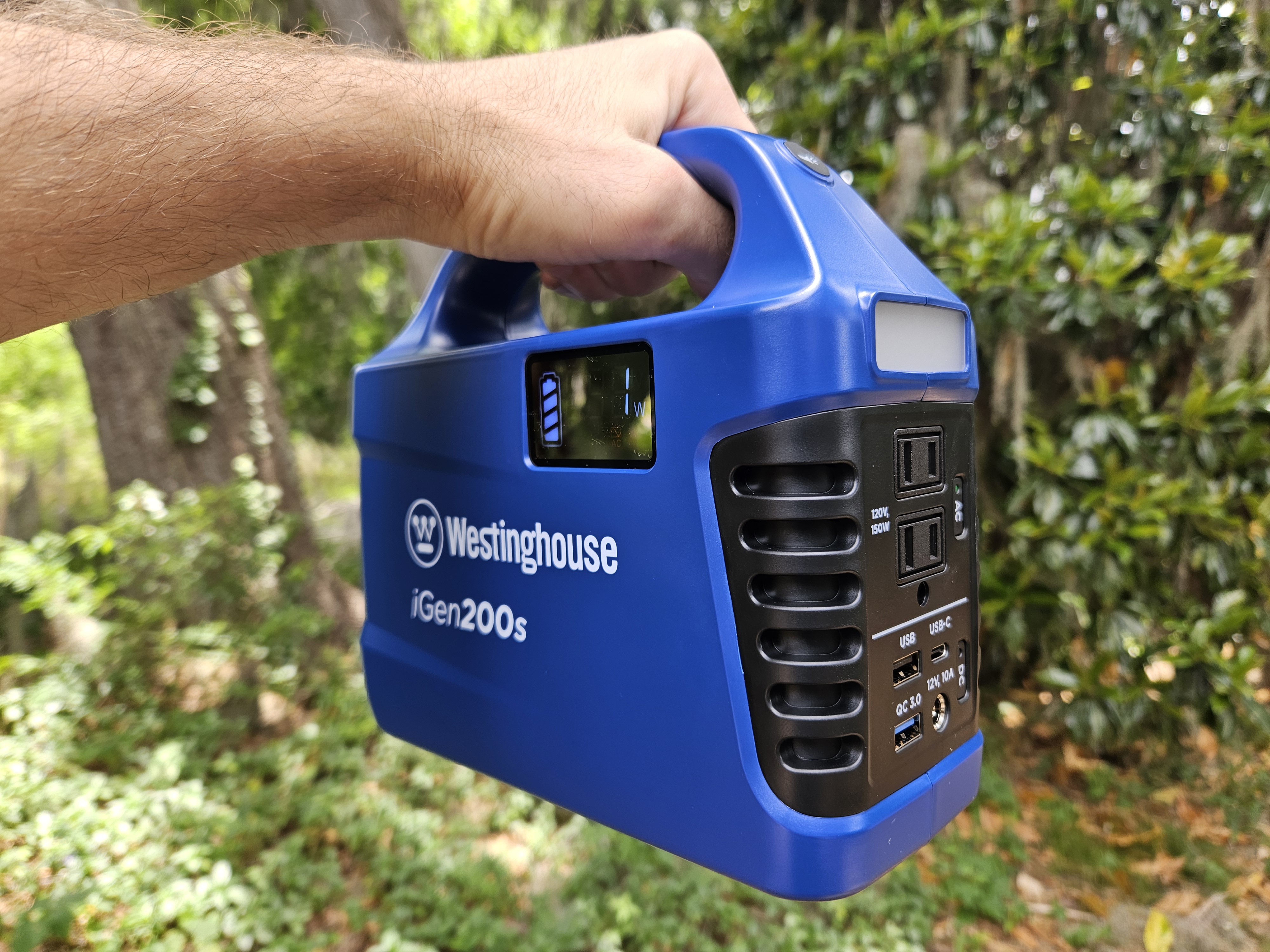
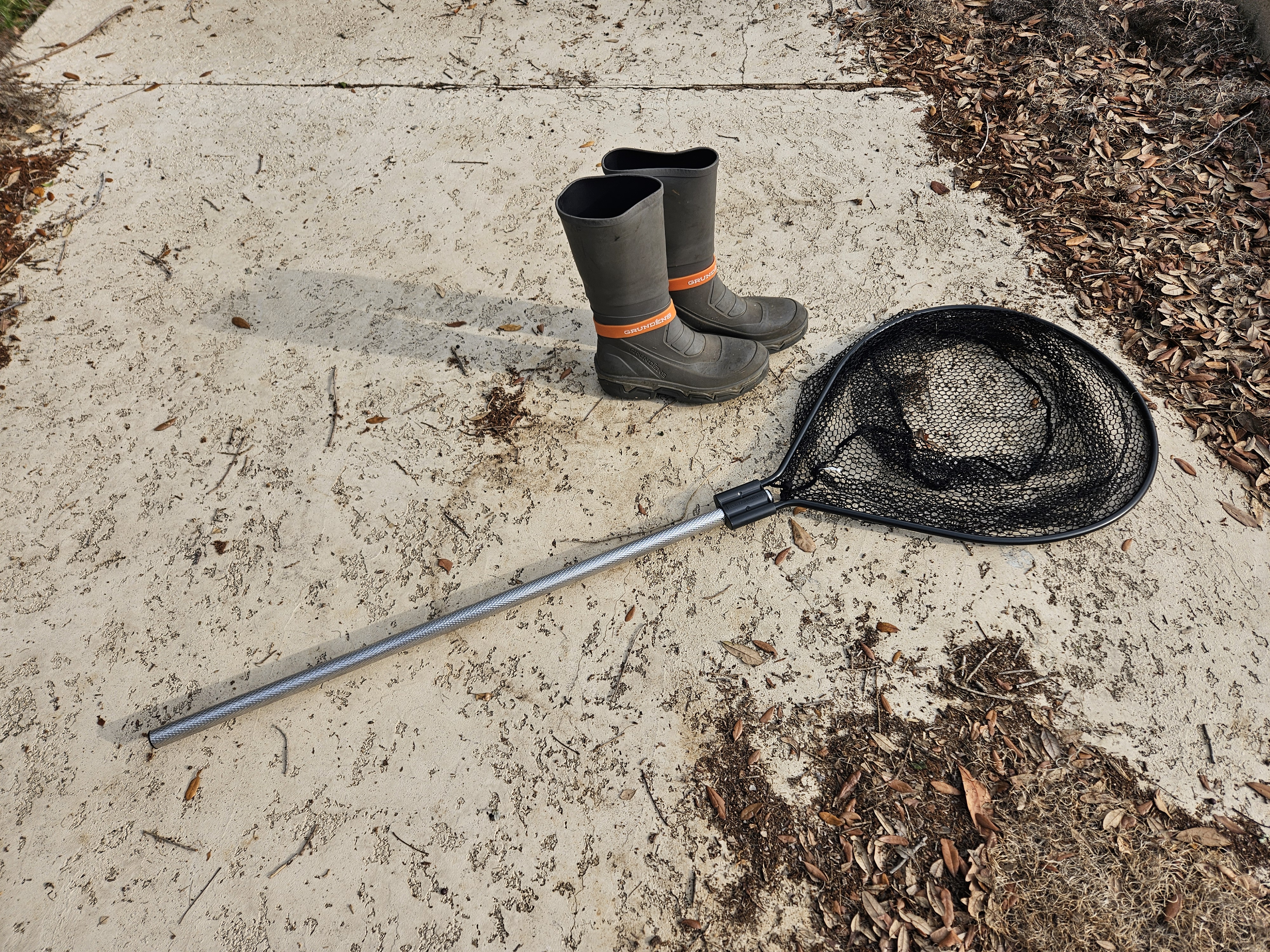
The gear used to drain the pool and capture the turtle. Click to enlarge photos and open gallery view.
Draining the Pool
The pump arrived with next-day shipping and after fully charging the battery it was off to drain the pool. The pump worked alright, although the flow rate appeared lower than the advertised maximum. I was curious what exactly it was, so I recorded the amount of time it took to fill a 3.5-gallon bucket of water. It took 75 seconds. This equals a flow rate of 2.8 gallons per minute or 168 gallons per hour. The battery lasted for just under an hour. So, I was able to drain about 160 gallons before having to recharge the battery. The battery took approximately 4 hours and 15 minutes to fully recharge. The first day I conducted 3 drainage and battery recharge cycles. The water level went down a few inches, so progress was incremental. At this point I ordered a portable power station. How these work is you charge the unit from an outlet, you take it with you, and you are able to plug in appliances or anything else that requires power (the unit has a standard electrical outlet and various USB ports). The one I bought is capable of 20 smartphone charges, 7 laptop charges, 2-3 hours of television operation, or 14 hours of mini fridge use. I figured maybe it would be powerful enough to power the heavy-duty pump which required an electrical outlet, and if not, I could charge the battery of my smaller battery-operated pump while it was in use. I also figured this might be a handy device in certain camping situations or in case of an extended power outage. While waiting for the power station to arrive I continued the cycle of pool draining with the battery-operated pump, followed by re-charging the battery. During this period of shuttling between my place and the pool, I regularly saw the alligator popping up in different areas of the pool, but only saw the turtle a few times and with only its nostrils and eyes emerging from the dark water. A few times in the afternoon, the alligator was found basking at the water’s edge but upon my approach it dashed into the water. With a bit of luck, I might have been able to net the alligator from the edge of the pool when it was near the surface and close to the edge but I would have no chance of netting the turtle, since I couldn’t see it. Therefore, I decided to continue draining the pool until I was able to see (and hopefully catch) both of them. It turned out that the portable power station was unable to power the heavy-duty pump, and the design configuration of my battery powered pump made it such that it was not possible to simultaneously run the pump while charging the battery. Therefore, I ordered another battery for the battery powered pump. The wait while re-charging the battery was the rate-limiting step, so I figured with two batteries and chargers I would be able to run the pump while simultaneously charging the other battery. This worked well, and after a few more days the pool was sufficiently drained so as to attempt to capture both species.
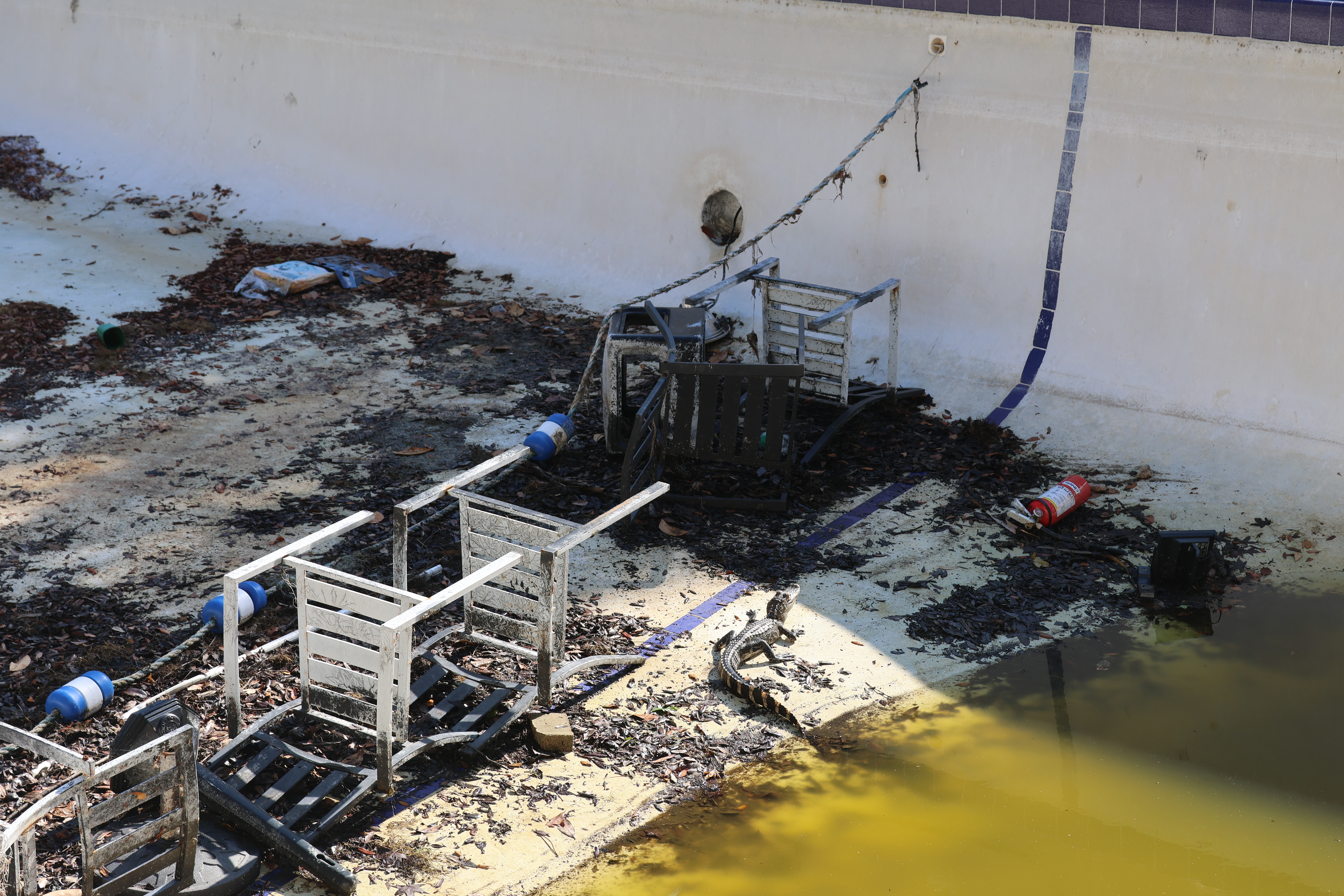
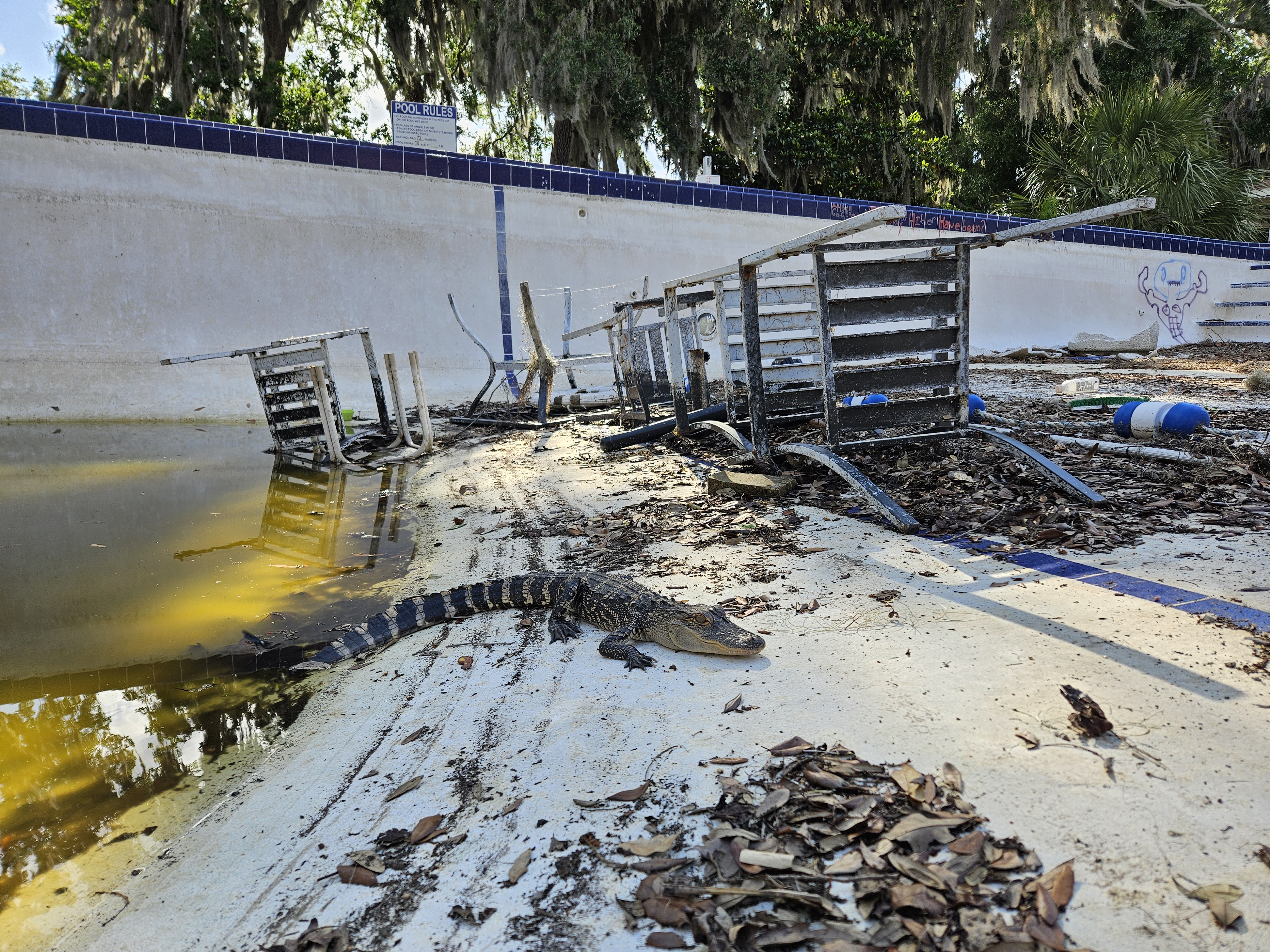
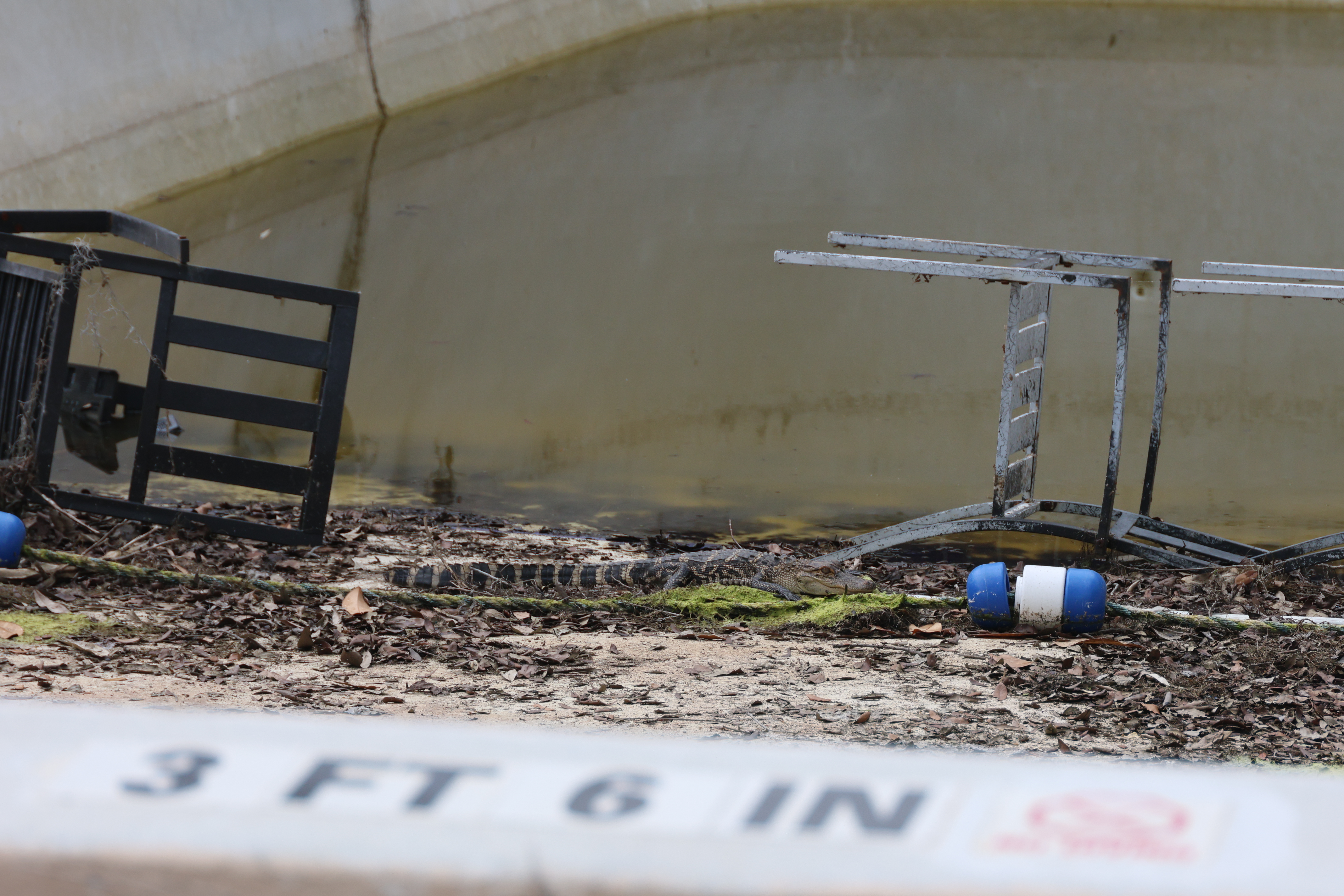
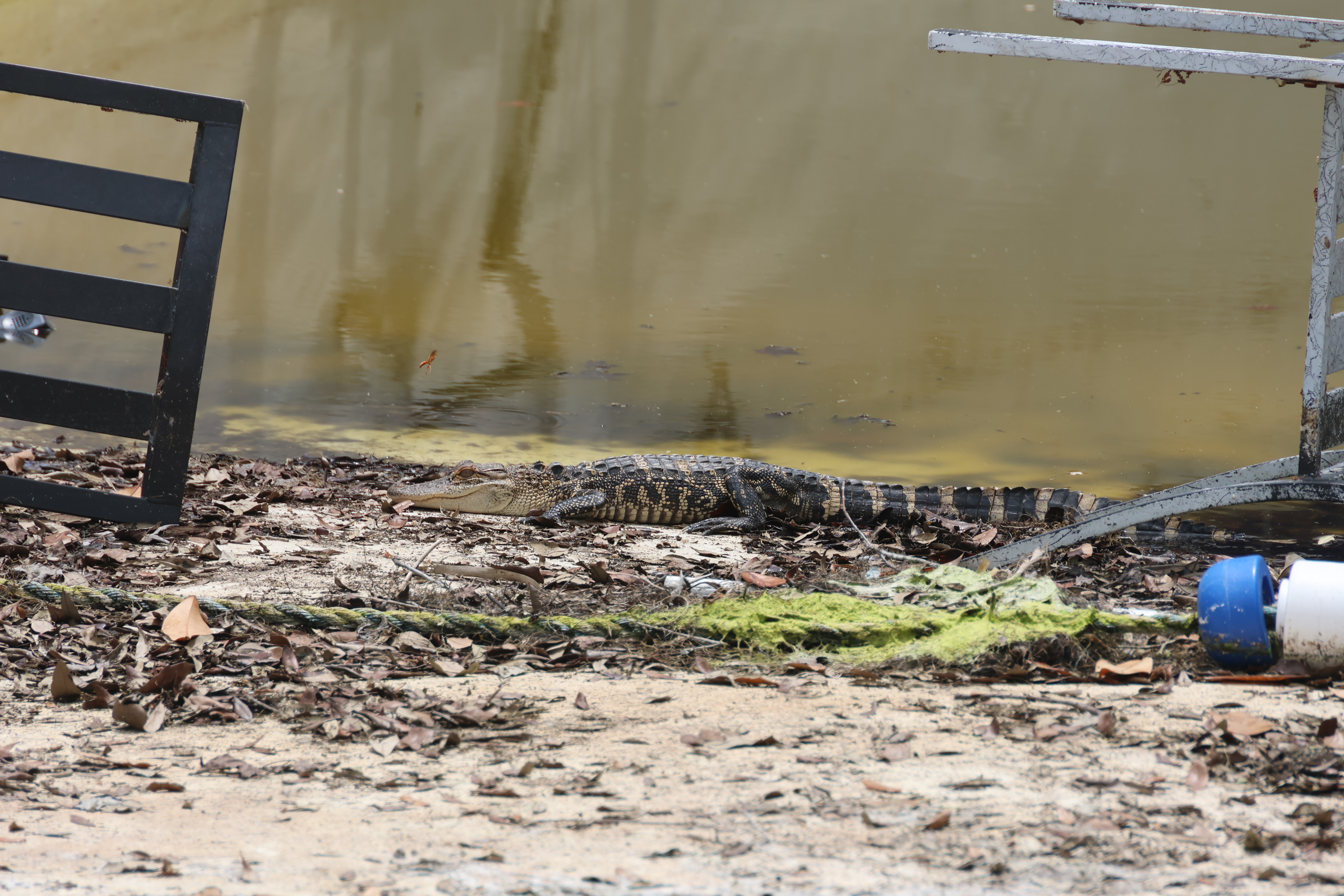
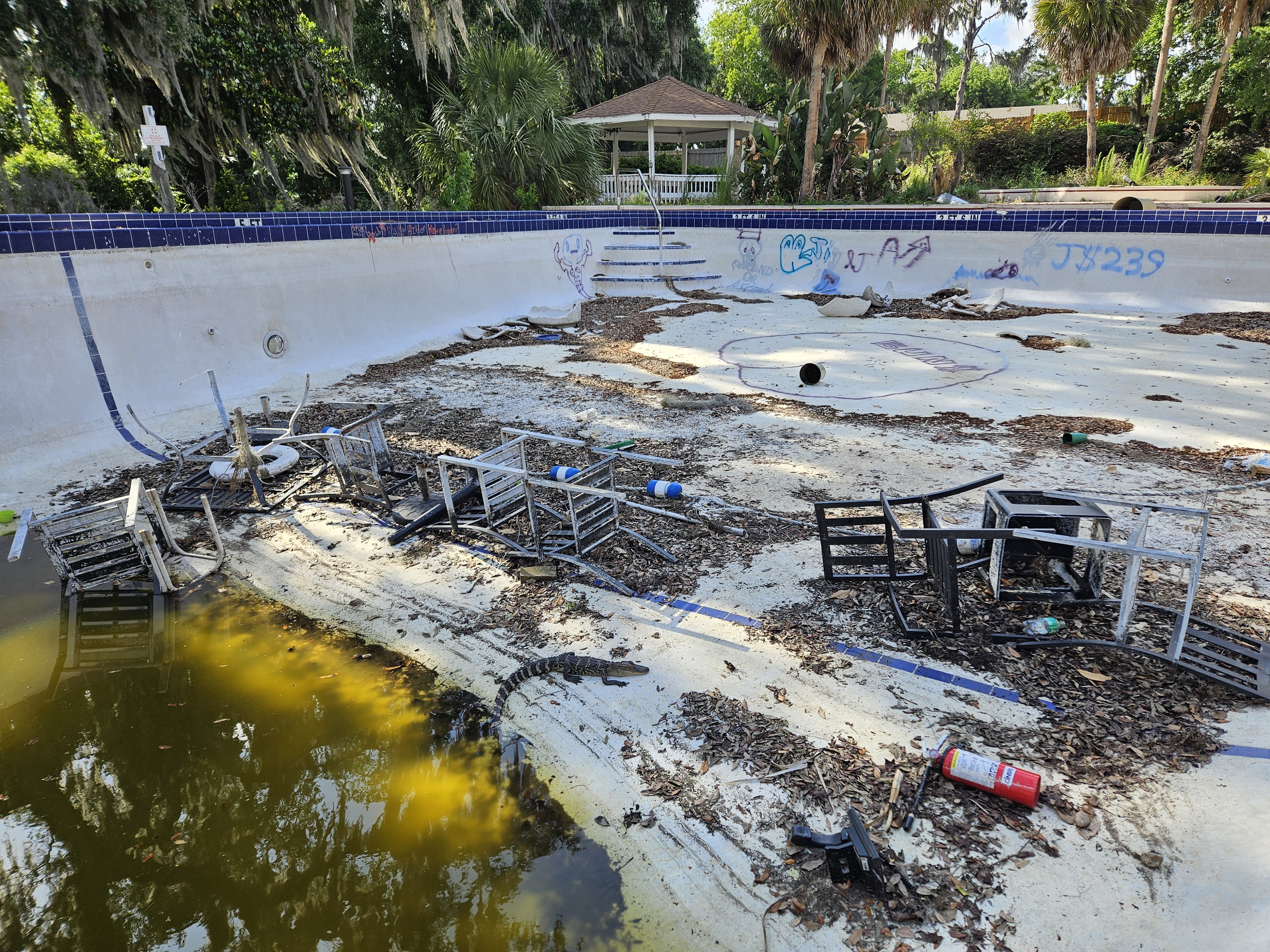
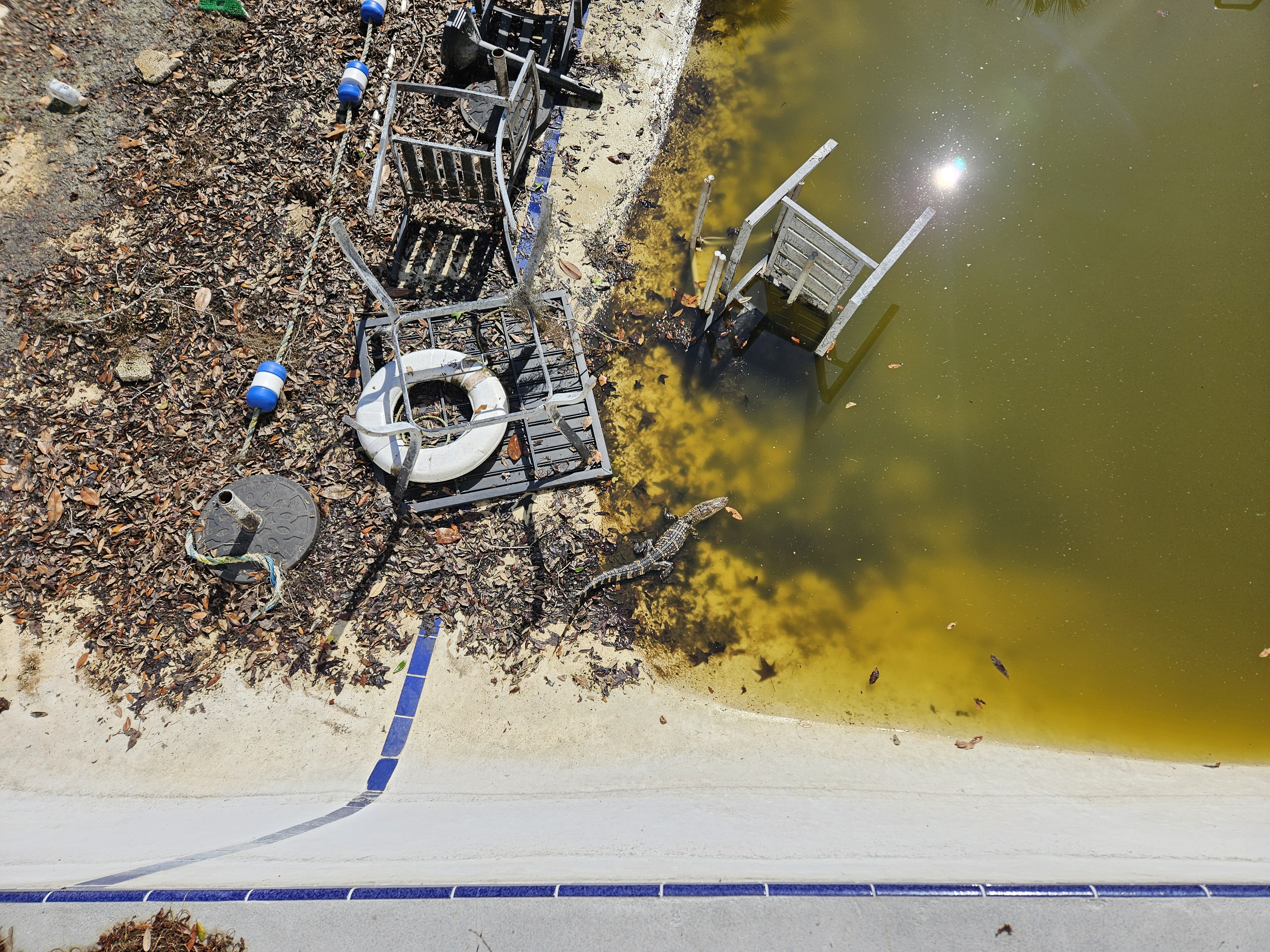
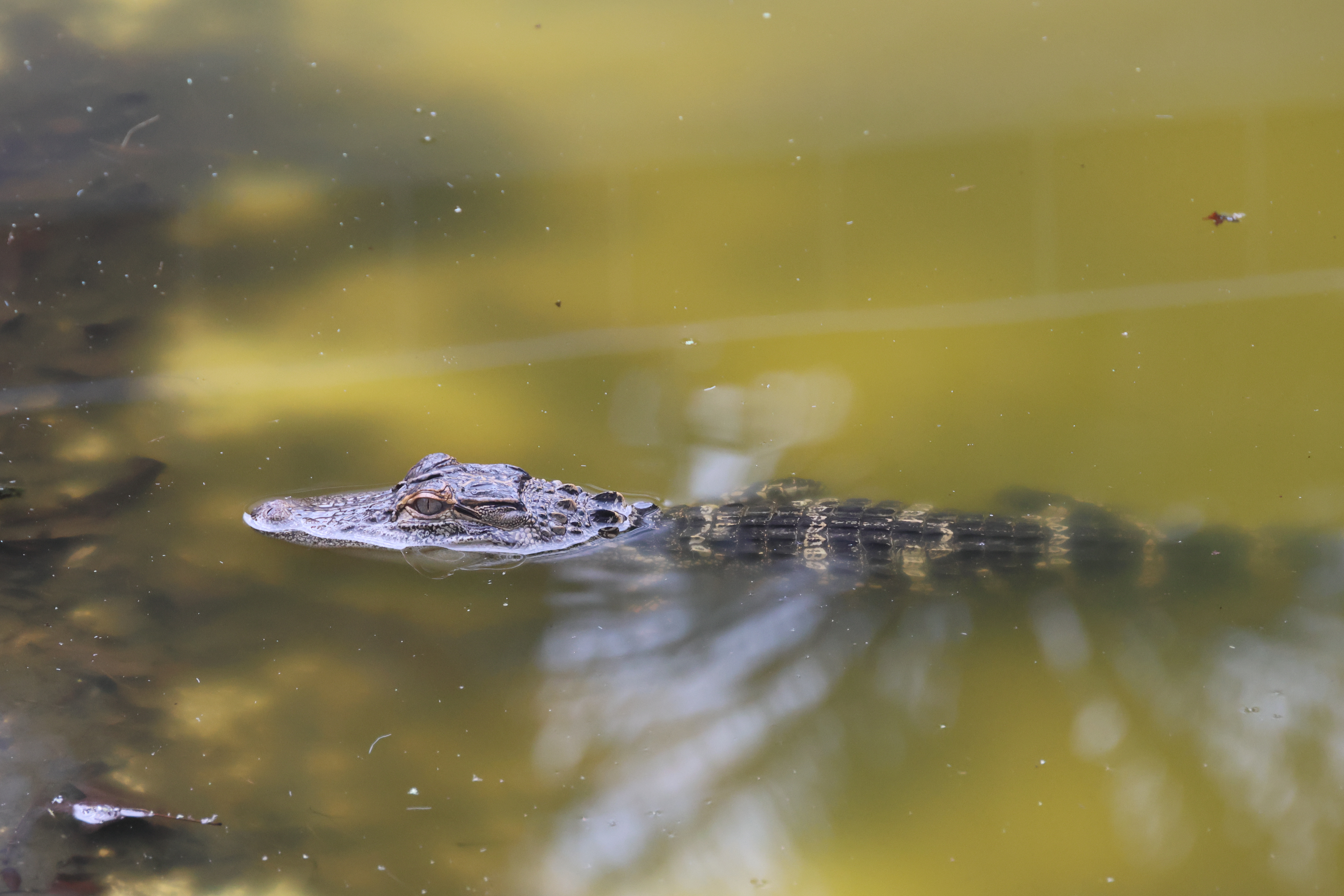
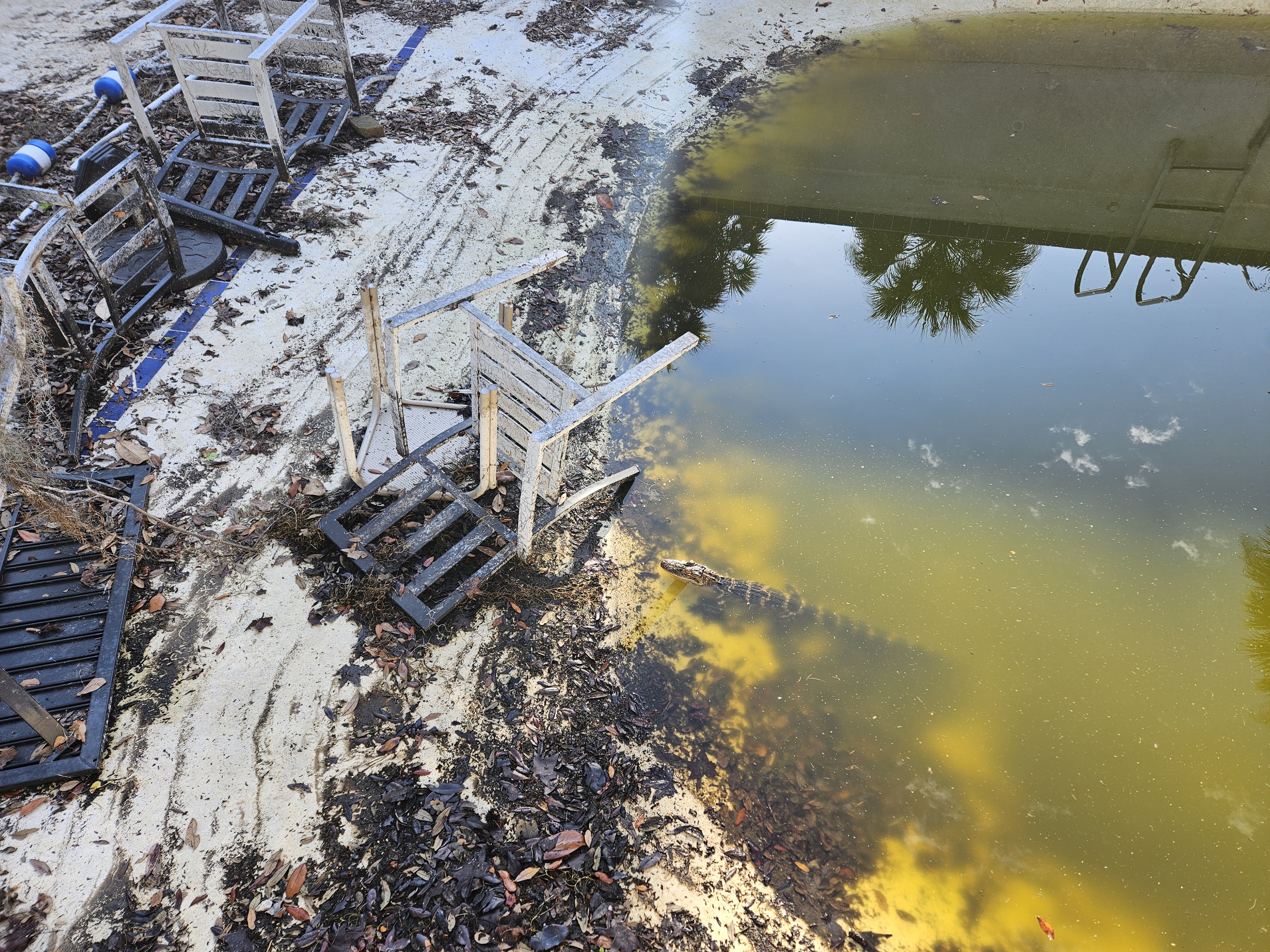
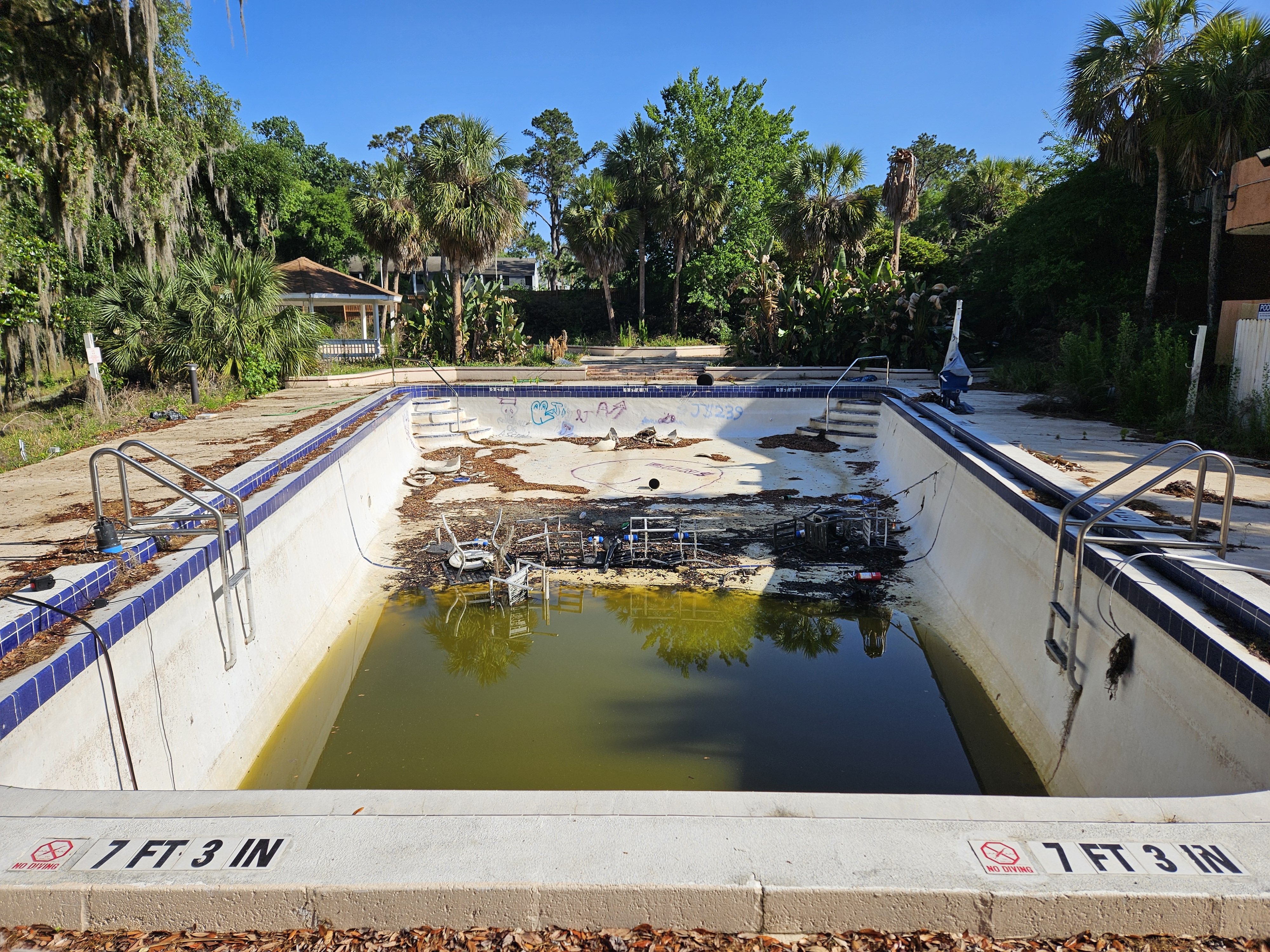
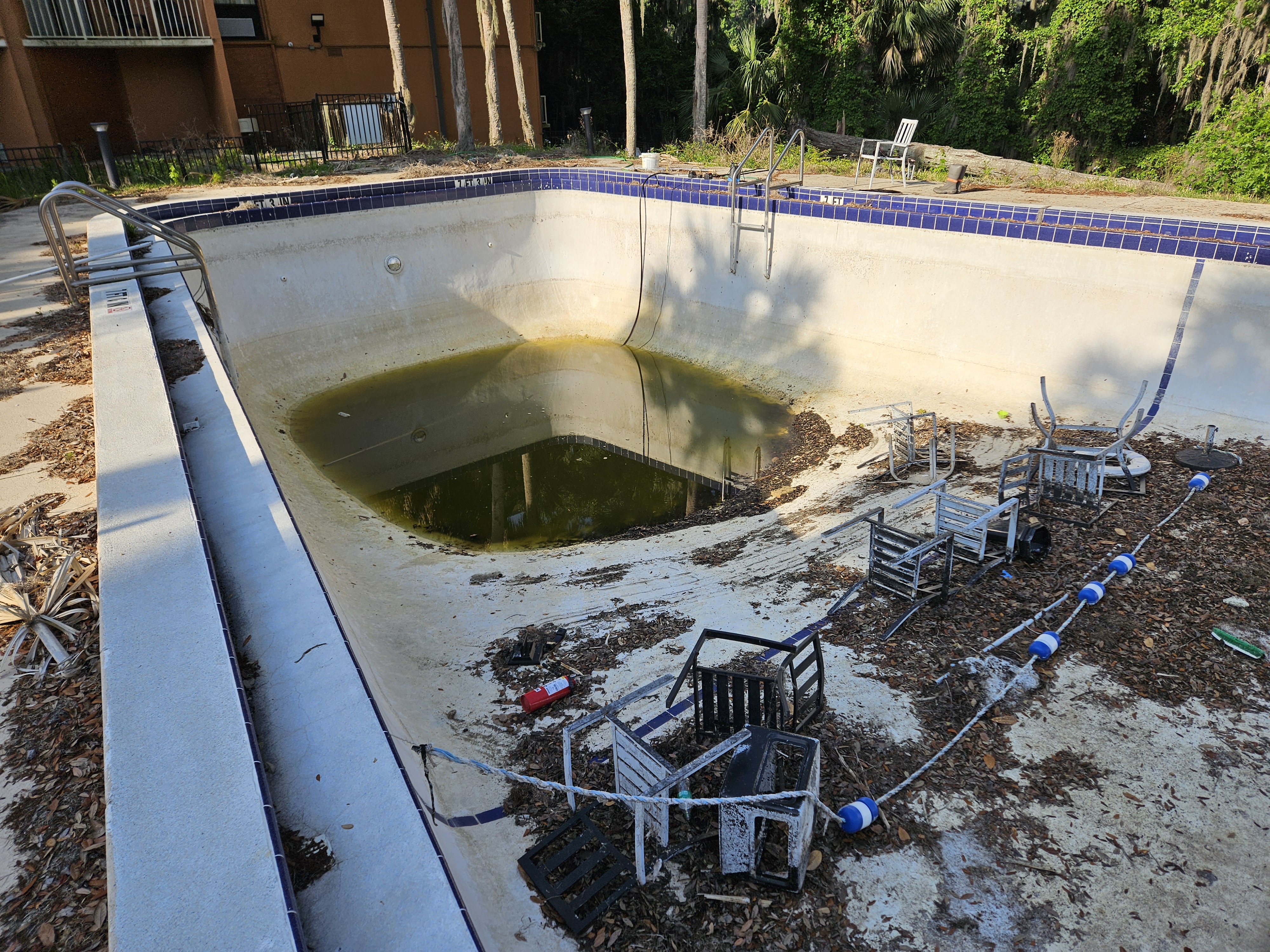
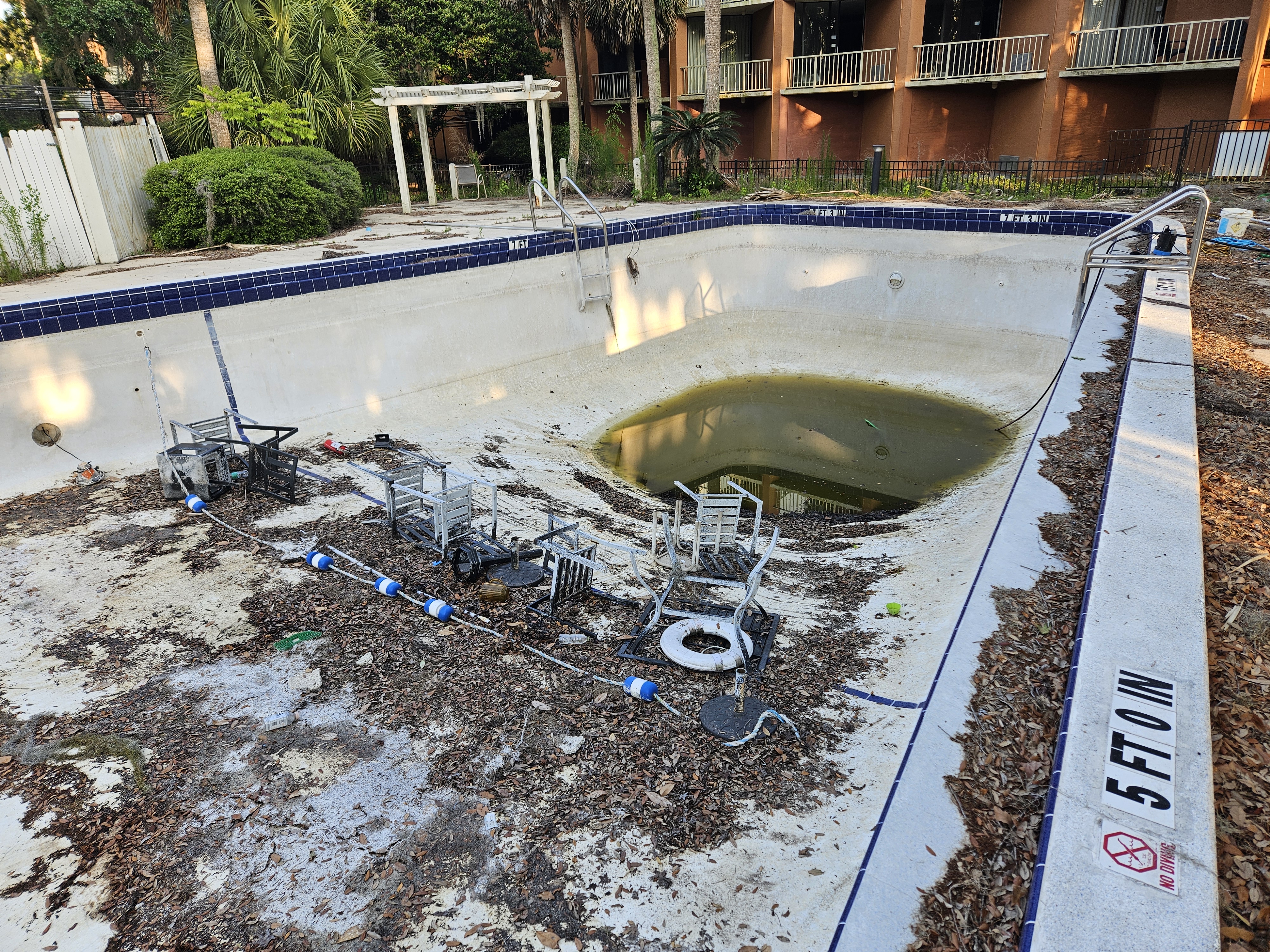
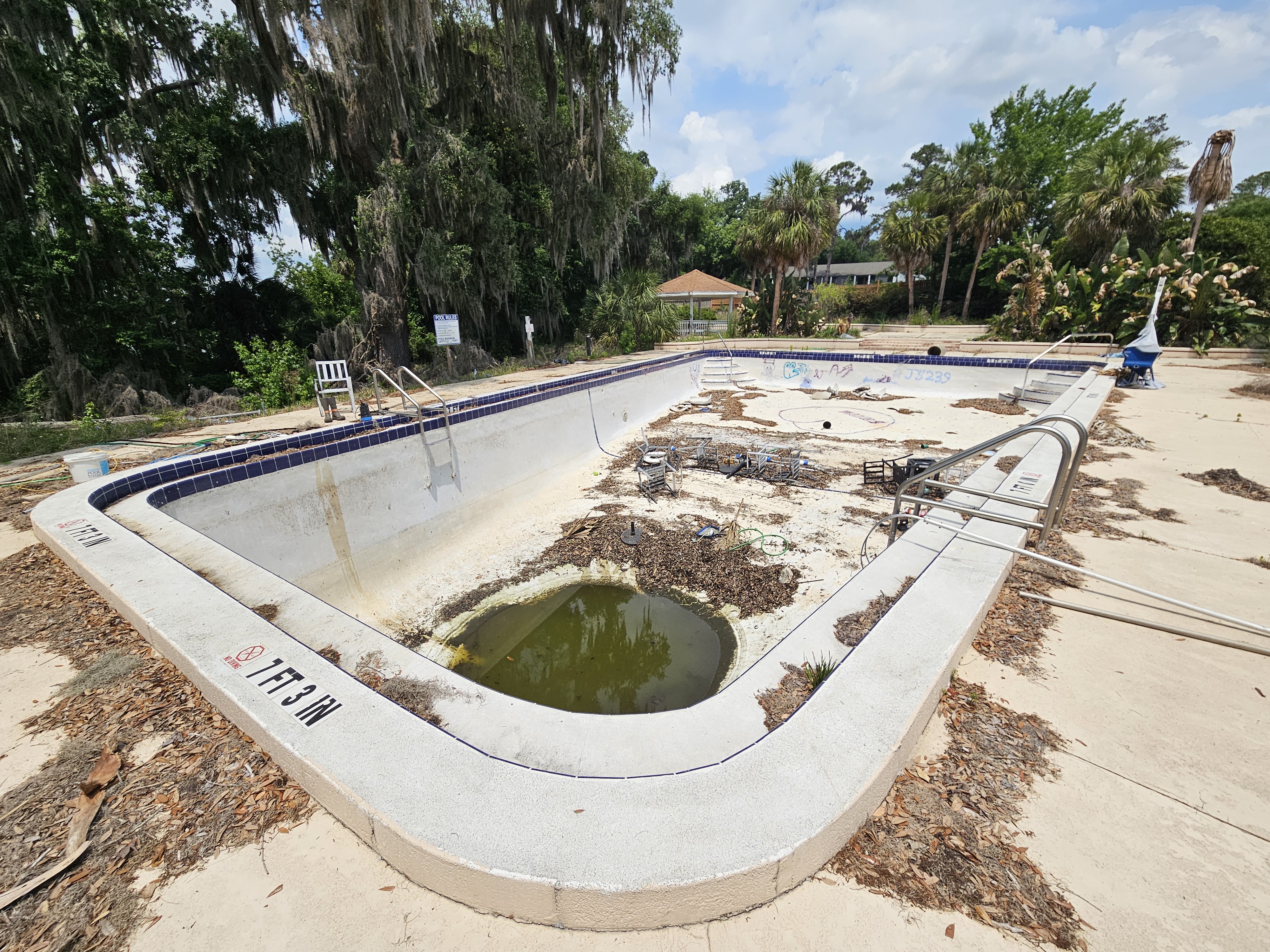
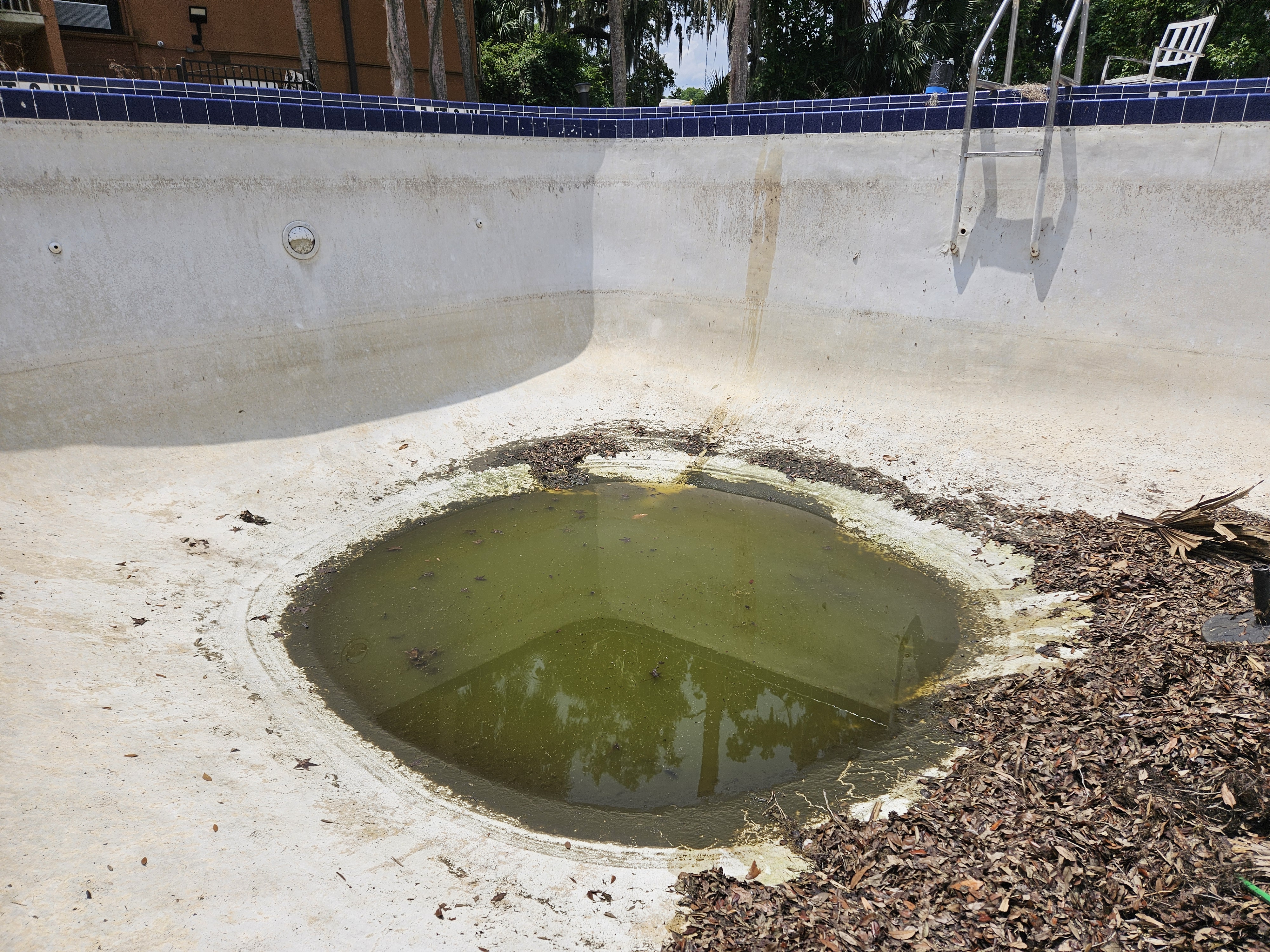
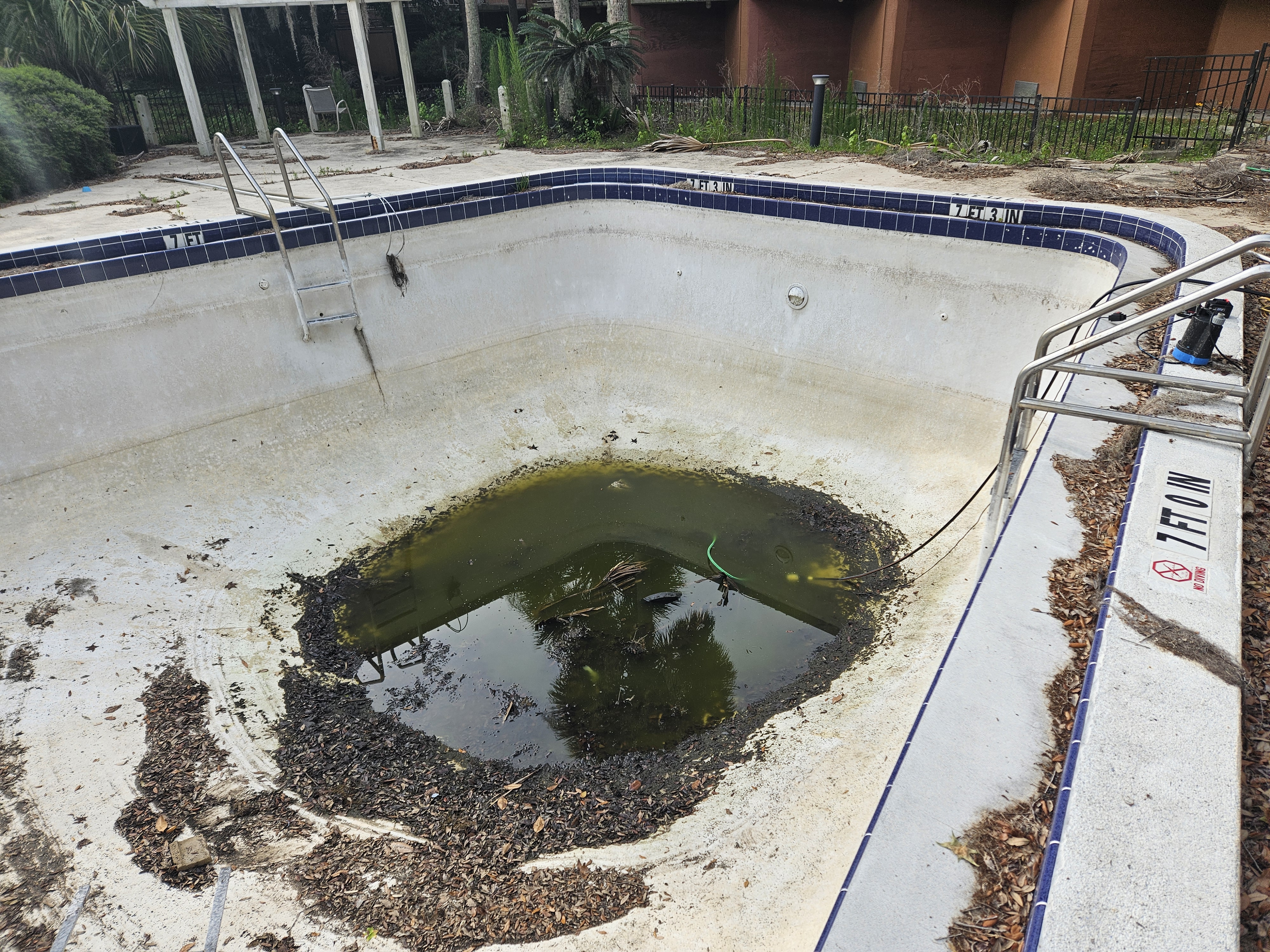
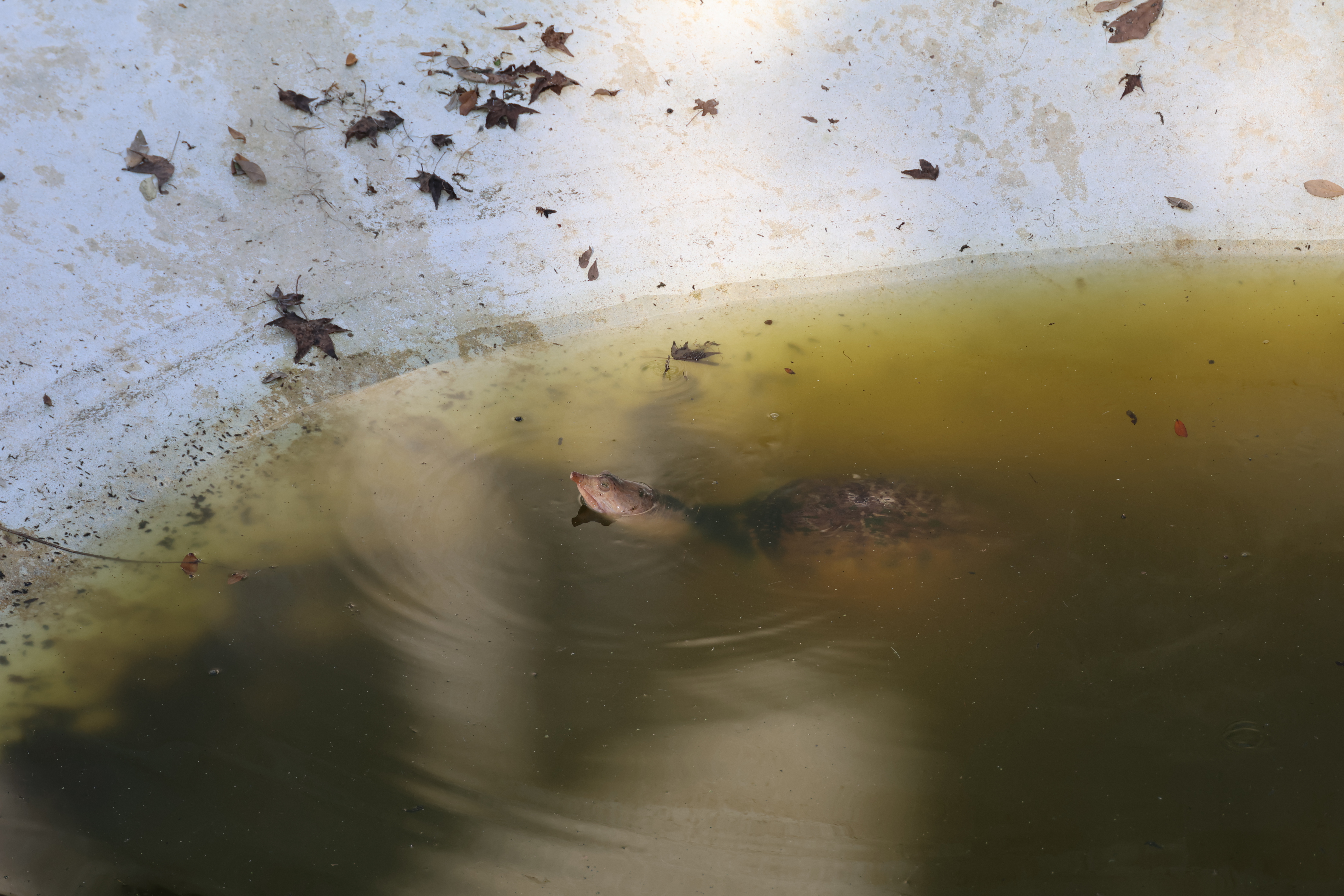
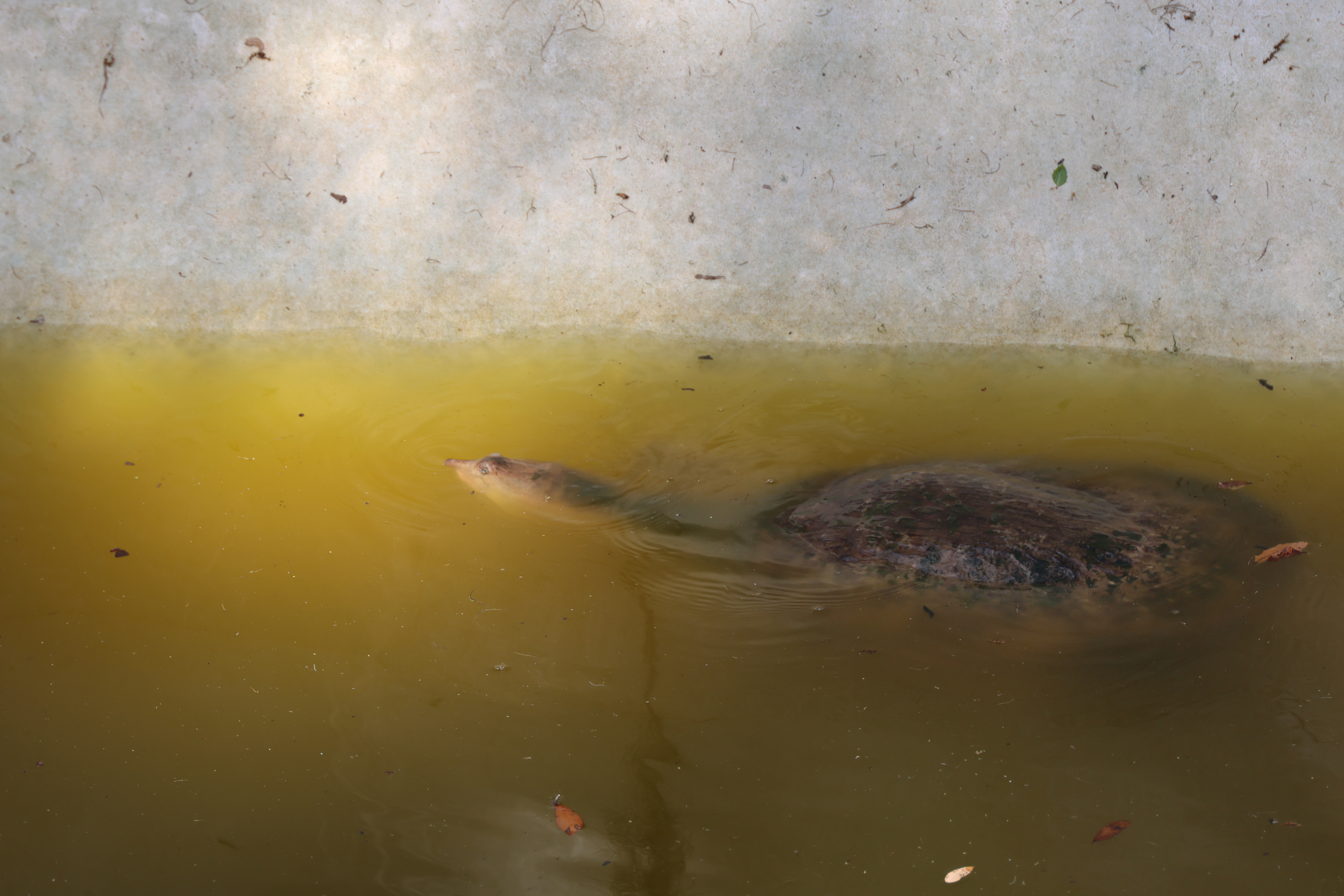
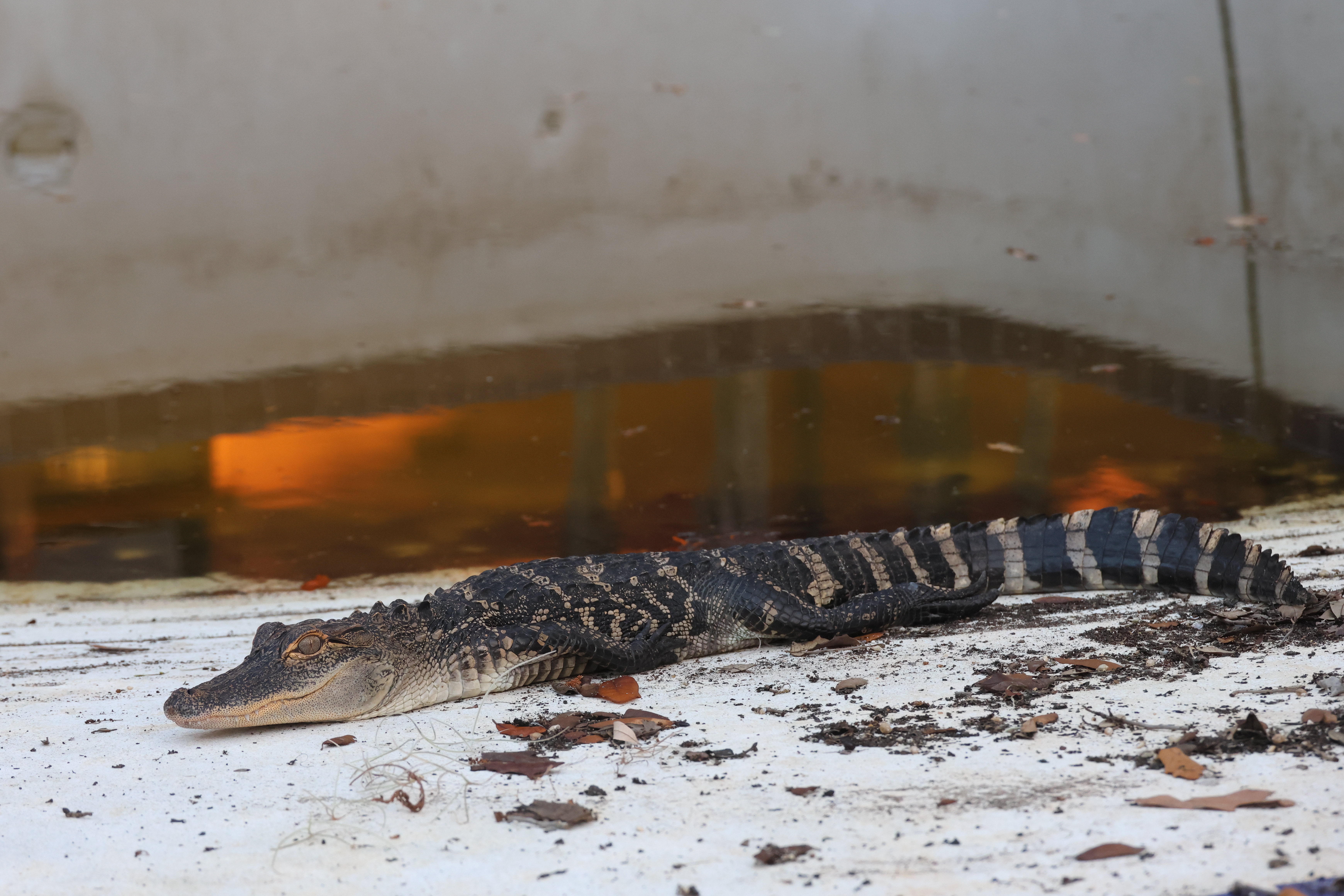
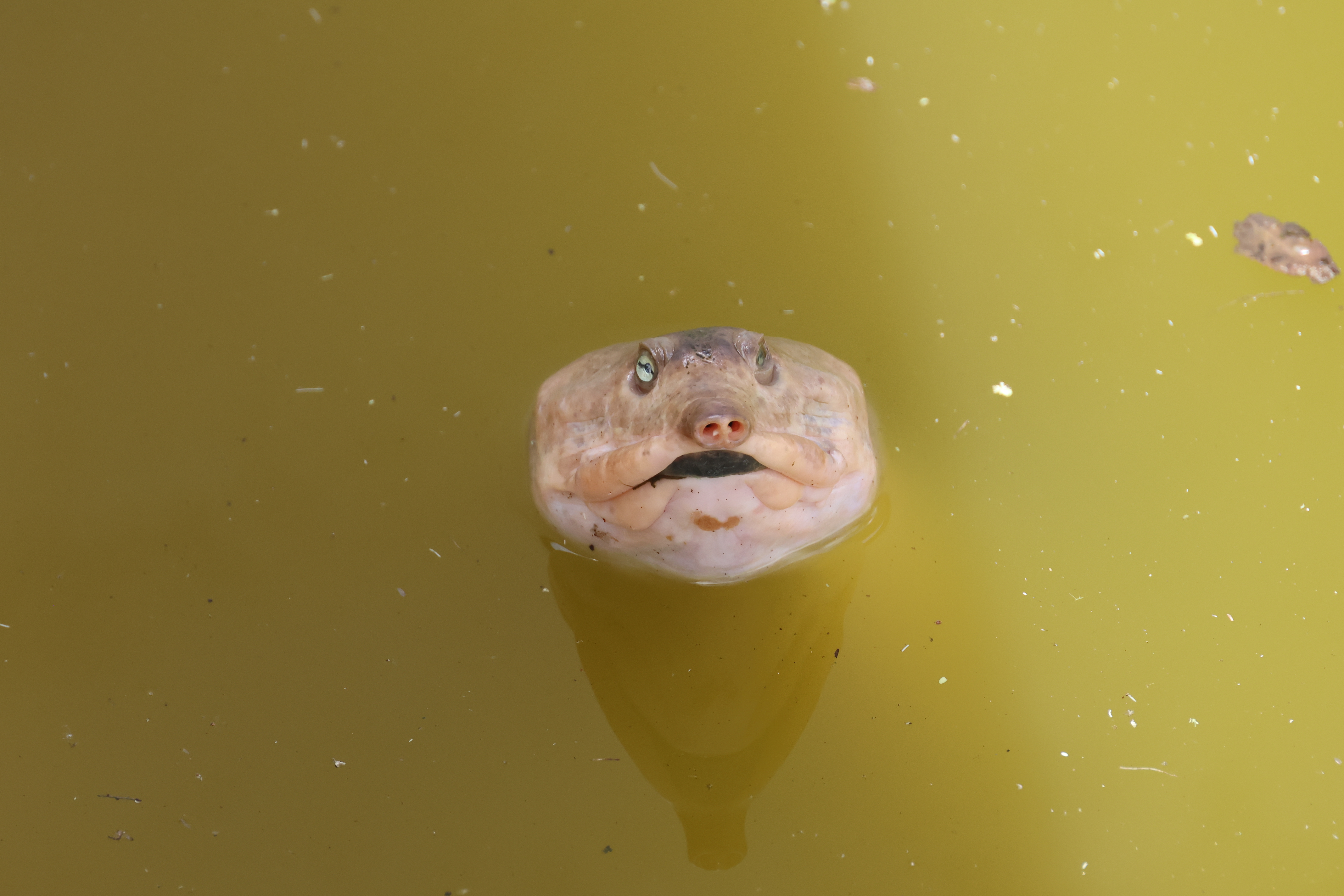
While draining the pool over several days, the Florida softshell turtle and American alligator were occasionally seen. Click to enlarge photos and open gallery view.
The Catch and Release
Once the water level was under a foot deep at the deepest point, I entered the pool with a large hand-net and began scooping. Almost immediately I felt my net hit a large heavy object on the bottom. I couldn’t see it because the water was dark brown but I could feel, with my other hand, that it was the leathery shell of a turtle. With the net going underneath the shell, I used my free hand to guide the turtle into the net opening. It barely fit. I then gingerly carried the net onto land as the net felt like it was about to break given the weight. I estimate the turtle weighed around 50 pounds with a shell length of 24 inches. It was massive. It had some dark green algae growing on its head and shell. Once on land, I removed it from the net and took a few pictures. I decided it would be best to carry it the ~50 yards to the lake by hand rather than in the net, because the net felt like it was going to give out. I put my whole hand and forearm underneath the shell and then I put my other hand and forearm on top of the shell – essentially forming a sandwich. This was so that the turtle was well supported underneath and stabilized from above. Softshell turtles have really long flexible necks. A few times, the turtle reached its neck backward and came close to biting my hand, which was atop the shell. By the time I made it to the lake my arms were burning. It felt like I was carrying a bag of cement mix. Thankfully, I did not get bit. Immediately upon setting the turtle down at the water’s edge it dashed into the water and swam away.
There was no alligator in the pool. I kind of figured this was the case as I hadn’t seen it for the past few days, and prior to that I had seen it more frequently. I am fairly certain that the alligator made it out on its own via the stairs in the corner of the pool and was able to make the short downhill journey to the lake. I think that my presence around the pool, the gradual draining of the water from the pool over the course of several days, and the buzzing sound of the pump (alligators are sensitive to vibration) convinced the alligator that this was not a good place to be and that it should seek greener pastures elsewhere. Therefore, sometime when I was not around (likely at night) it simply escaped on its own accord. Honestly, this was probably the best-case scenario, as you are supposed to have a permit in order to catch an alligator.
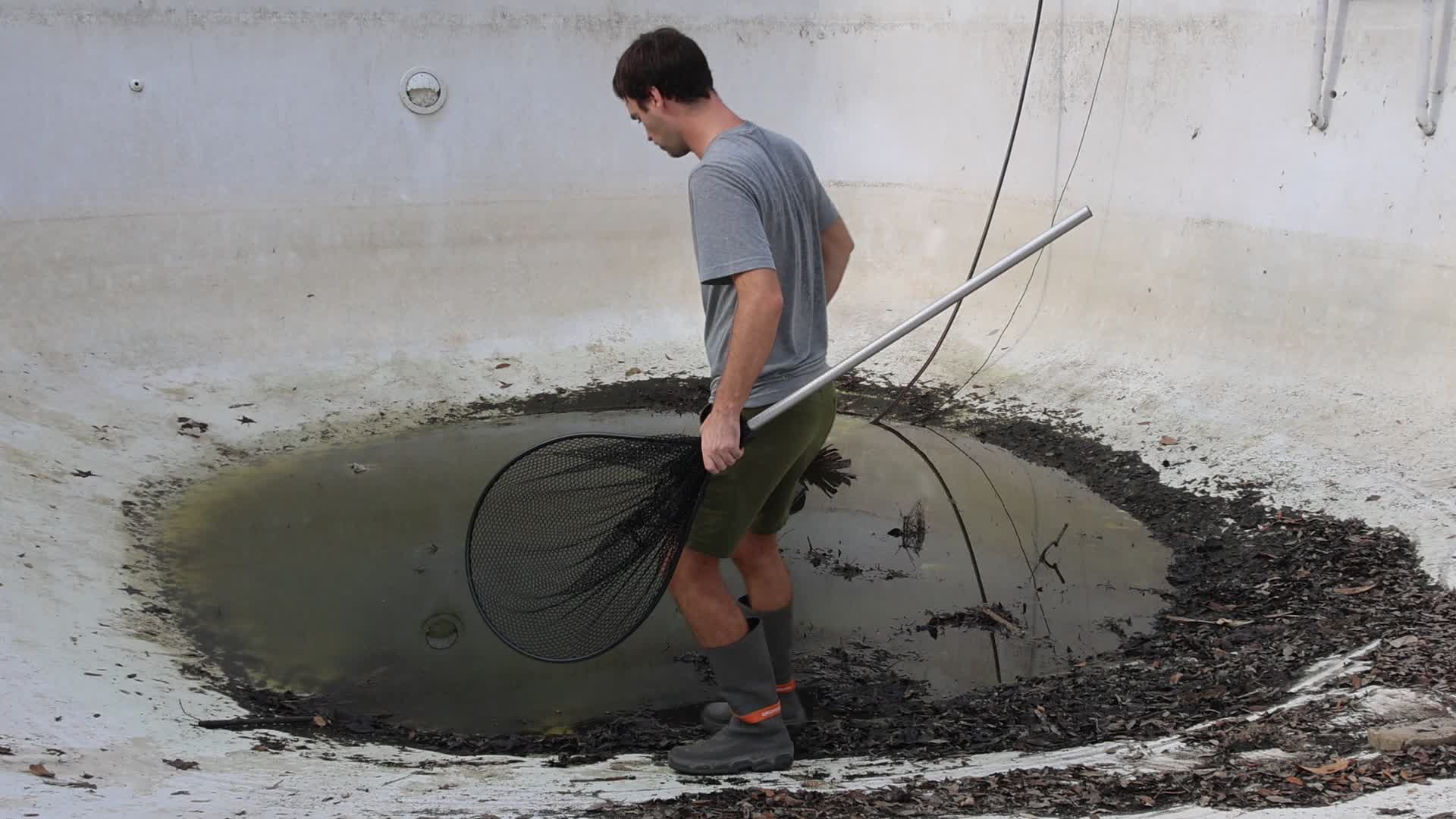
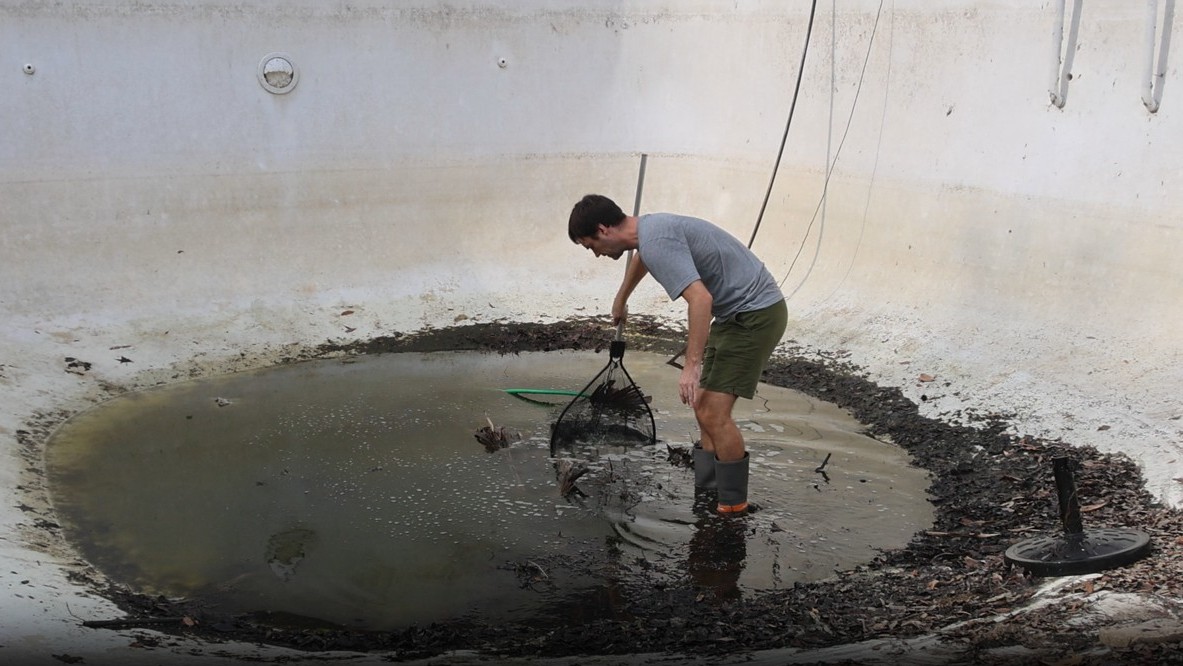
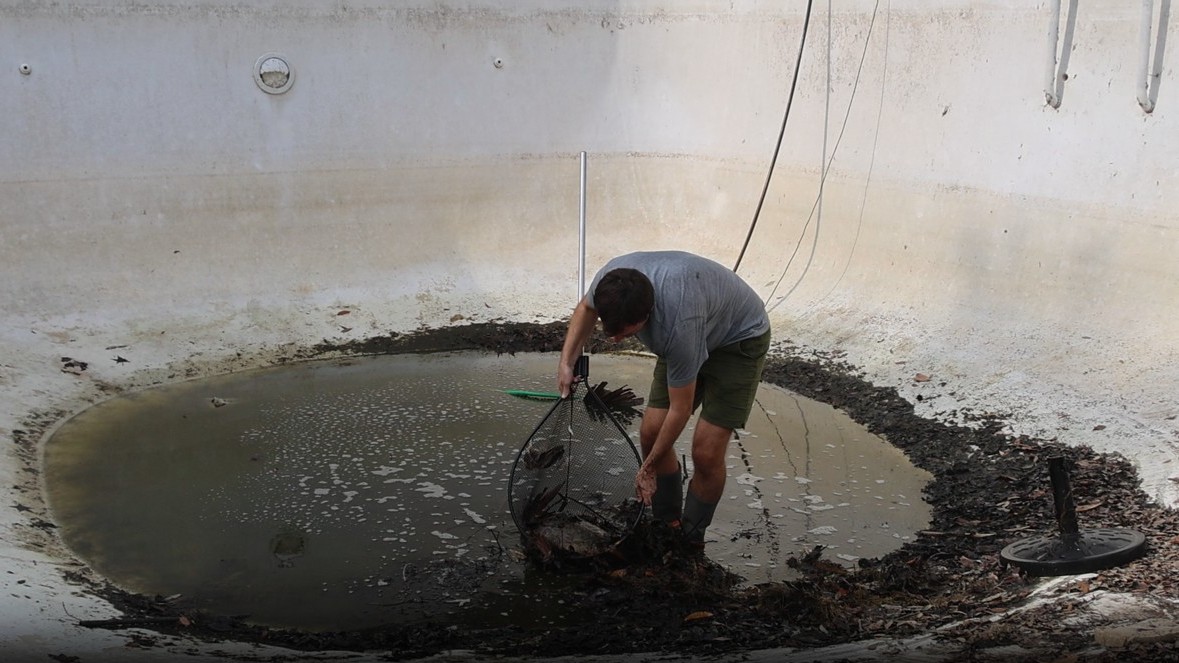
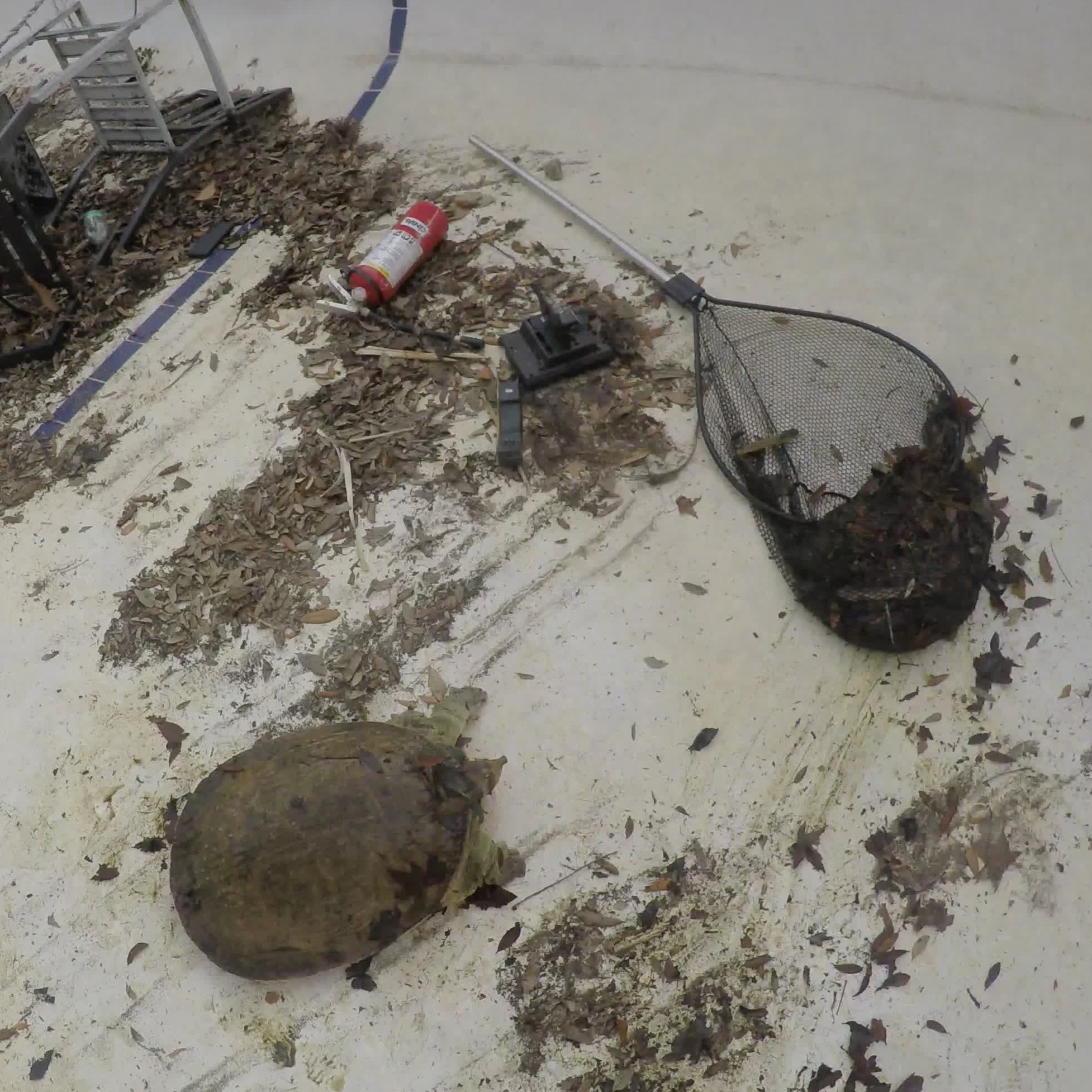
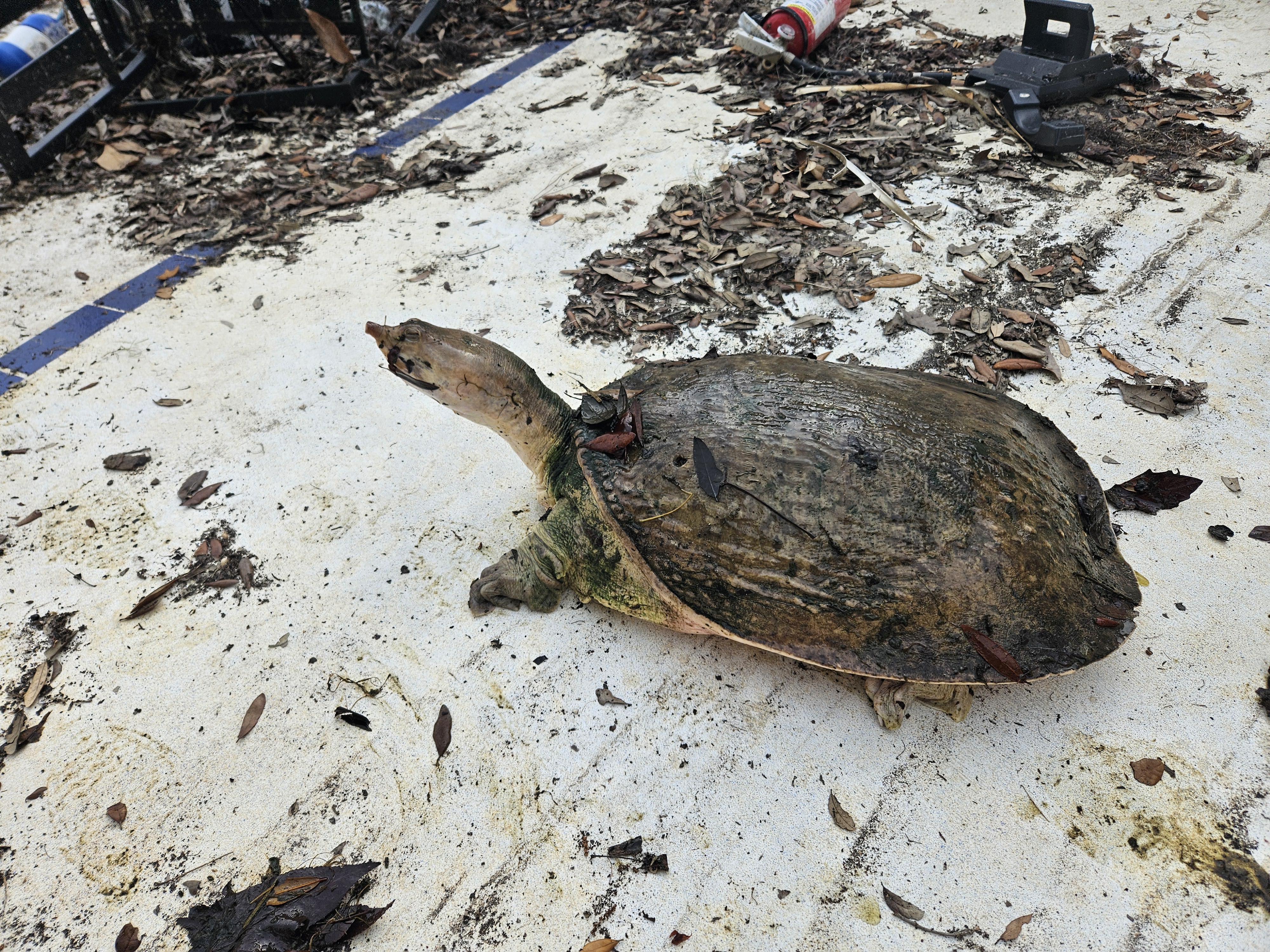
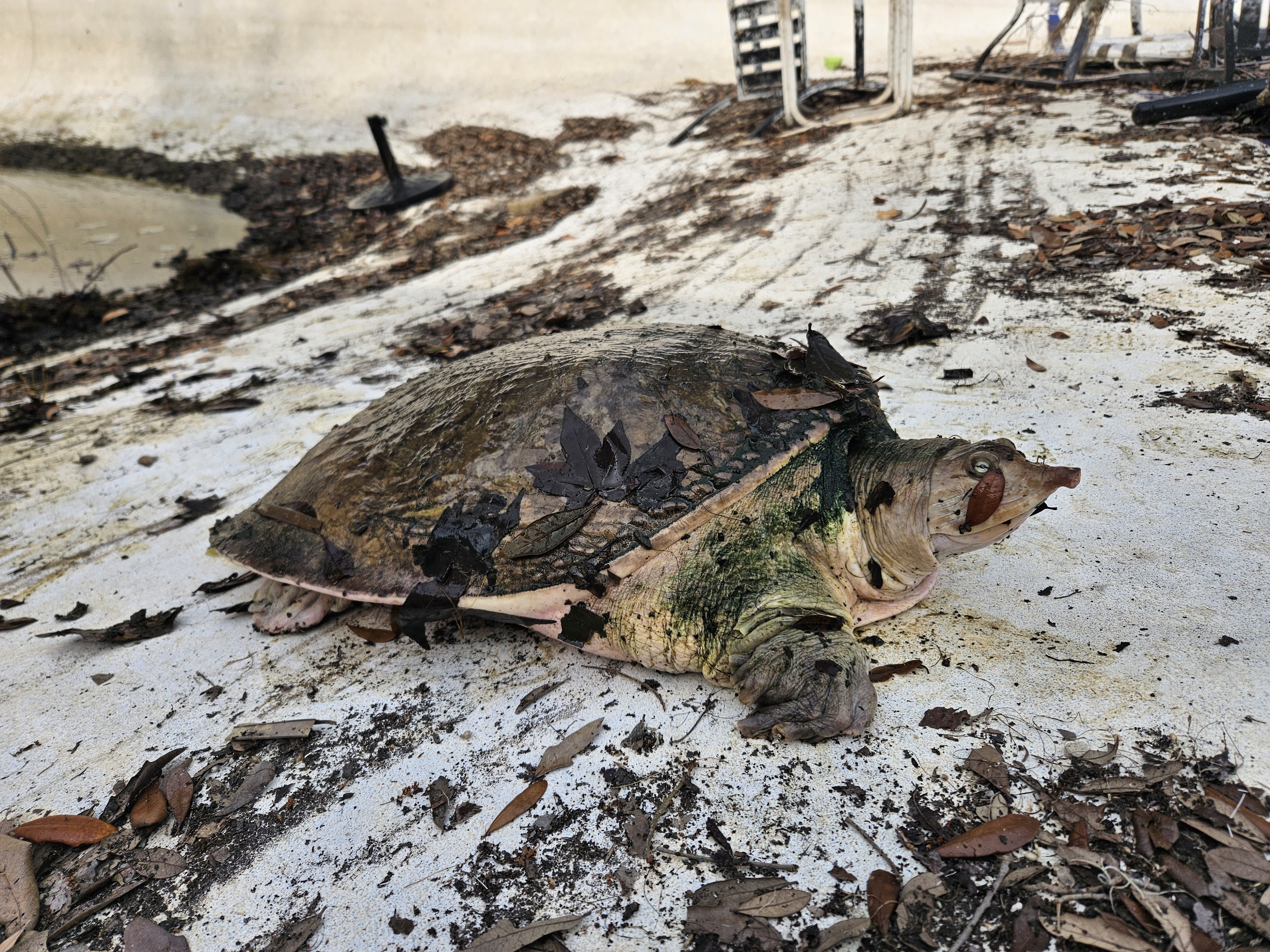
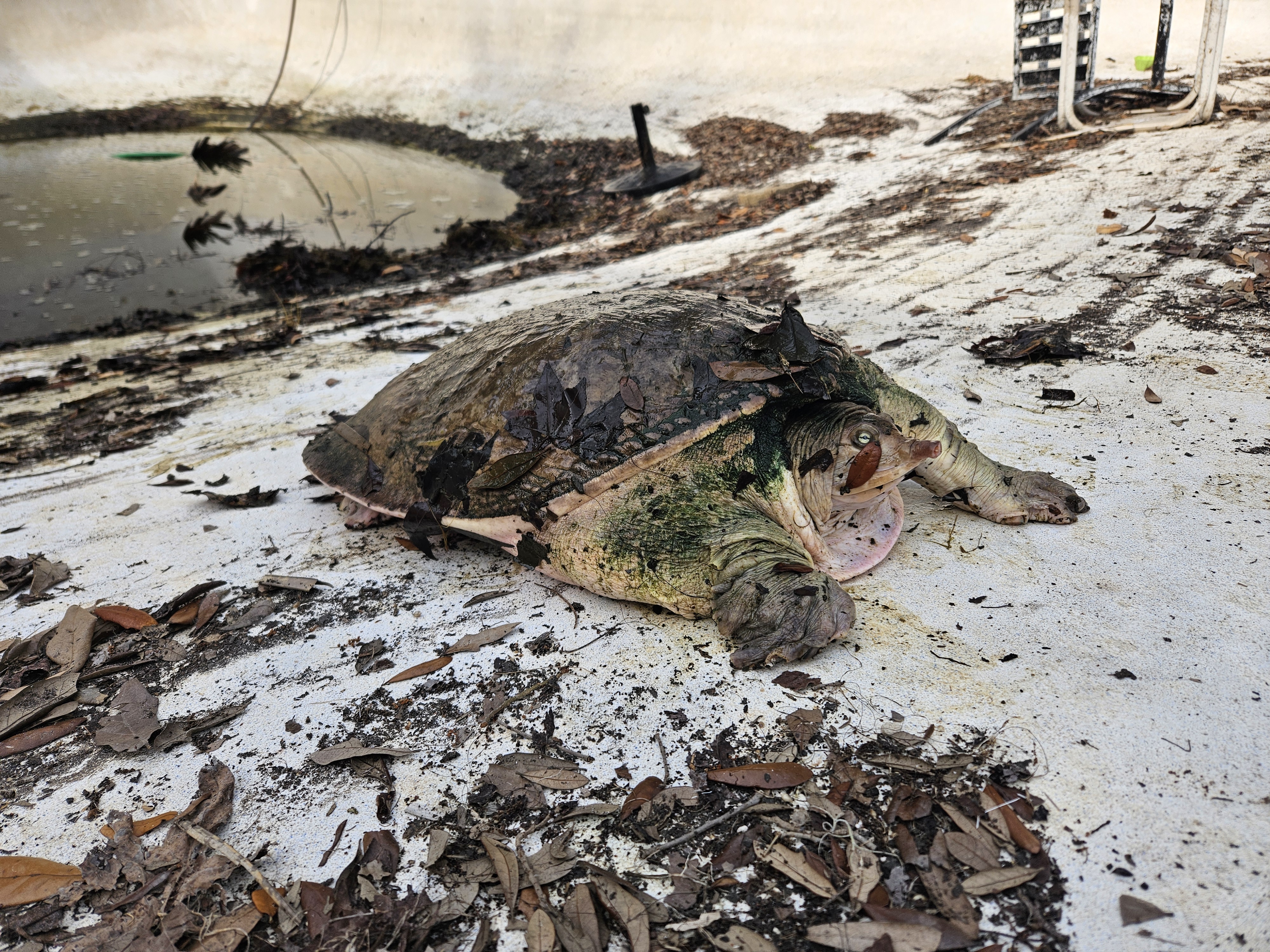
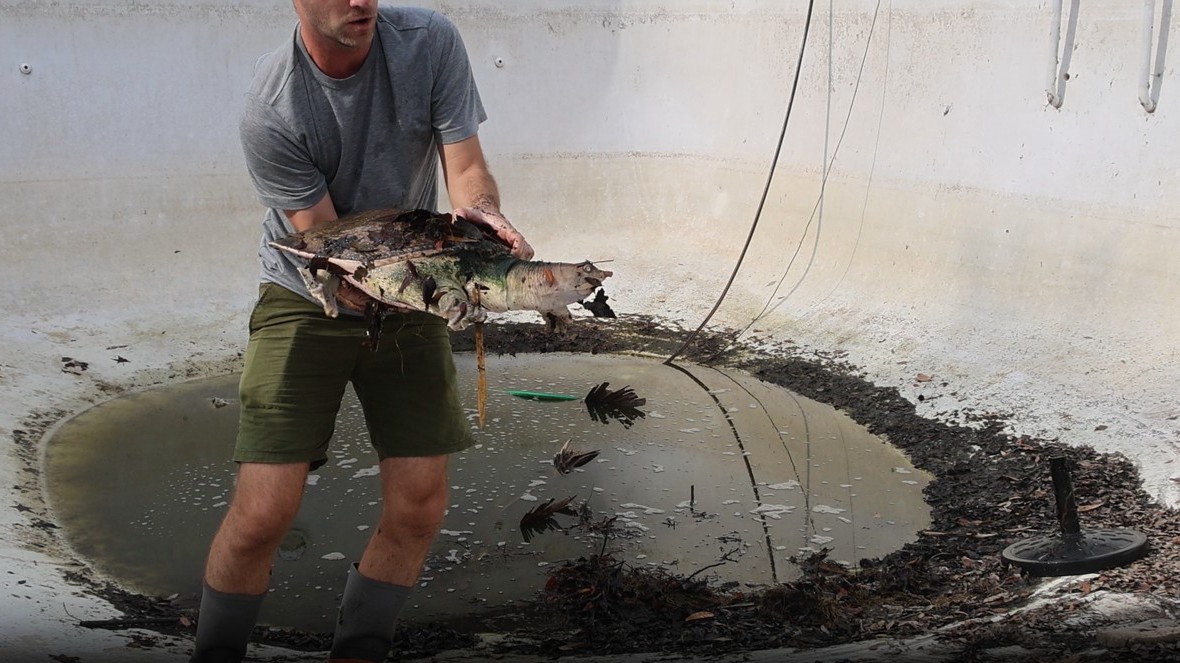
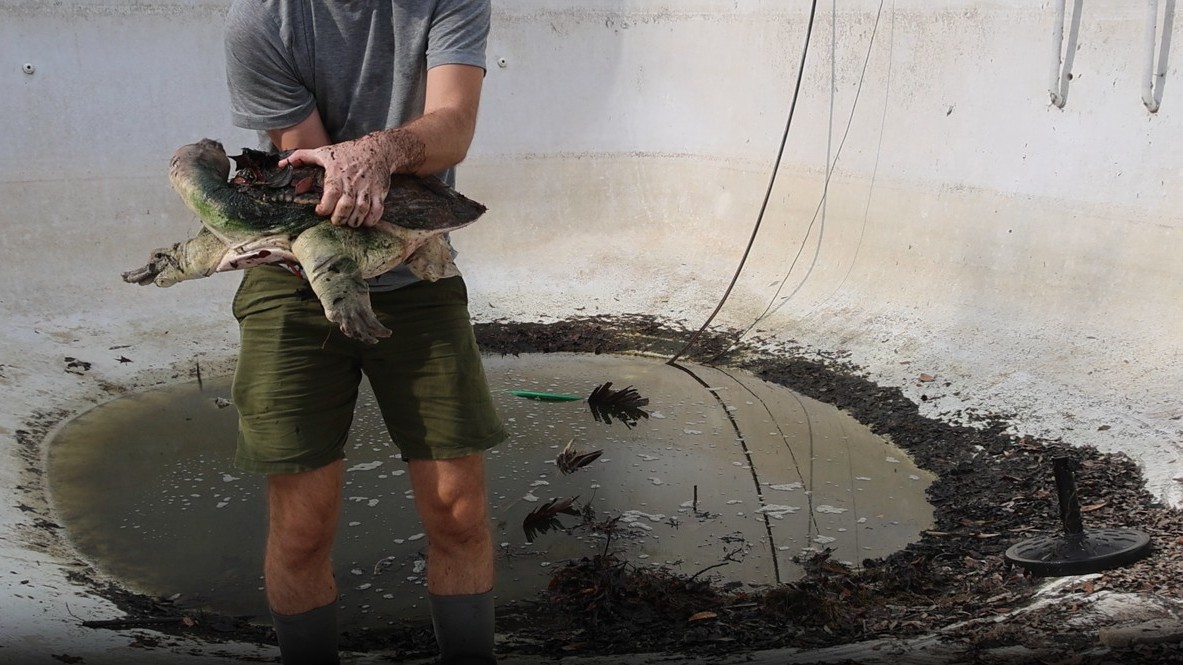
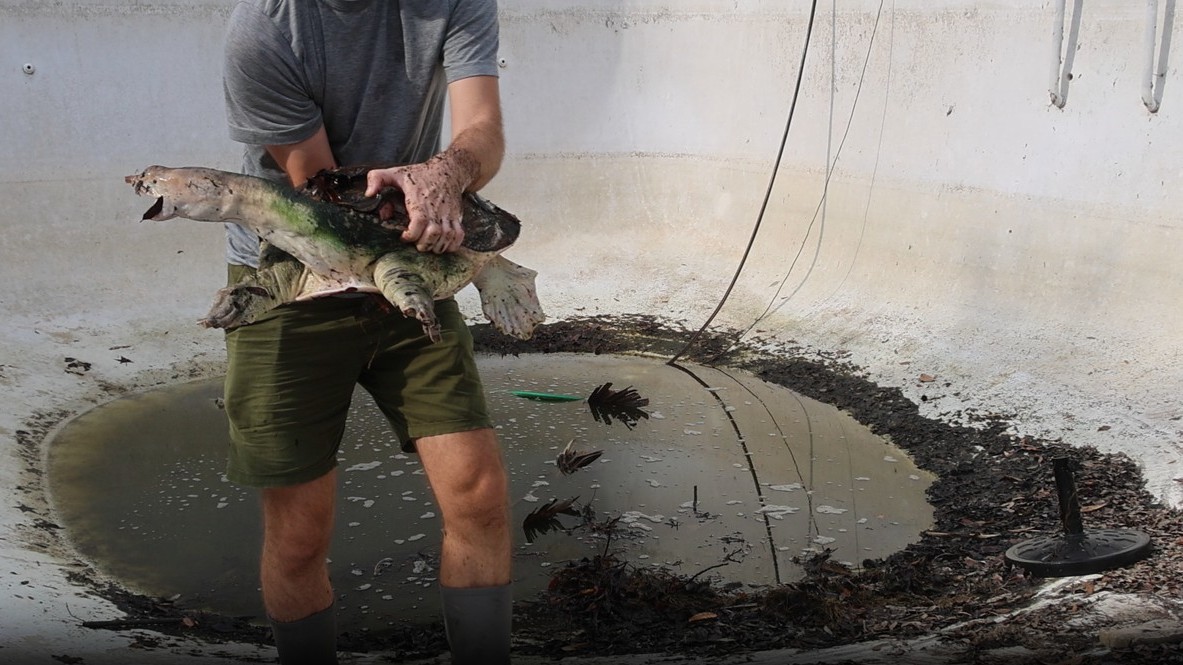
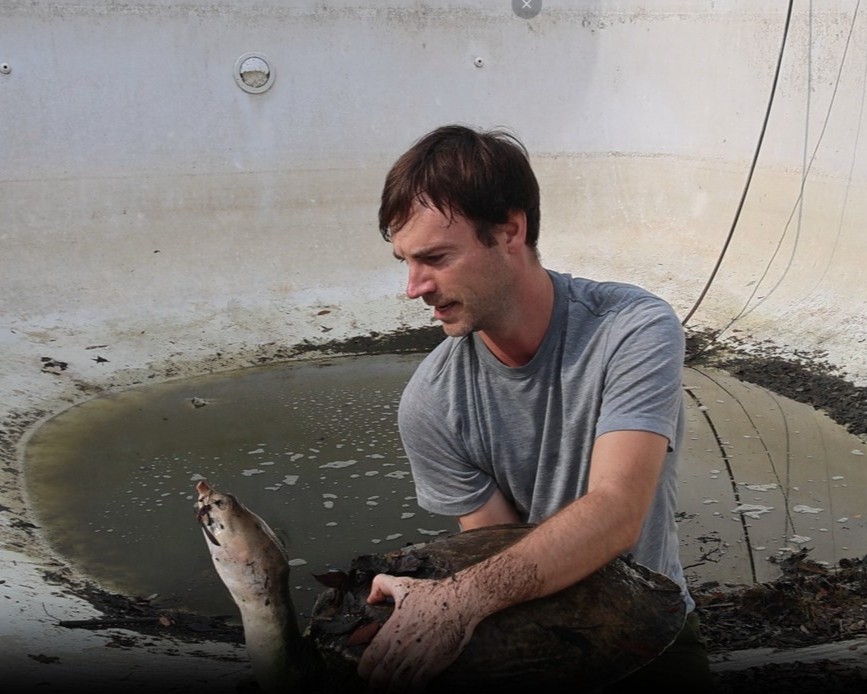
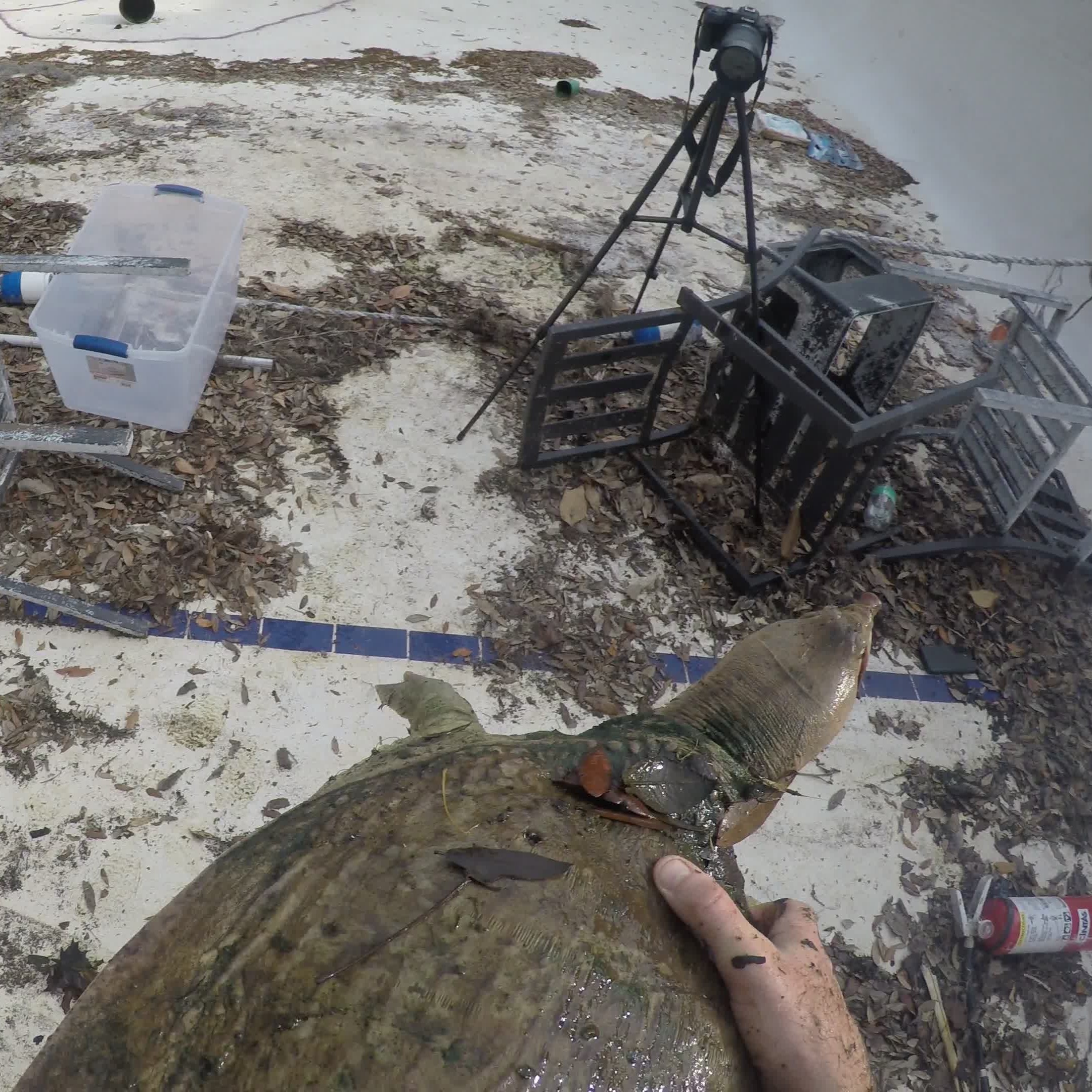
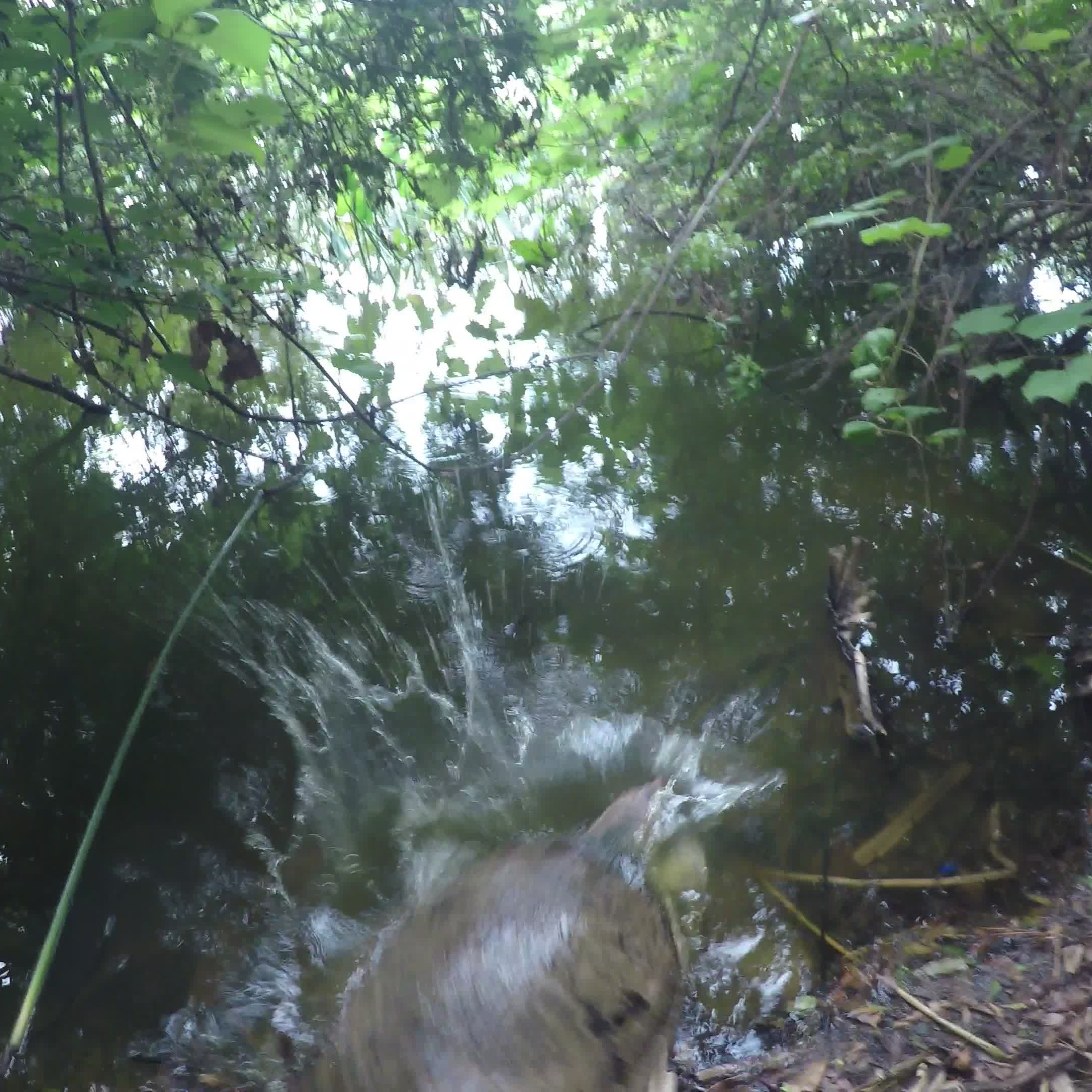
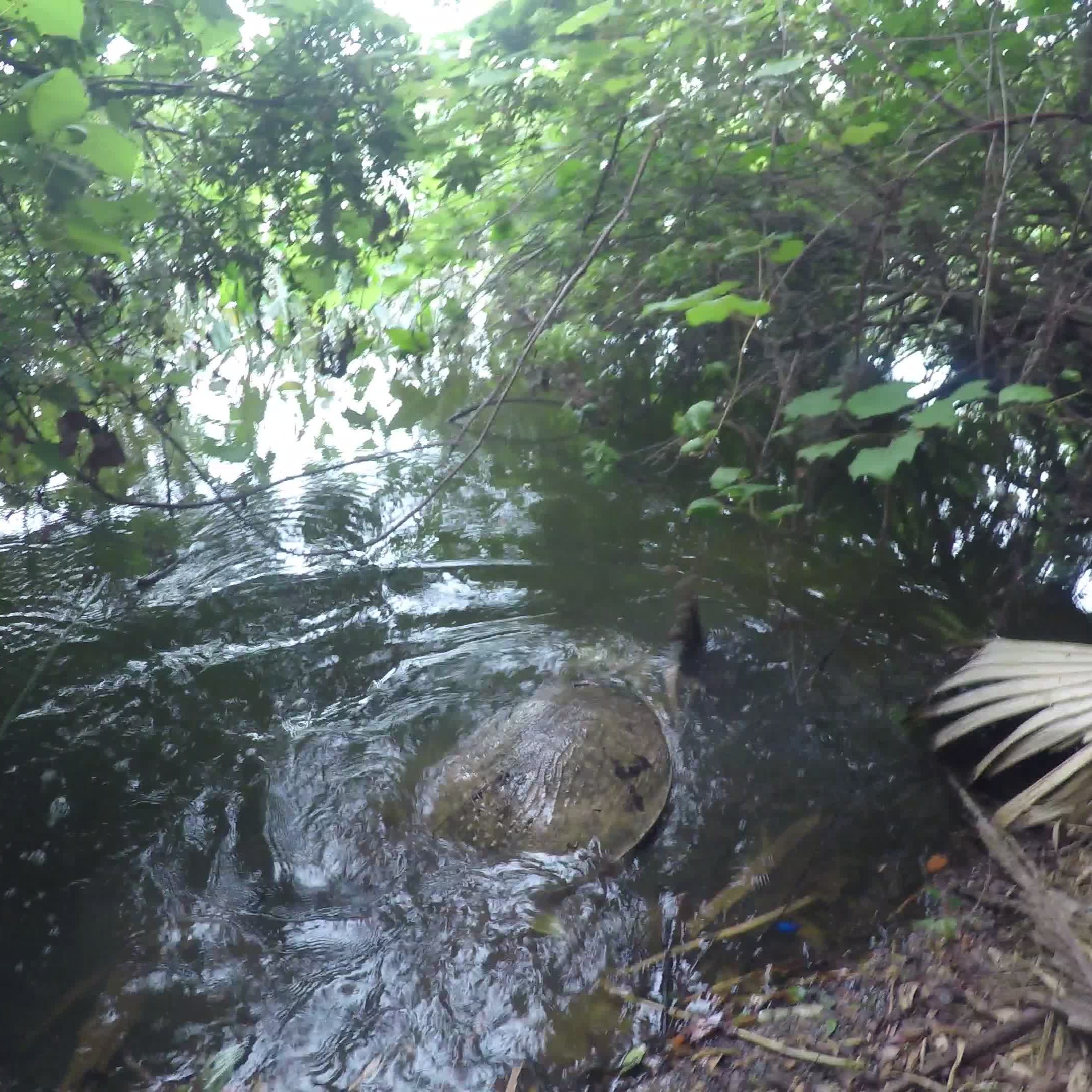
Once drained to under a foot of water, I was able to net the turtle, carry it about 50 yards to the lake, and release it. Click to enlarge photos and open gallery view.
Postscript
Alligators and Florida softshell turtles are both carnivorous. There did not appear to be any food source in the pool. The pool contained many small aquatic insects, but I do not believe these would have been seen as prey by either species. There were no other animals of any kind in the pool. There were no fish, no amphibians, no mammals, and no other reptiles. There were also no dead animals apparent in the drained pool. Yet, despite an apparent lack of food sources, both animals seemed to be in good physical condition. They did not appear injured or emaciated. Florida softshell turtles are very aquatic. It is only during the springtime that female softshell turtles leave the relative safety of the water in search of terrestrial nesting sites. Furthermore, as temperatures warm alligators become more active. Gainesville has moderately cool winters and both species are very unlikely to be moving over land during the winter. When both of these factors are considered together (i.e. no apparent food sources yet both animals appeared in good condition, and both species likely to be active only in the spring when temperatures warm), the most parsimonious scenario is that both species inadvertently fell into the pool within the past two months.
Could either species have escaped on its own? There are two sets of concrete steps in either corner of the shallow end of the pool (where there was no water). Each step is around 10-12 inches high. The alligator, which was around 2.5 feet in length, must have made it out using these steps while I was in the process of draining the pool. Even while still trapped in the pool, I thought that it escaping on its own was a real possibility. I do not think it would have been physically possible for the softshell turtle to escape on its own, despite its large size. Furthermore, in my limited observations, the turtle was never seen in the region of the pool with the stairs. It was instead always either in deep water or on the very edge of the water.
What would have happened if the Florida softshell turtle was not rescued? There are probably four possibilities. The first is that, unable to escape, it would eventually succumb to the elements and/or lack of food. I noticed the pool gets full sun in the afternoon, there is no shade, and the water in mid-spring was already quite warm. So, it is possible it would die from heat stress or infection while trapped in what is essentially a concrete prison that lacks food. The second possibility is that as conditions deteriorate (i.e. lack of food, poor habitat) the turtle would make a more concerted effort to escape and successfully do so via the stairs. This seems unlikely. A third possibility is that someone else would come by, notice it was trapped, and remove it. Finally, the fourth is that conditions change making it easier for it to escape on its own. We are currently in the dry season, with the rains beginning in summer (usually early June). With frequent afternoon downpours, the water level in the pool will eventually rise. This would make escape easier. As water levels rise, the only available basking spot would be the stairs, and there would be less and less of them to traverse. Eventually, without human intervention, the water level would reach the lip of the pool allowing the turtle to simply crawl out. However, waiting this long would not have been good for this turtle. As judged by the size, this was clearly a female (males are much smaller and don’t travel over land in the spring). Females move about on land in the springtime in order to find a nesting site. By being trapped in the pool, this female would miss the nesting season. By returning it to the wild, hopefully it can find a suitable nesting site and lay eggs this spring.
Finally, I made a video documenting the capture and release of this Florida softshell turtle.
 Reason and Nature
So happy to see you rescue the Soft-shell! You really worked hard to save the poor creature.
>
LikeLike