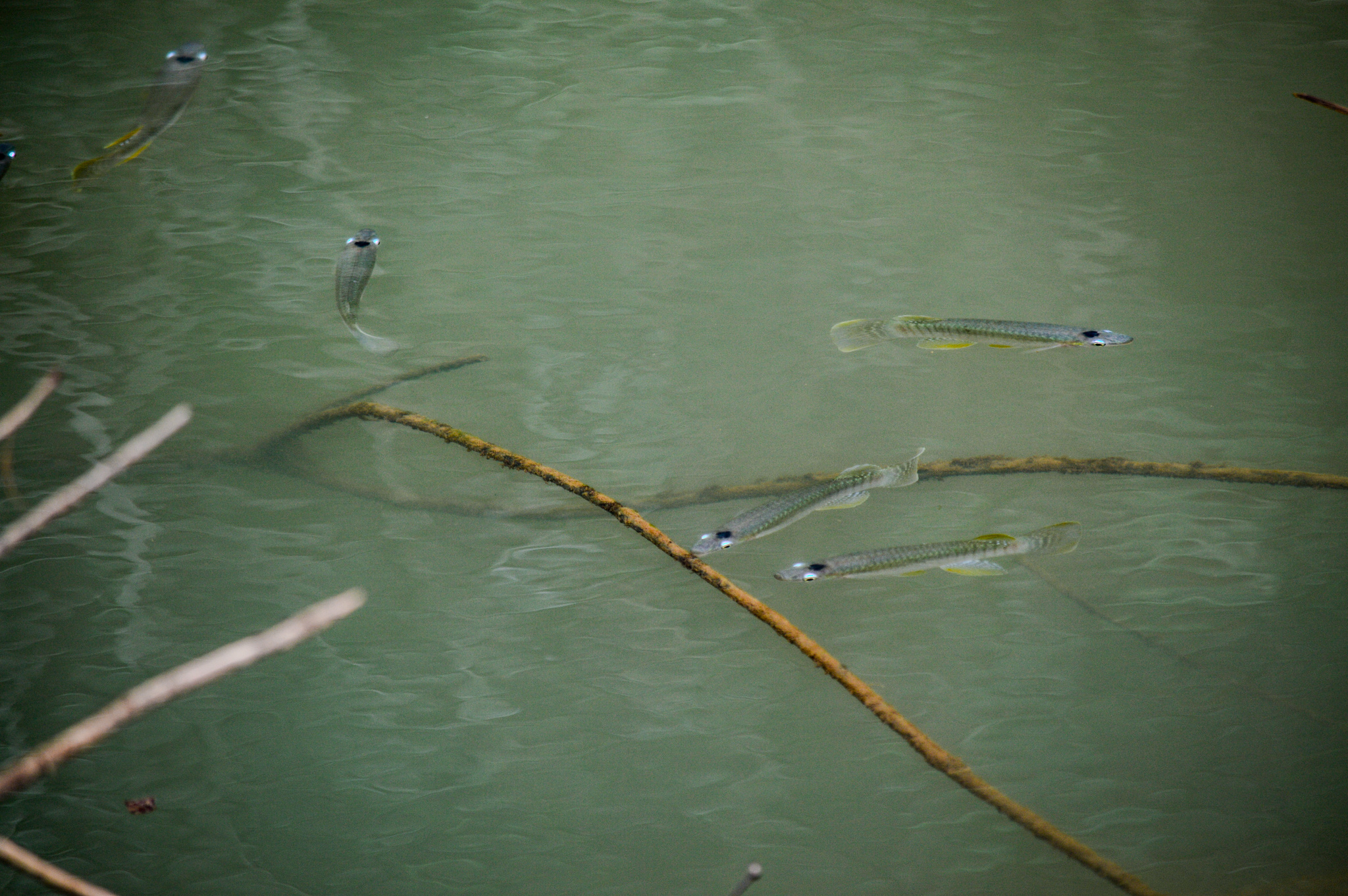
The white-eye fish (Oxyzygonectes dovii) has distinctive white eyes which are fluorescent in appearance. They tend to swim just below the water surface in open estuary habitat. This combination of features make them very easy to spot, despite their small size. I recently witnessed this firsthand. While sitting on a balcony overlooking an estuary in Puerto Jiminez, Costa Rica, I saw a small group of white-eyes swimming 10 yards below. Later, when crossing a bridge, I again spotted a small group of white-eyes in the waters far below. Interestingly, the estuary habitat where I observed these fish had lots of fish-eating birds, including both herons and kingfishers. It would seem that having bright white eyes that are clearly visible from above would attract the unwanted attention of predatory birds. This begs the question: Why do these fish have bright white eyes?
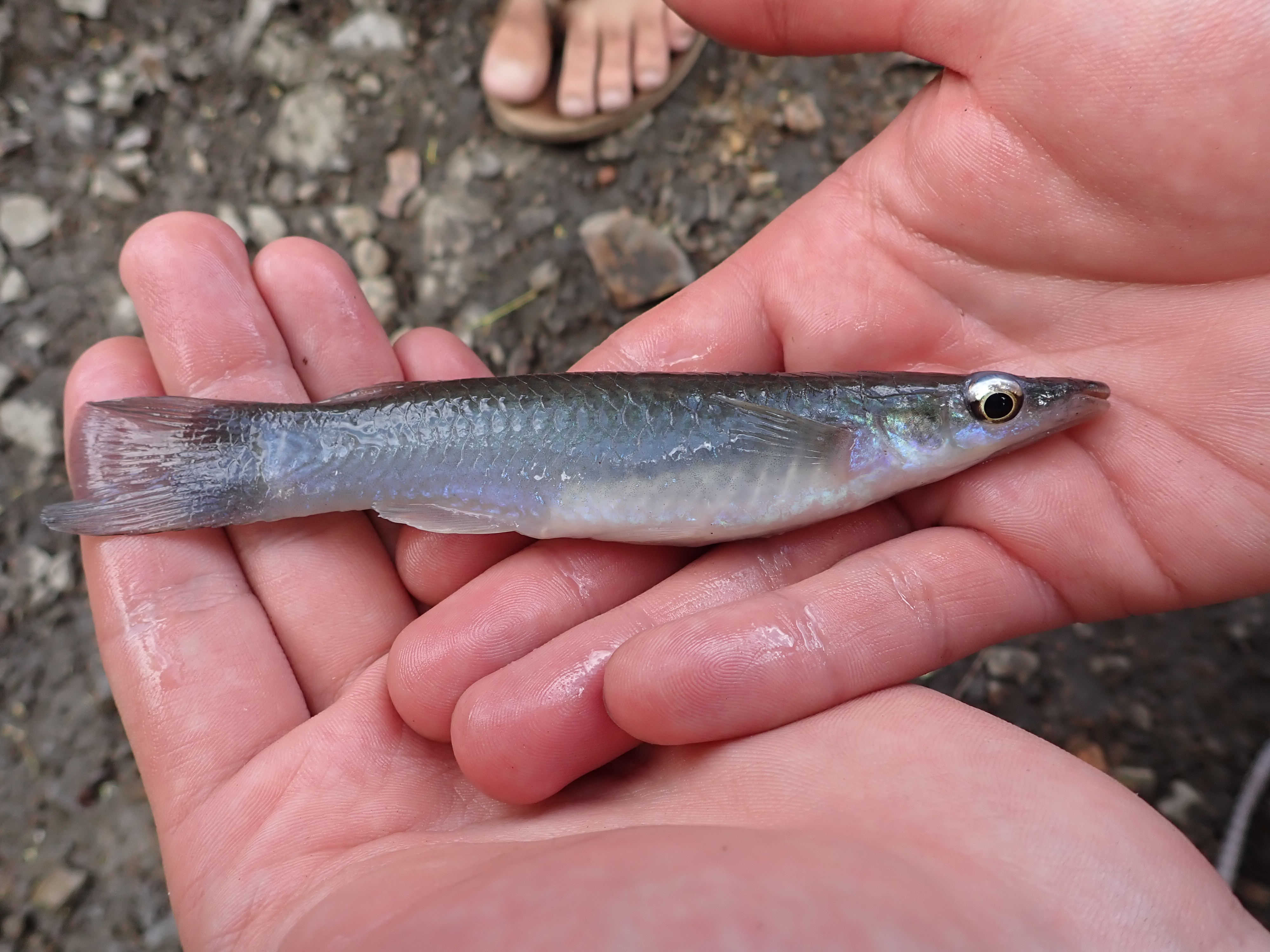
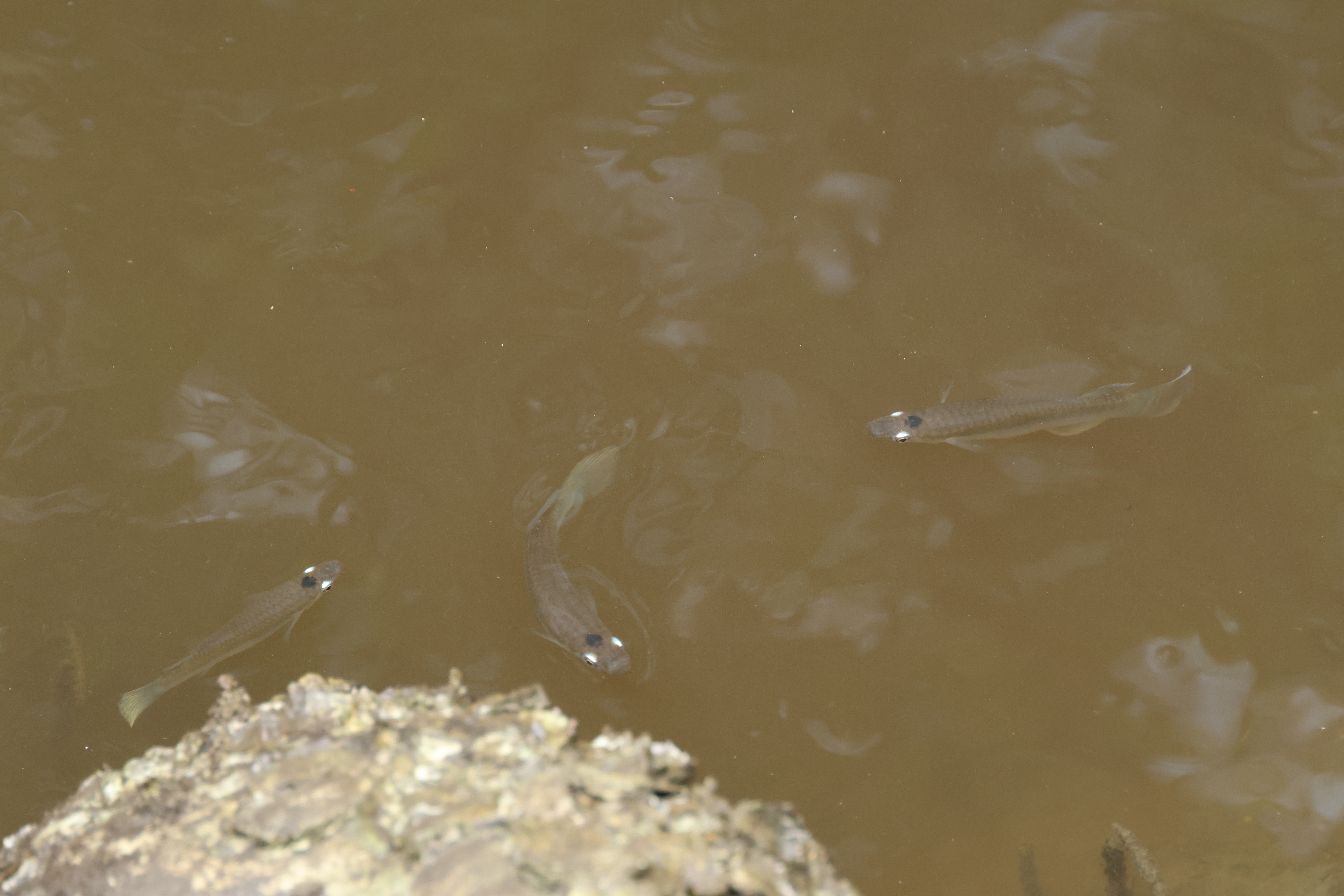

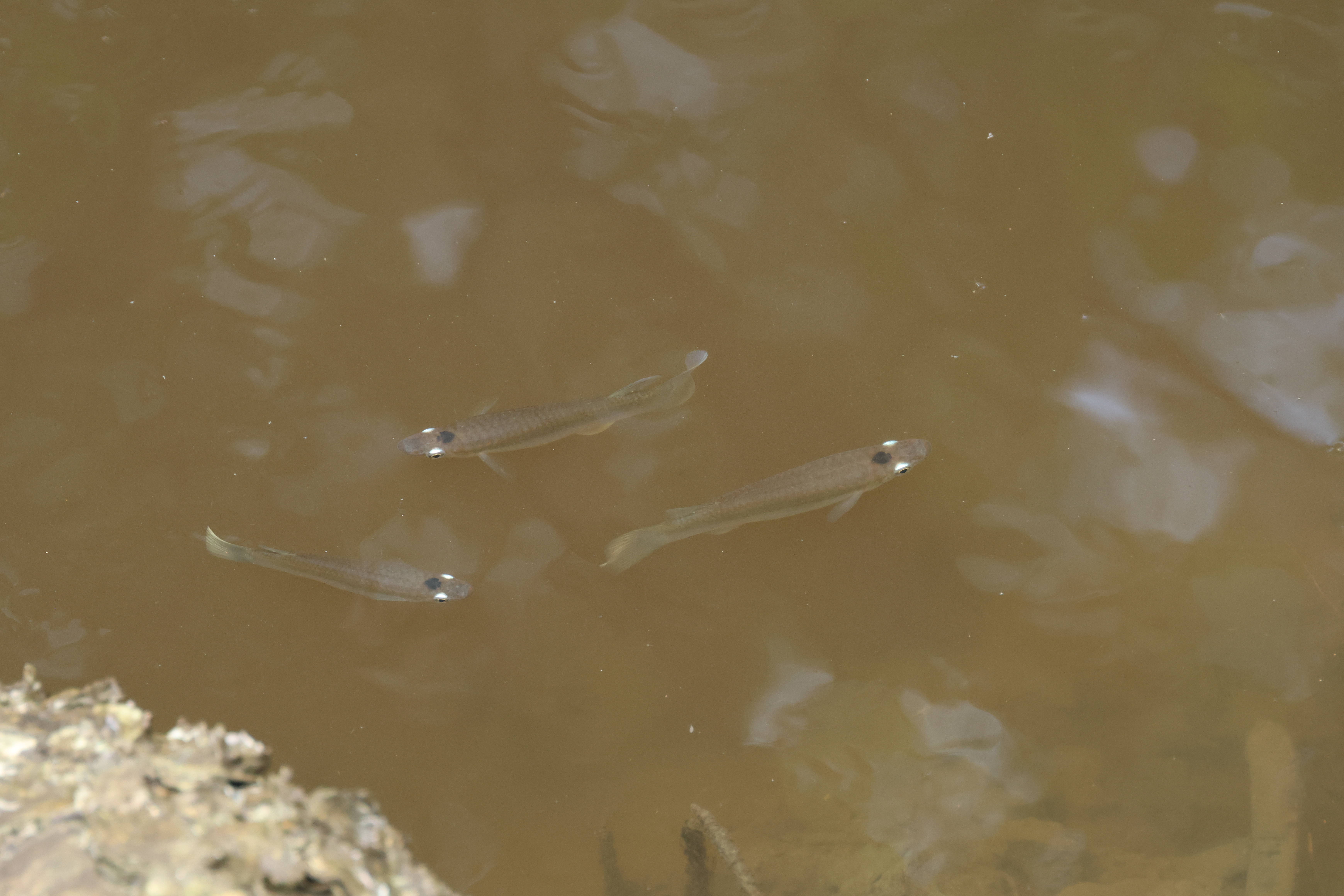
The white eyes of Oxyzygonectes dovii are visible from some distance. All photos taken by A. Furness in Costa Rica. Click to enlarge.
I can think of four general hypotheses, which I will refer to as camouflage, sexual selection, signaling, and sensory. Below I summarize what little natural history information is available for this species, and then evaluate these four hypotheses in light of this information and my own field observations.
Natural history
The white-eye (Oxyzygonectes dovii) is a killifish in the family Anablepidae. It is the sole egg-laying species in this family, as the other 18 species (in the genera Anableps and Jenynsia) give live-birth to fully developed offspring. Oxyzygonectes dovii is found in Pacific coastal drainages of Nicaragua, Costa Rica, and Panama. Here, they inhabit brackish estuaries (i.e. where rivers flow into the Pacific Ocean). They reportedly eat detritus, algae, and occasionally terrestrial insects. They reach a maximum size of about 6 inches (15 cm), and exhibit sexually dimorphic coloration (males more colorful). Oxyzygonectes dovii gets its common name (white-eye fish) from its distinctive white eyes.

Evolutionary tree of the Order Cyprinodontiformes (killifish and livebearers). The family Anablepidae, which contains the white-eye (Oxyzygonectes dovii), is indicated with an arrow. Tree credit: Piller et al. (2022).
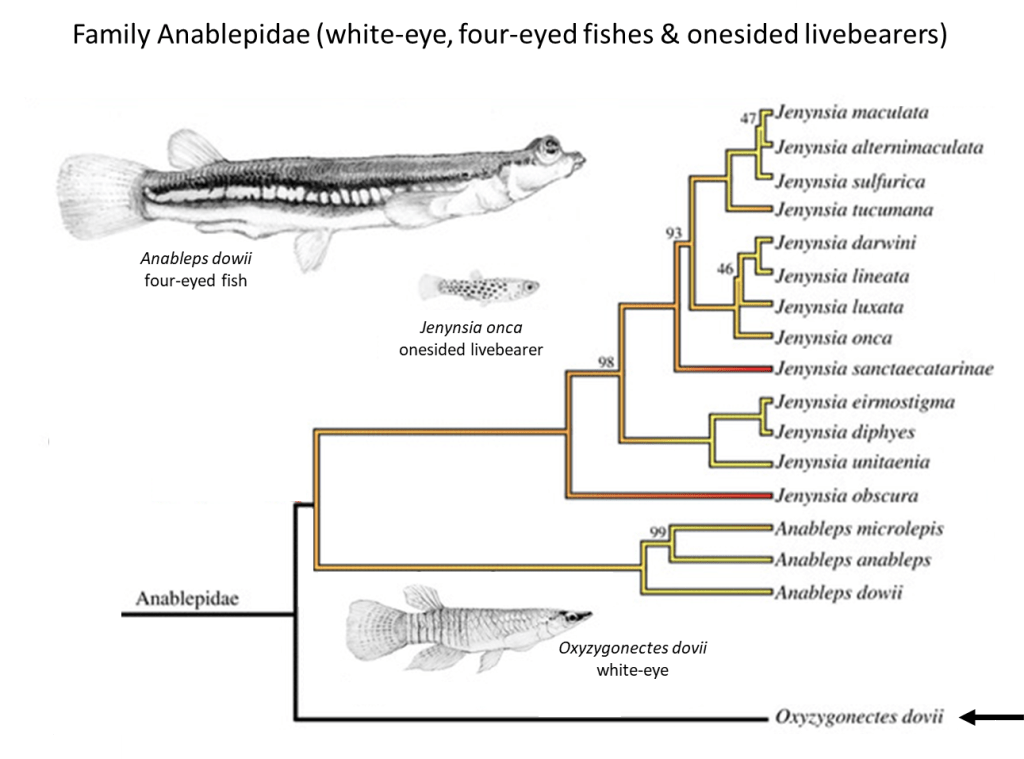
Evolutionary tree of the fish family Anaplebidae. Oxyzygonectes dovii, the only egg-laying species in the family, is indicated with a black arrow. The 3 livebearing species in the genus Anableps are known as four-eyed fishes because each eye is divided into two different parts, such that they can simultaneously see both above and below the water surface. Tree credit: Torres-Dowdall et al. (2022).




Photos of Oxyzygonectes dovii in the wild, taken by iNaturalist users. Photo credits given in individual photo captions (click to enlarge and view).


Oxyzygonectes dovii are found in estuary habitat, where rivers enter into the Pacific Ocean. All the above photos are locations in Costa Rica where I observed this species.
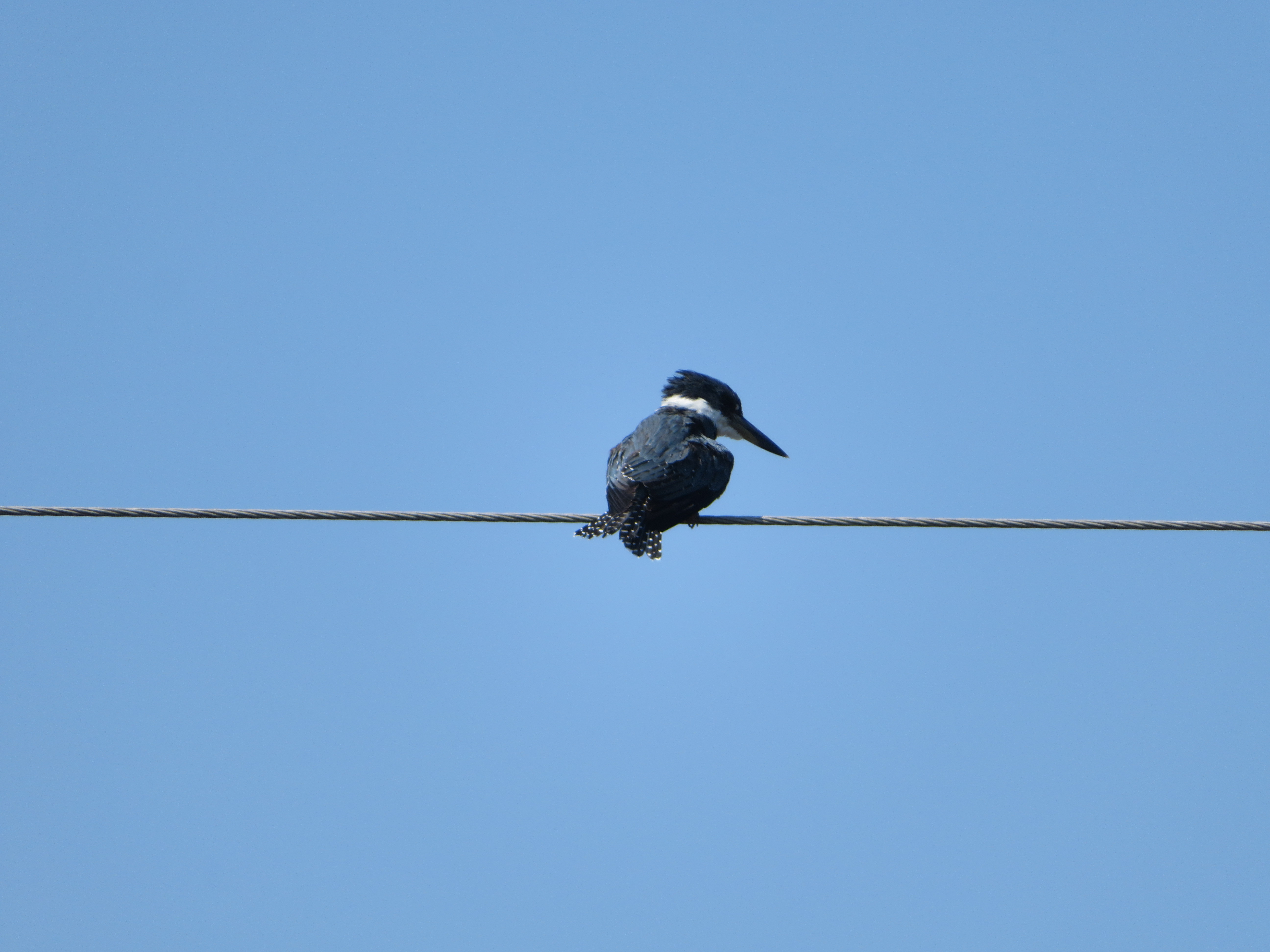


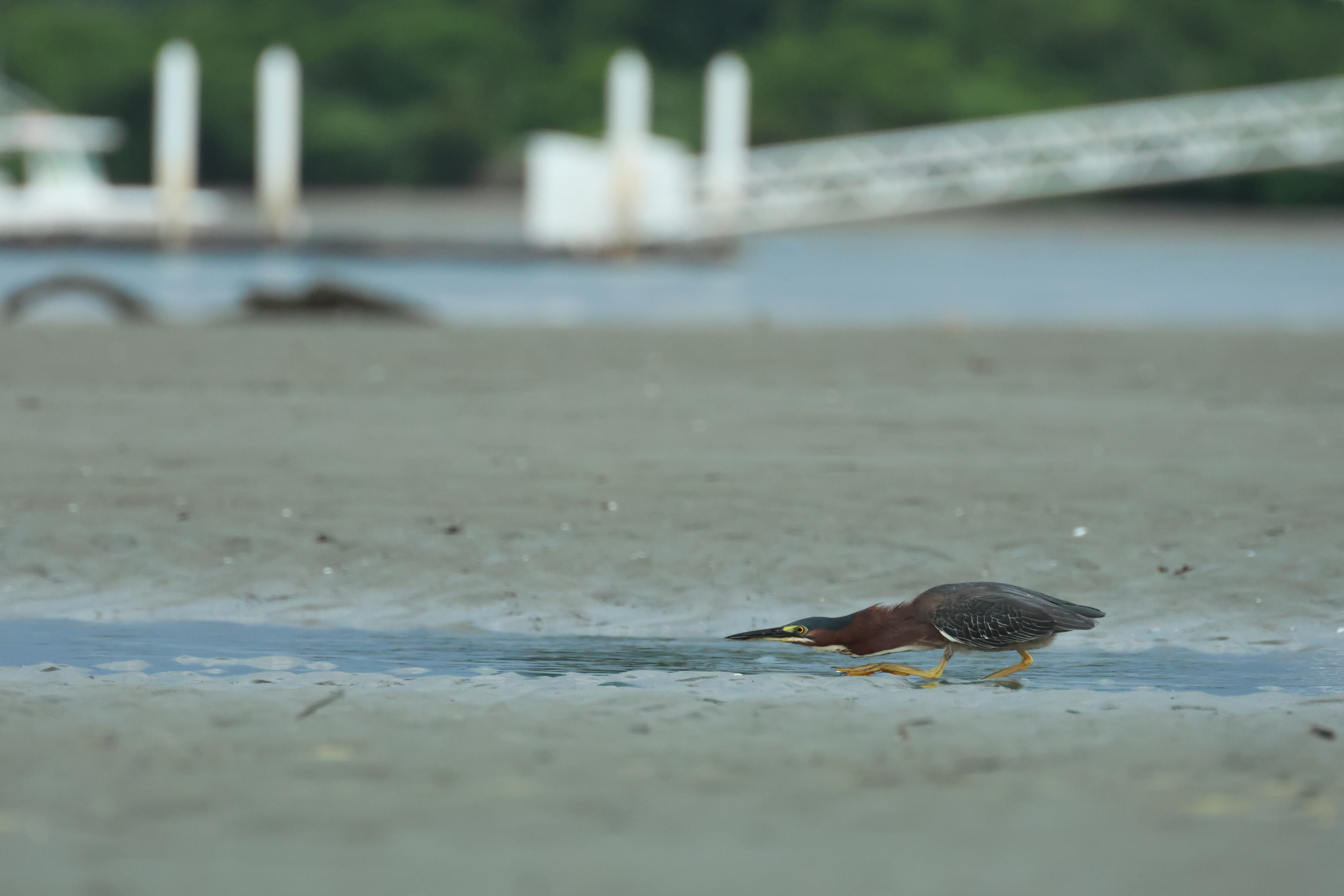
The estuary habitat where Oxyzygonectes dovii is found is also home to fish-eating birds, including herons and kingfishers. All photos taken by A. Furness in Costa Rica. Click to enlarge.
Camouflage hypothesis
It is possible that white eyes could function as camouflage in a bright coastal environment. Many animal species, including fish, exhibit a form of camouflage known as countershading in which the underside of the body is light in coloration and the dorsal is darker. This potentially makes the body match its background better when viewed from both below and above. In fact, body countershading is found in Oxyzygonectes dovii. However, in this species the top half of the eye is white in coloration and the bottom is dark. Therefore, the eye itself exhibits reverse countershading (i.e. dark under and light upper) which is the opposite pattern seen on the rest of the body. This is therefore inconsistent with a camouflage explanation. Furthermore, having observed these fish in the wild I can say with confidence that the white eyes stand out compared to the rest of the fish. I had no problem spotting these rather small fish from long-distance specifically because of their bright white eyes. Birds apparently have better eyesight than humans, and can see the color white (ref). So, a camouflage explanation seems unlikely.
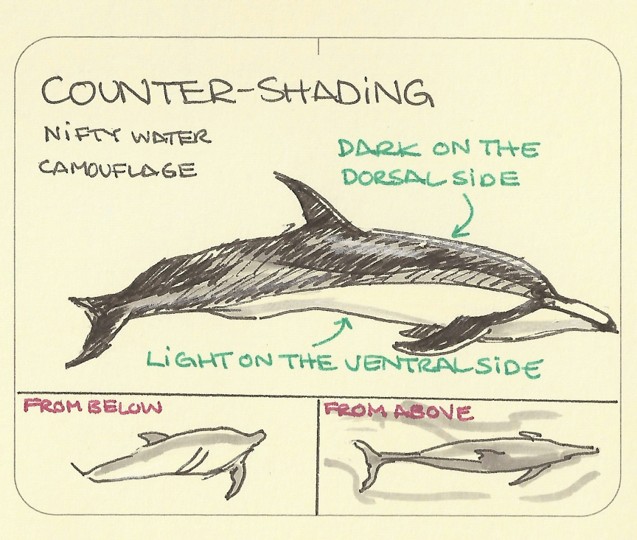
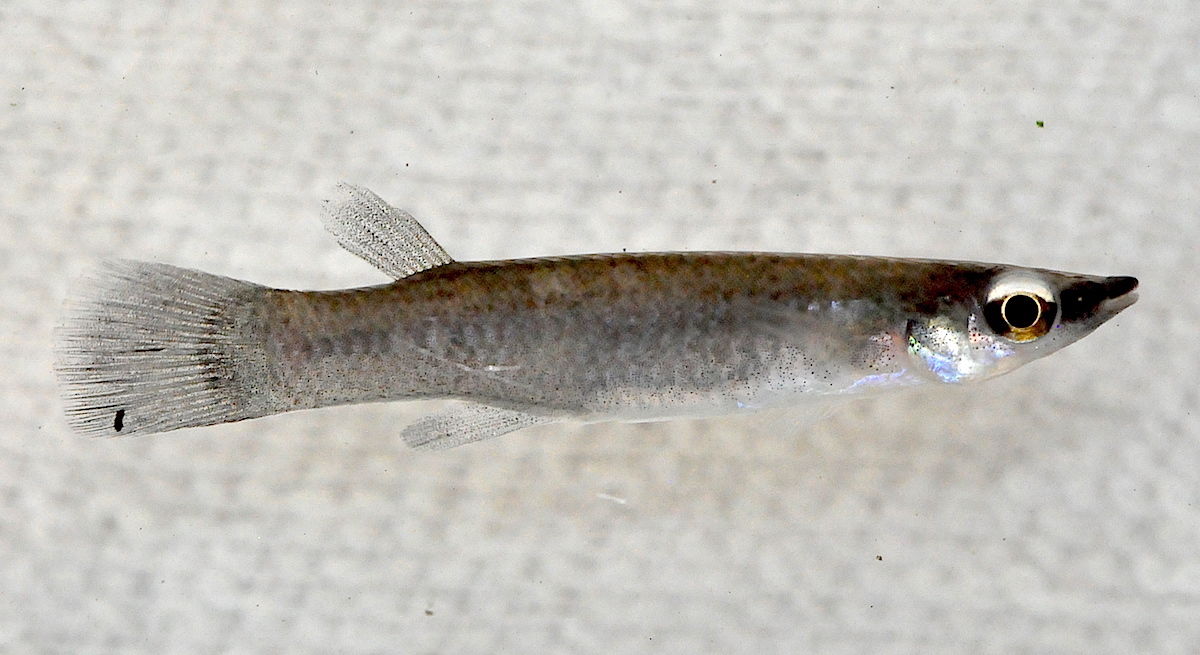
Oxyzygonectes dovii exhibit body countershading (light ventral and dark dorsal), but the eye itself exhibits reverse countershading (dark vental and light dorsal). Photo credits given in individual photo captions (click to enlarge and view).
Sexual selection hypothesis
Sexual selection is a form of selection in which certain traits are favored because they increase reproductive success. Probably the most famous example of a sexually selected trait is the peacock’s tail. The elaborate tail is present in males (peacocks), but not females (peahens). The explanation for how such a seemingly maladaptive trait could arise is that although costly (in terms of energy and survival) it has been favored due to an offsetting increase in reproductive success (i.e. female preference for the trait). Could the white eyes of Oxyzygonectes dovii be analogous to the peacock’s tail? In this species, males are more colorful and appear to have larger dorsal and anal fins (i.e. they exhibit dimorphism in coloration and morphology). But the bright white eyes do not follow this pattern. That is, both male and female Oxyzygonectes dovii have white eyes. This suggests that there is some benefit of having white eyes that accrues to both sexes (or at the very least there is minimal cost). Sexual selection therefore seems a less likely explanation.

Mature male and female Oxyzygonectes dovii are easily distinguished. However, both sexes have white eyes. Photo credits: iNaturalist user andresbioch (top), A. Furness (bottom). Click to enlarge.
Signal hypothesis
Another hypothesis is that the white eyes of this species function as a conspicuous mark that helps maintain schooling cohesion (i.e. a conspecific signal). This hypothesis posits that the reflective eyes help other nearby fish locate and align with each other. Oxyzygonectes dovii does appear to be a schooling species. I observed them swimming just below the surface in clusters of 2 to 12 individuals. However, if the white eye is functioning as a reference point for maintaining body positioning as part of a school, then it is unclear why only the top half of the eye is white in coloration as this is conspicuous not only from the side (as would be seen by a conspecific) but also from above (as would be seen by bird predators). Furthermore, why highlight a vulnerable area (i.e. the eye), when presumably a mark anywhere on the body (and only visible from the side) could act as reference point for maintaining schooling cohesion? Having bright white eyes seemingly draws attention to the head, the opposite of mimicry in which eyespots or marks on other body regions deflect predator attacks away from the vital head region. Therefore, white eyes acting as a conspecific signal seems an unlikely explanation for their evolution.

In Costa Rica, I observed Oxyzygonectes dovii schooling, as can be seen in this photo depicting a group of seven individals. If white eyes evolved as a conspicuous signal to coordinate movement and maintain schooling cohesion then we would expect maximum visibility from the side (i.e. as viewed by a neighboring fish), but the white eyes are also highly visible from above (i.e. as would be viewed by a bird predator).
Sensory hypothesis
The sensory hypothesis posits that white eyes aid in vision, perhaps by reflecting intense light away from the retina. Oxyzygonectes dovii are found in tropical estuaries without much overhead cover to provide shade, and they live at the waters surface. This is likely amongst the brightest aquatic habitat. Therefore, this species may experience intense selection for reducing glare and limiting the amount of light that enters the eye. Fish generally do not have eyelids. It appears the angle of the Oxyzygonectes dovii eye is slightly downward facing. The downward curvature of the eye, combined with white reflective material concentrated only on the upper portion of the eye, may function somewhat like an eyelid to deflect blinding glare and reduce overall light load from above. Finally, it is worth noting that white is the most reflective color. The hypothesis that the white eyes of Oxyzygonectes dovii serve to regulate light entering the eye from above appears consistent with the available data.

Oxyzygonectes dovii appear to have an eye orientation that is slighly downward facing and the white reflective material is located only on the upper portion of the eye. This is perhaps consistent with an adaptation for limiting the amount of light that enters the eye – something which may be important given they swim just below the water surface in high light environments (i.e. estuaries often with little shade). Photo credits: iNaturalist user andresbioch (top), A. Furness (bottom). Click to enlarge.
Further testing
An obvious question to ask is: Do other fish species that live in similar environments also have white eyes? It appears that at least some do. The closely related Anableps species have similar habitat usage as Oxyzygonectes dovii and appear to have reflective white coloration surrounding their unique eyes. Within the Order Cyprinodontiformes (which contains Oxyzygonectes dovii) several species are referred to as topminnows because they live at the top of the water column. The livebearing pike topminnow (Belonesox belizanus) appears to have white reflective material on the top of its eyes (although to a lesser extent than Oxyzygonectes and apparently only visible from certain angles). Similarly, some killifish species with the common name topminnow – such as the Blackspotted topminnow – also have white reflective material on the upper eyes. This apparent association is consistent with the sensory hypothesis, but it is still speculative – a “just so story.”
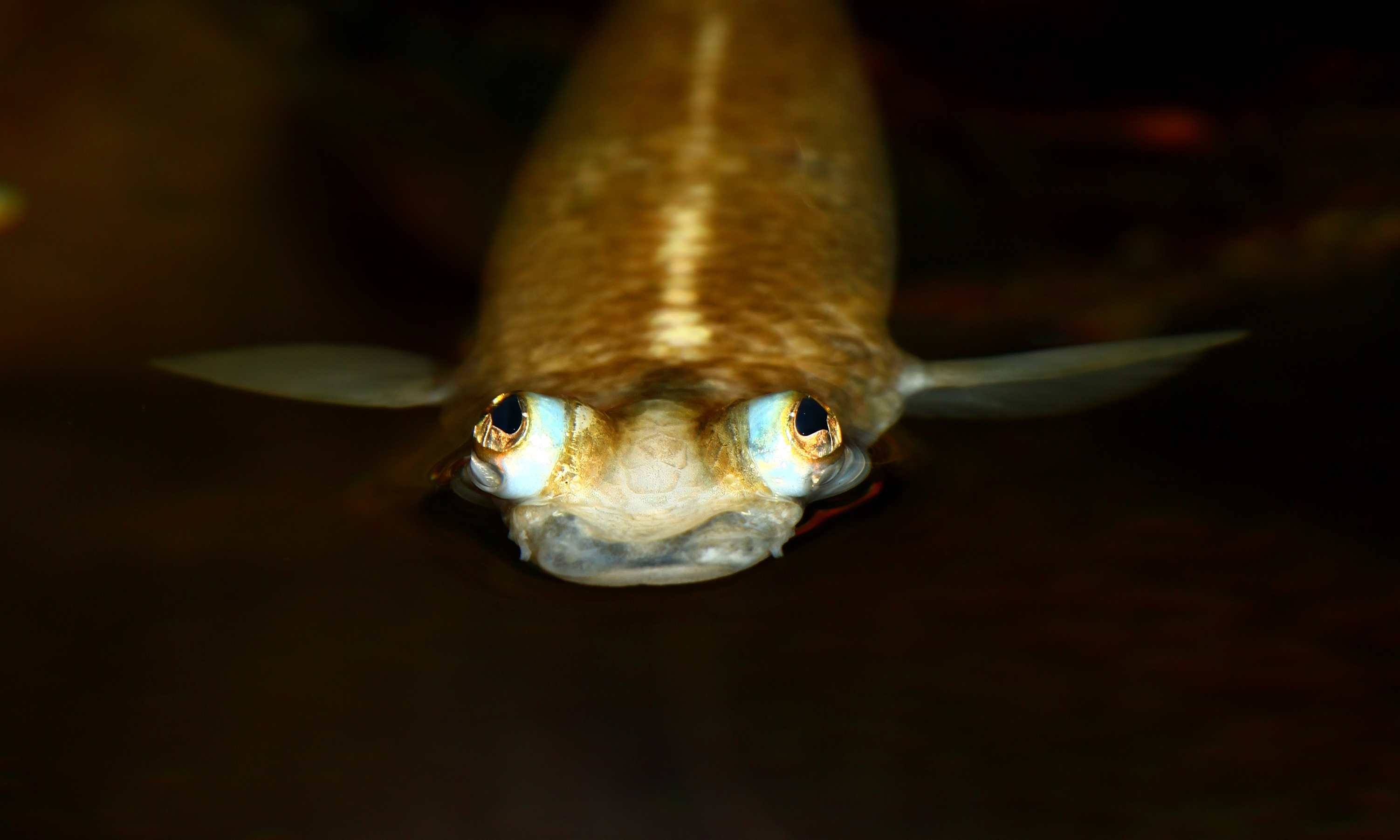

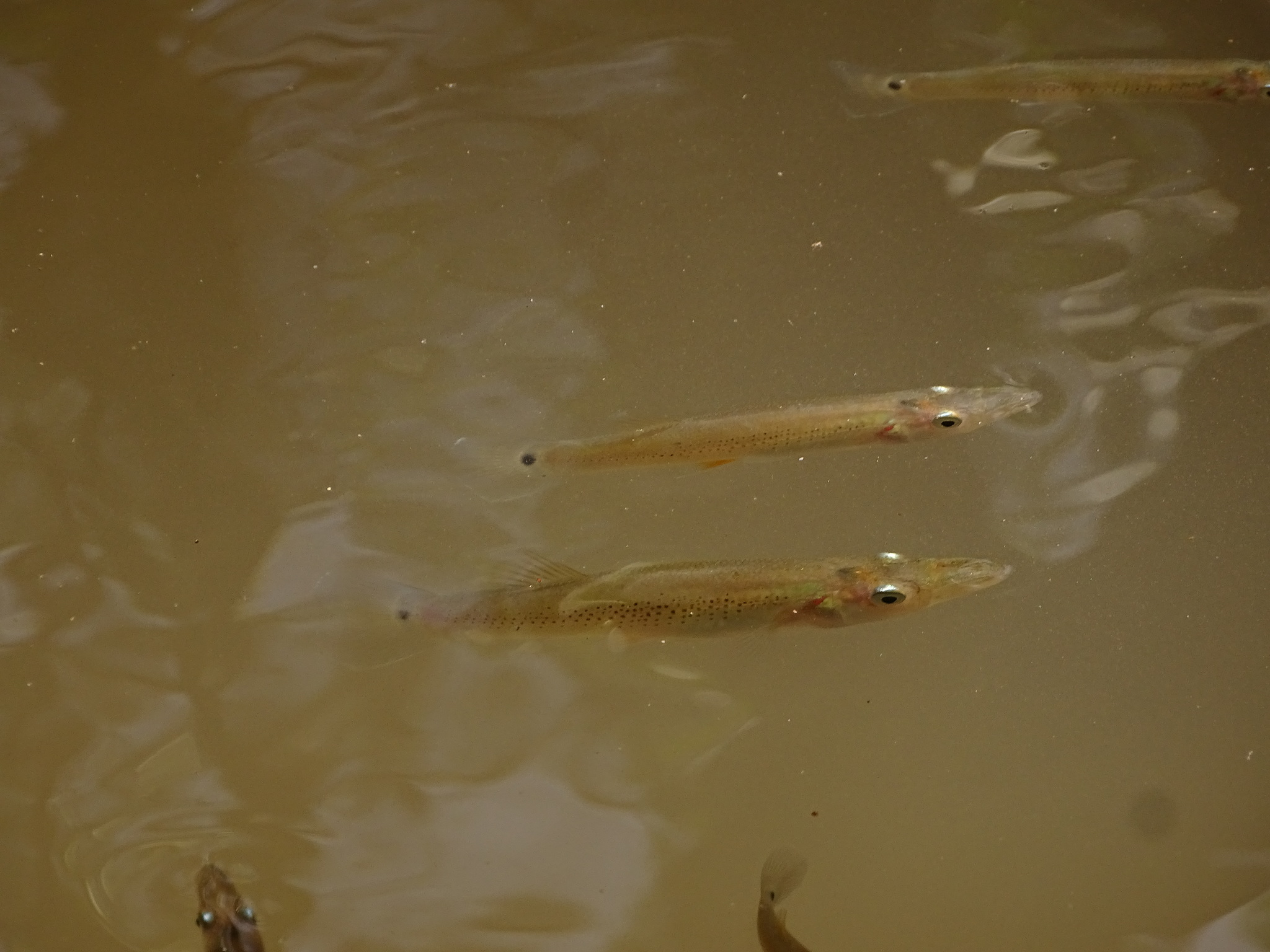
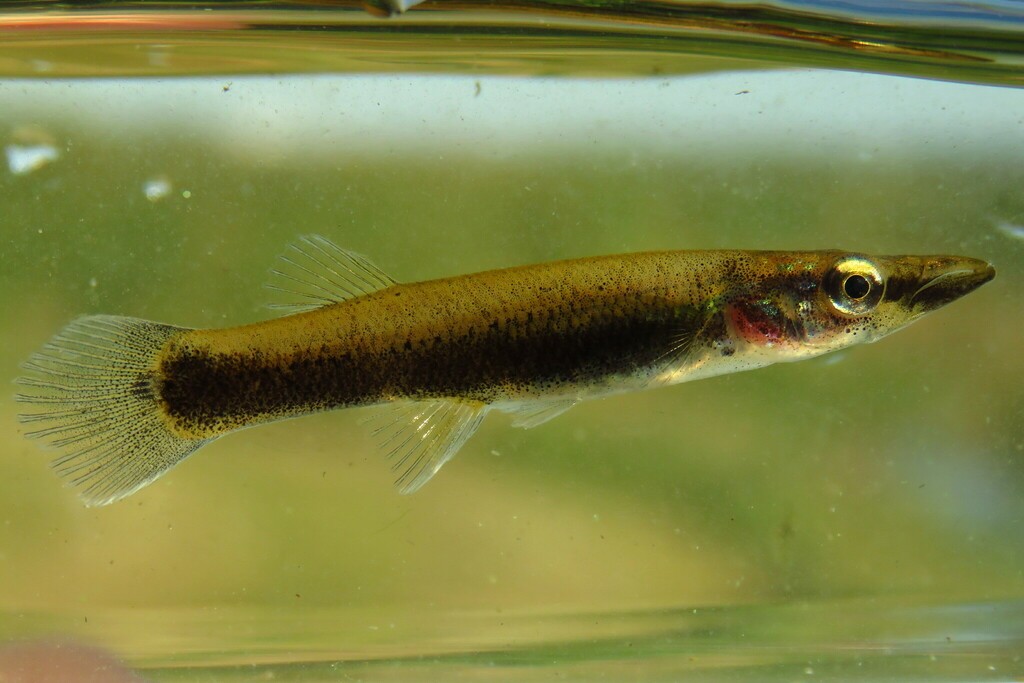

At least some other fish species (in the Order Cyprinodontiformes) which spend a lot of time at the water surface appear to have reflective white material on the upper portion of the eyes. However, in these species this trait doesn’t appear to be as well developed as in the distinctive white-eye fish (Oxyzygonectes dovii). Photo credits given in individual photo captions (click to enlarge and view).
One way to more formally test the sensory hypothesis would be to conduct a phylogenetic comparative analysis across fish species. This is just a fancy way of statistically testing for an association between habitat and presence of white eyes across a large sample of fish species. To conduct this analysis would entail first assembling a species-level data set. Specifically, you would score each fish species in the group being studied for white eyes (yes/no), water column usage (surface/below), habitat (open/closed), and perhaps schooling behavior (yes/no). You would combine this data set with an evolutionary tree containing these same species (in order to properly account for the fact that species are not independent data points but instead hierarchically related to each other as depicted in an evolutionary tree). Finally, you would implement a statistical test. The sensory hypothesis would predict a significant association between white eyes, open habitat, and surface-dwelling (as these last two variables are proxies for bright light environments).
 Reason and Nature