Amphibians are generally small, soft, and many bigger predators like to eat them. A few groups have evolved chemical defenses which make them toxic and therefore unpalatable to predators. One such group is the toads (family Bufonidae).
Herping (verb): the act of searching for amphibians and reptiles.
Several weeks ago, in the Everglades, I decided to go herping by slowly driving a dirt road at night to see what amphibians and reptiles might be afoot. There were actually several other people doing the same thing. I saw several different species.

The dirt road, pictured at sunrise.
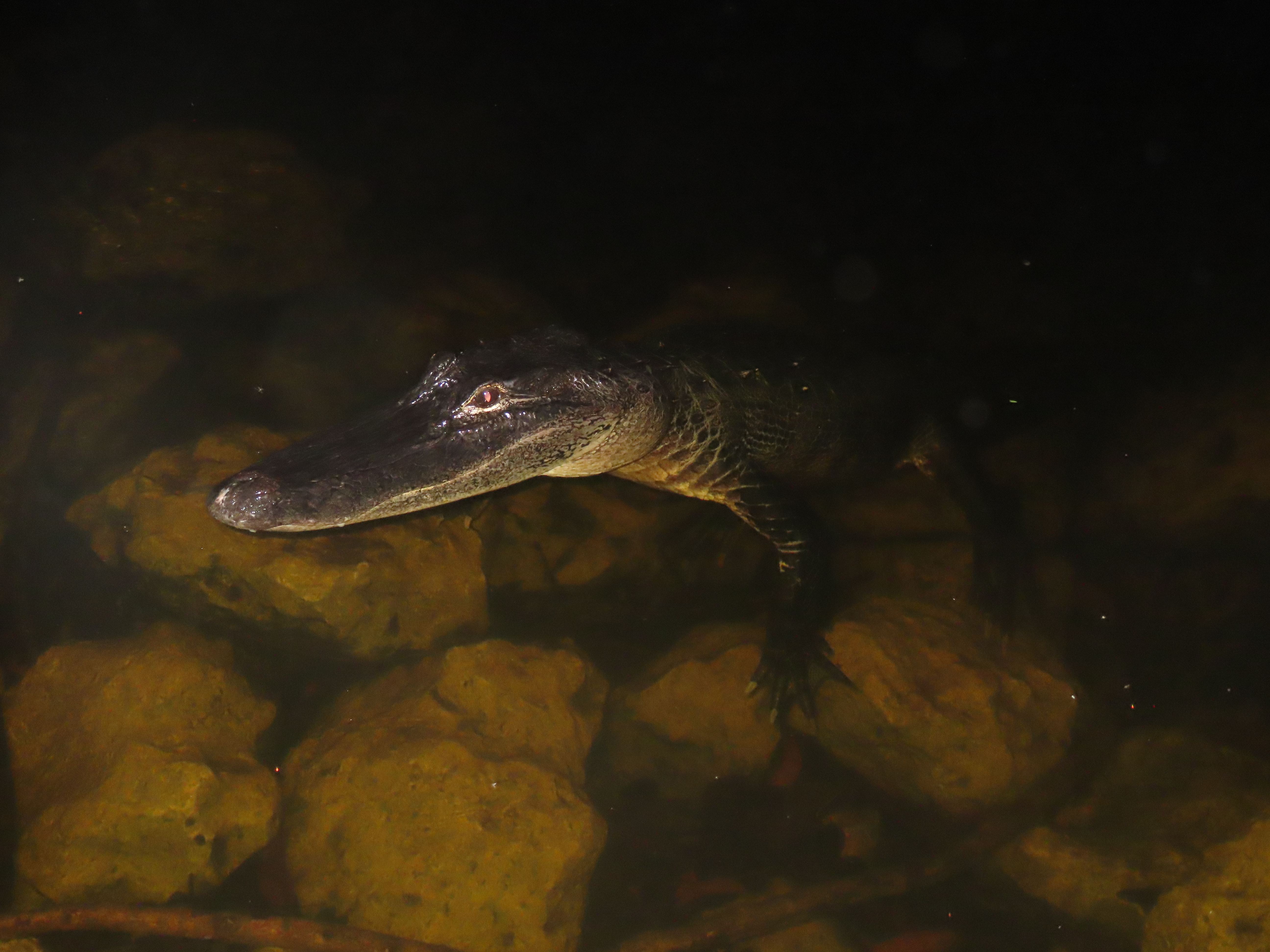
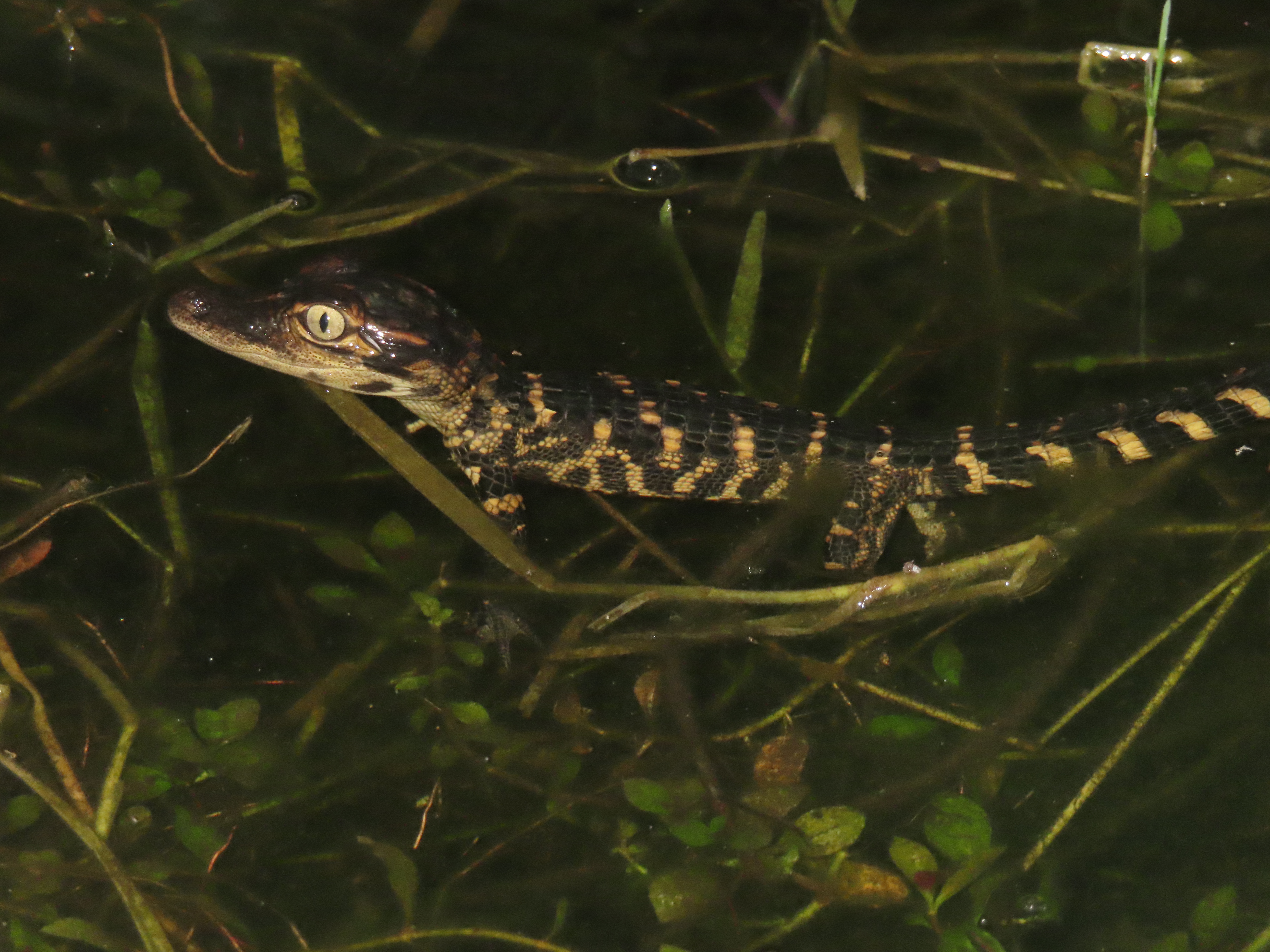
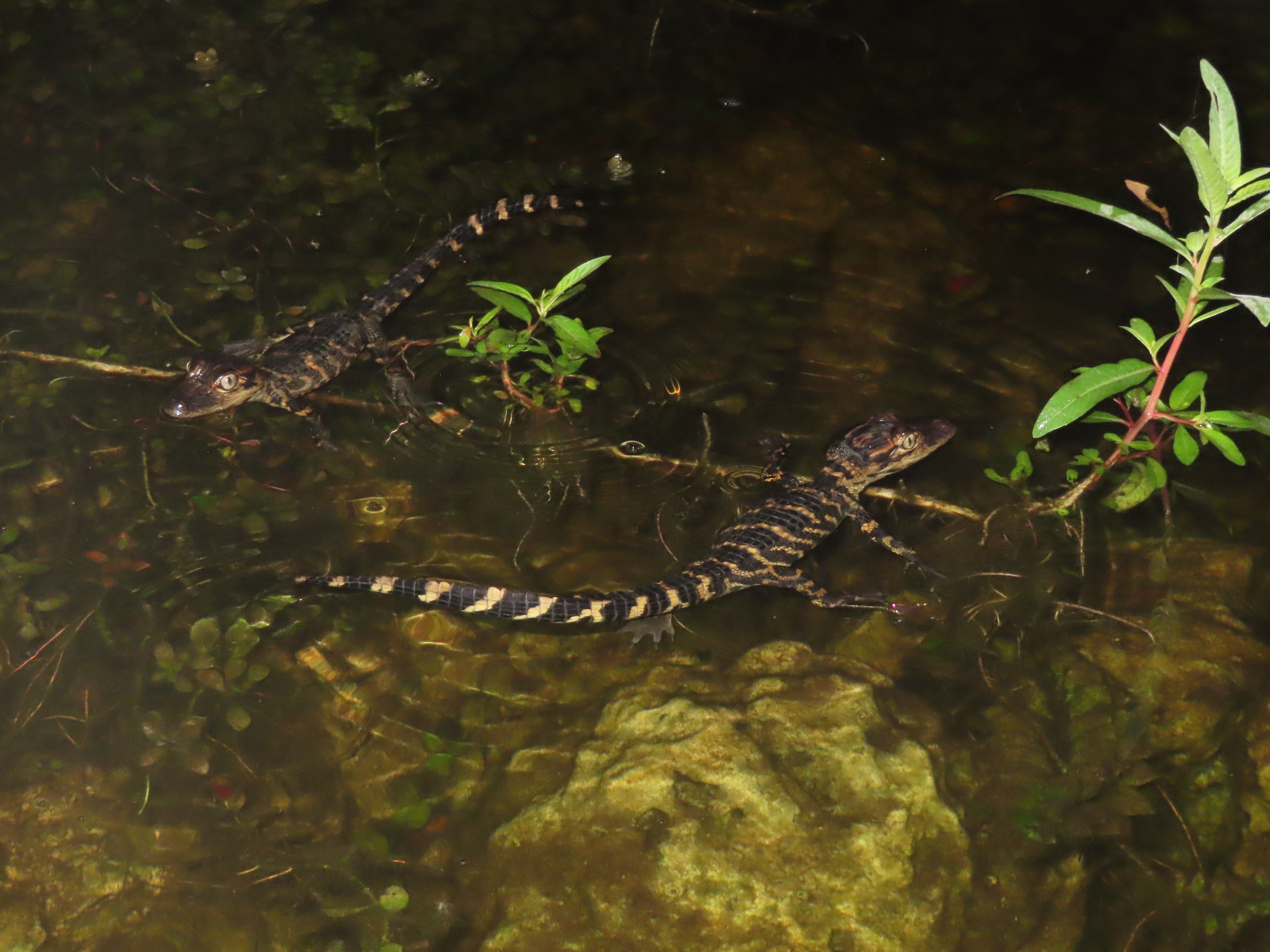
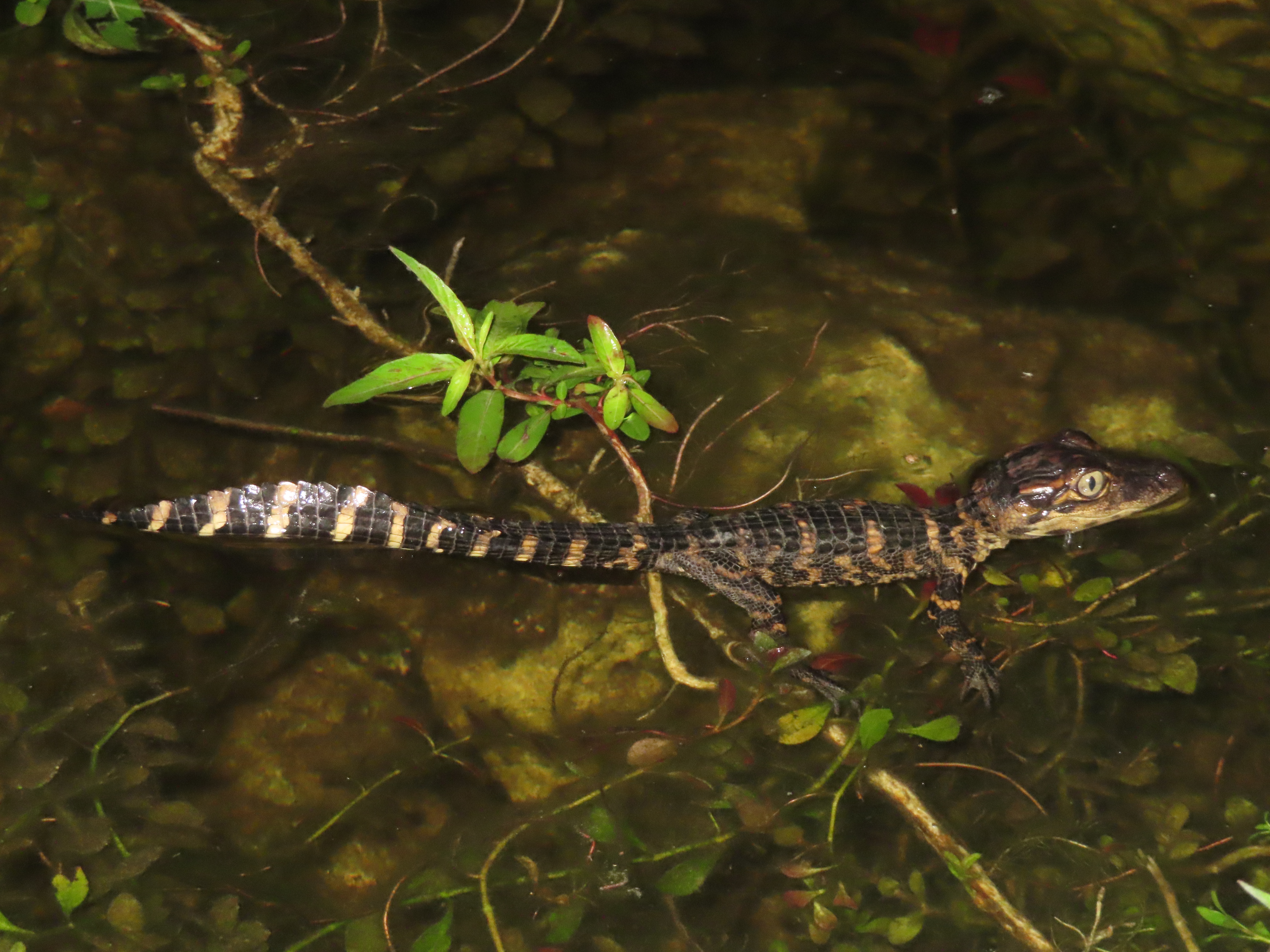
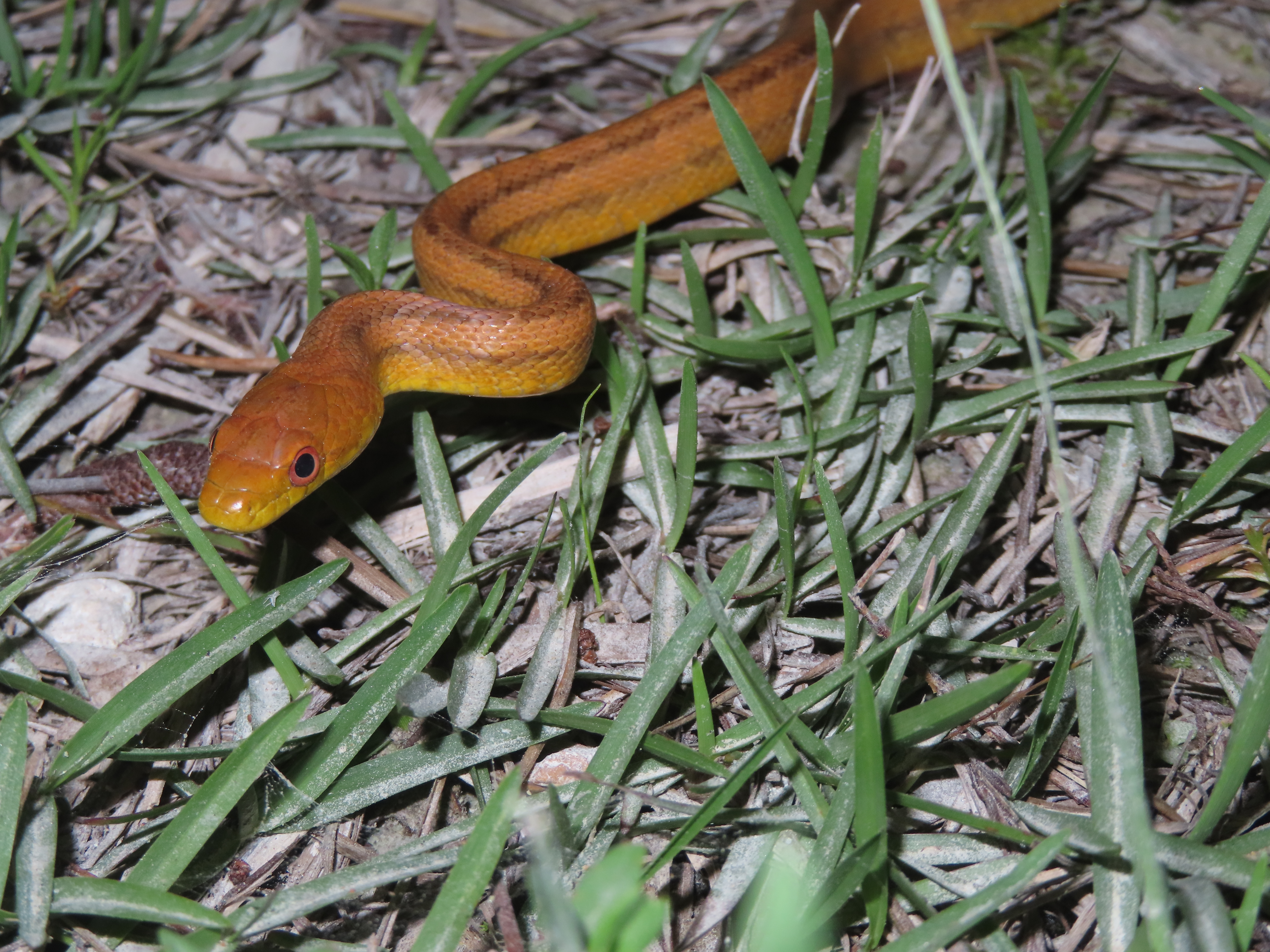
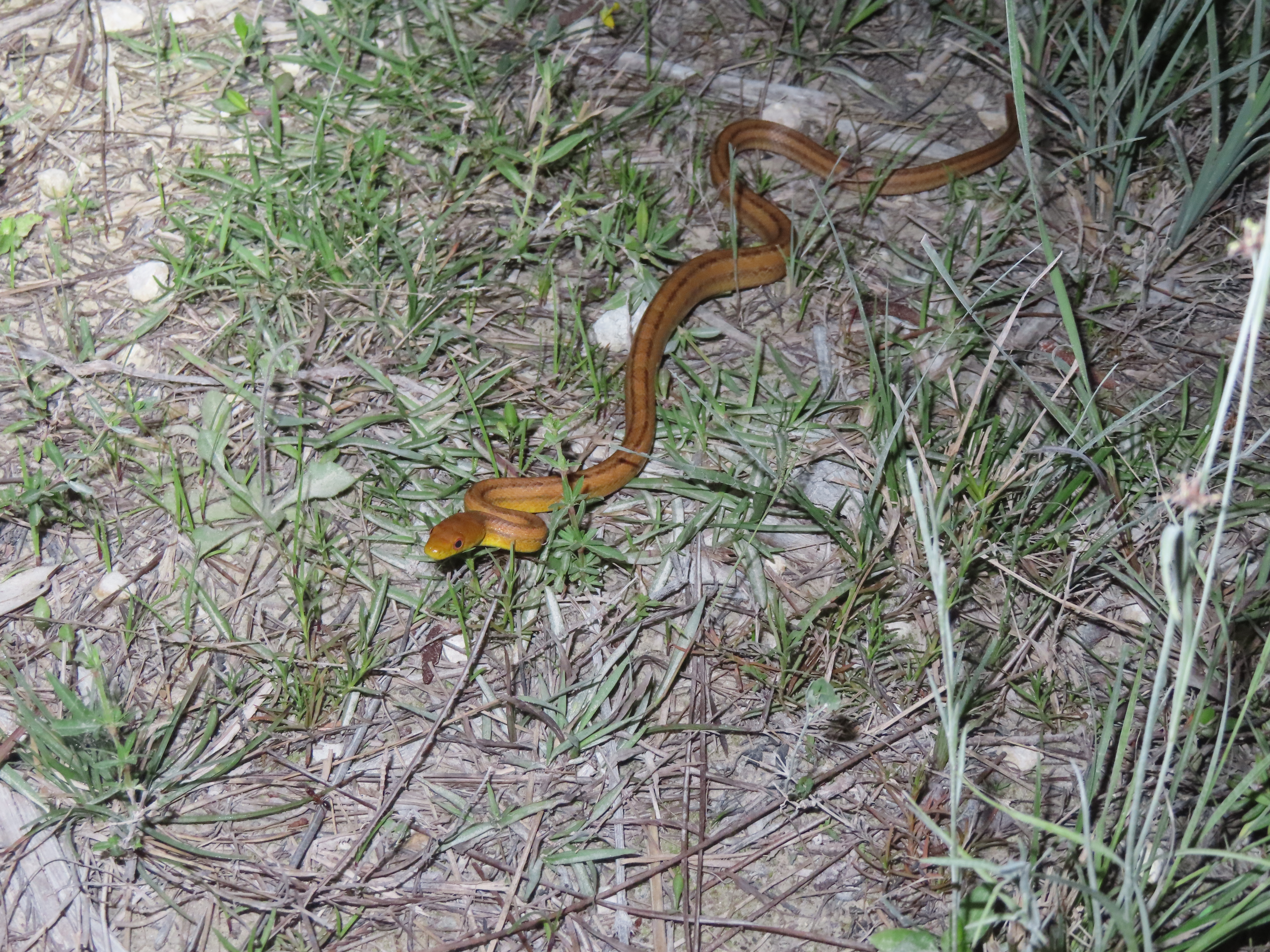
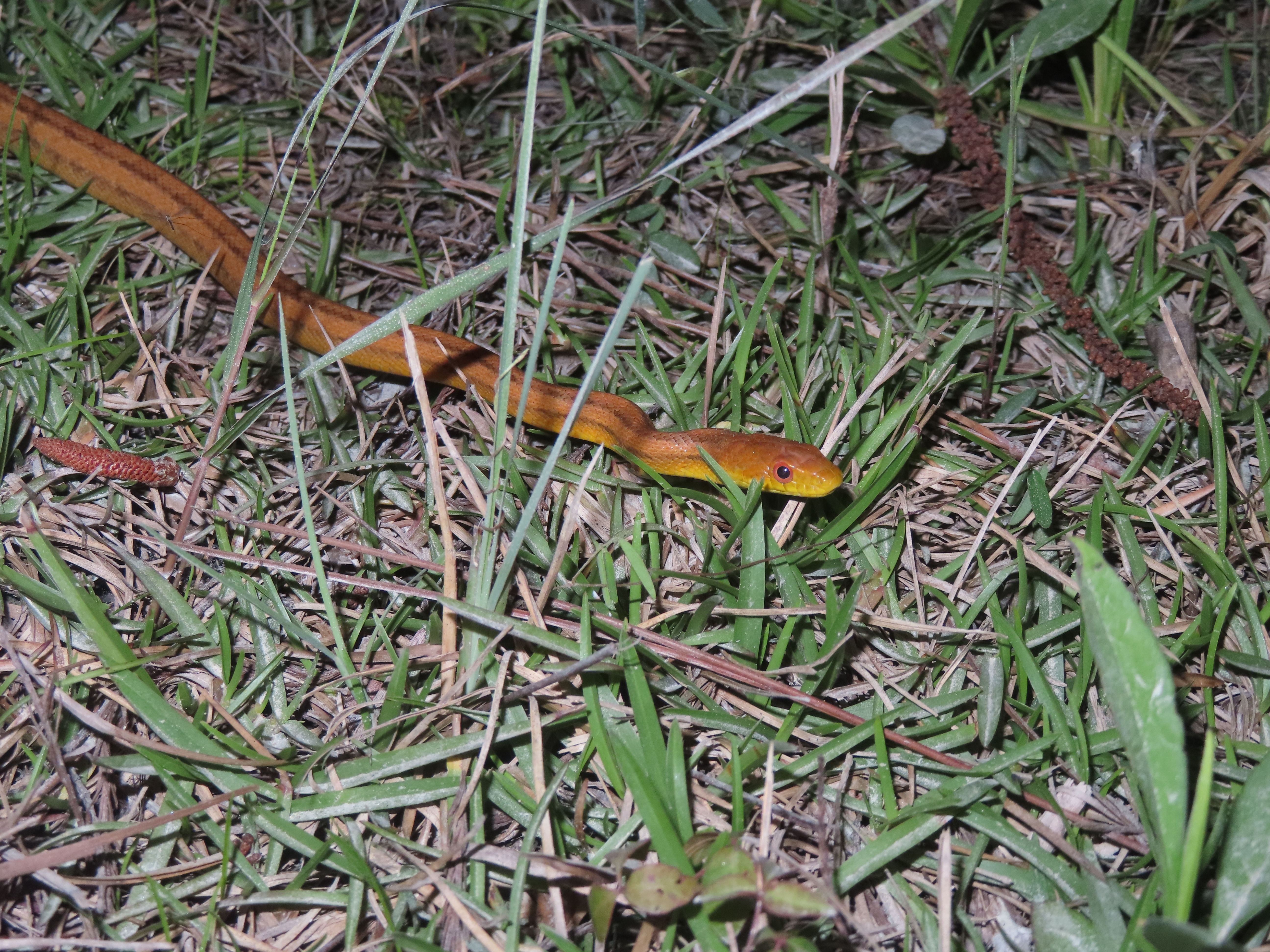
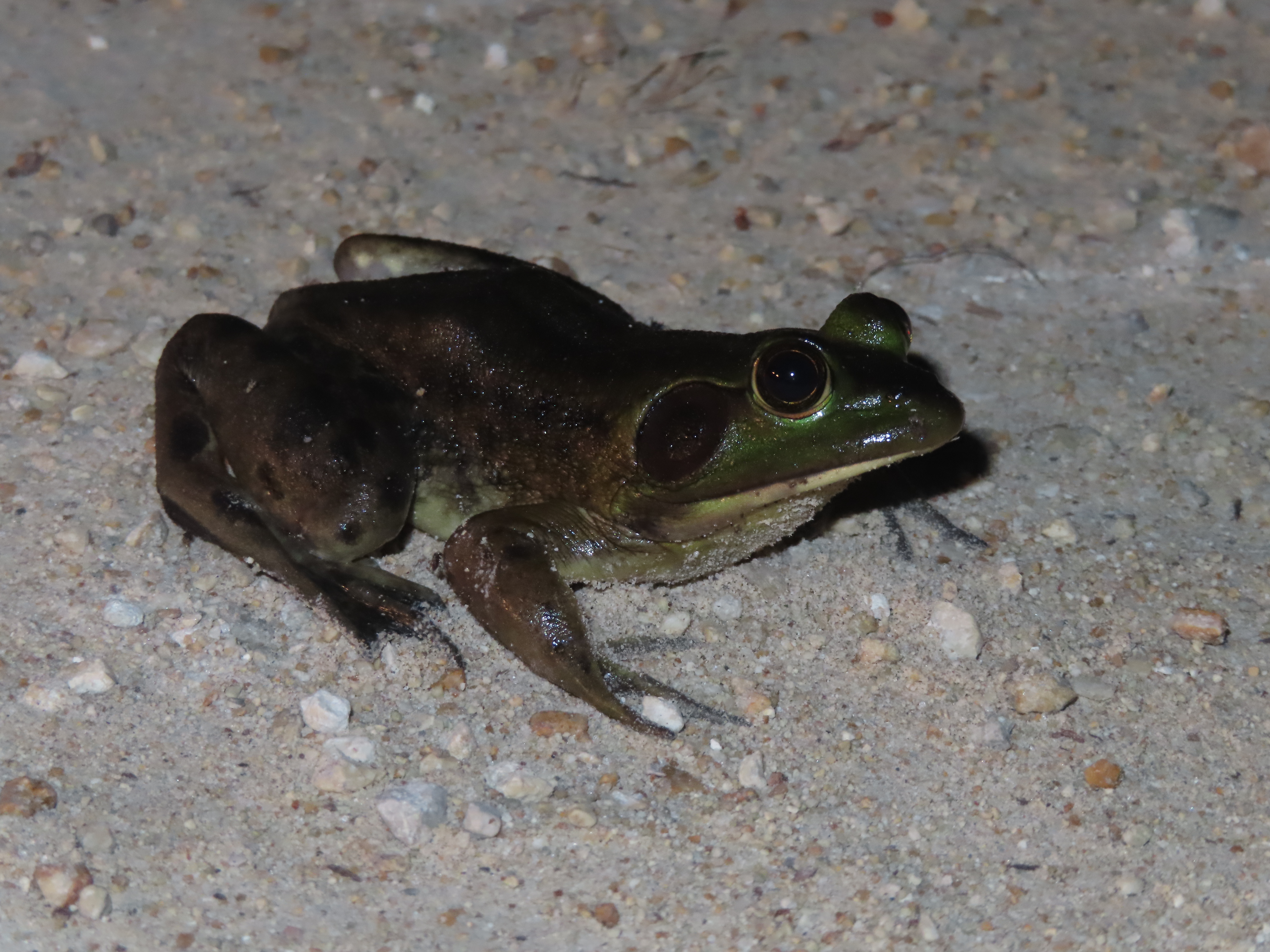
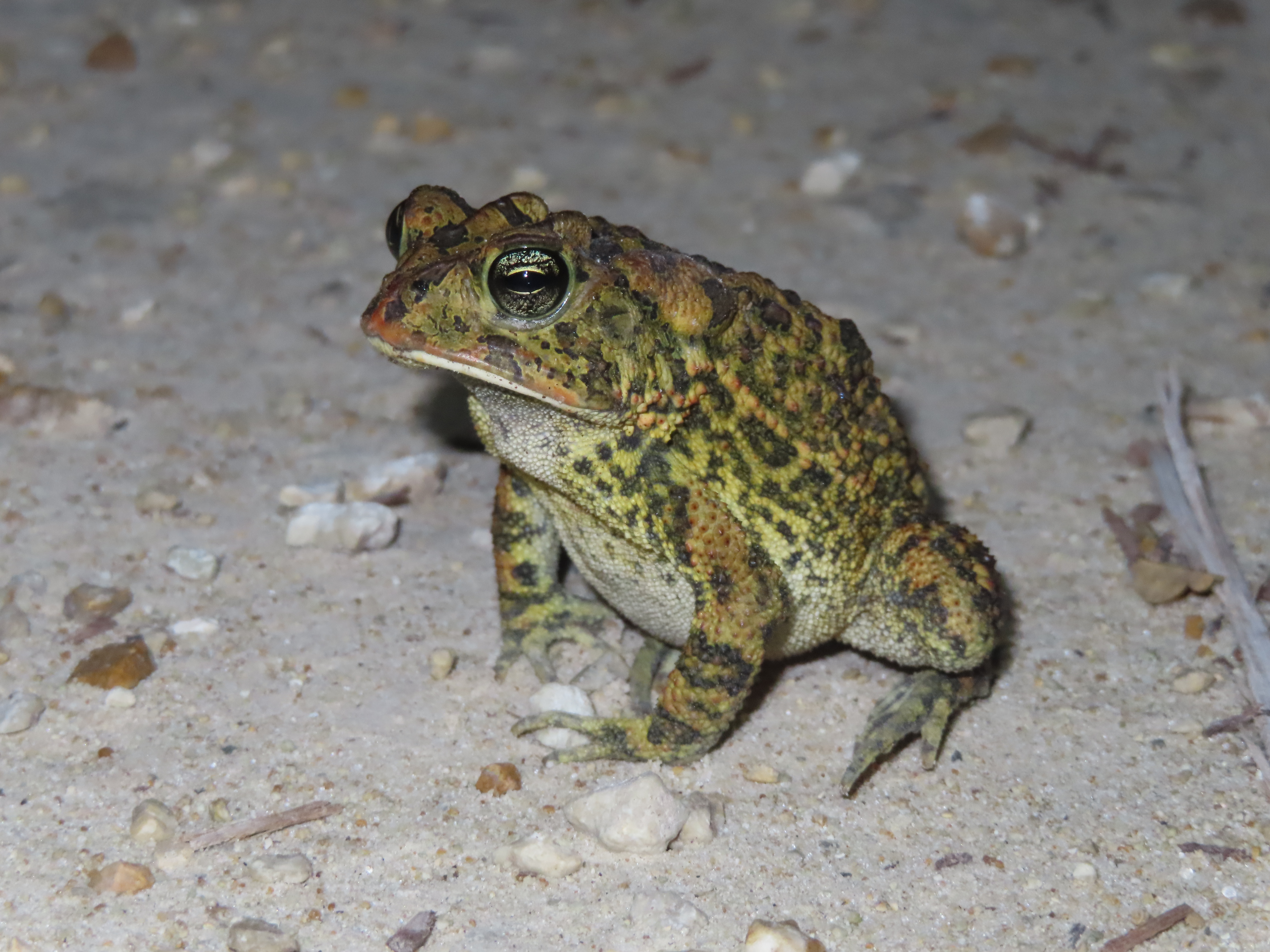
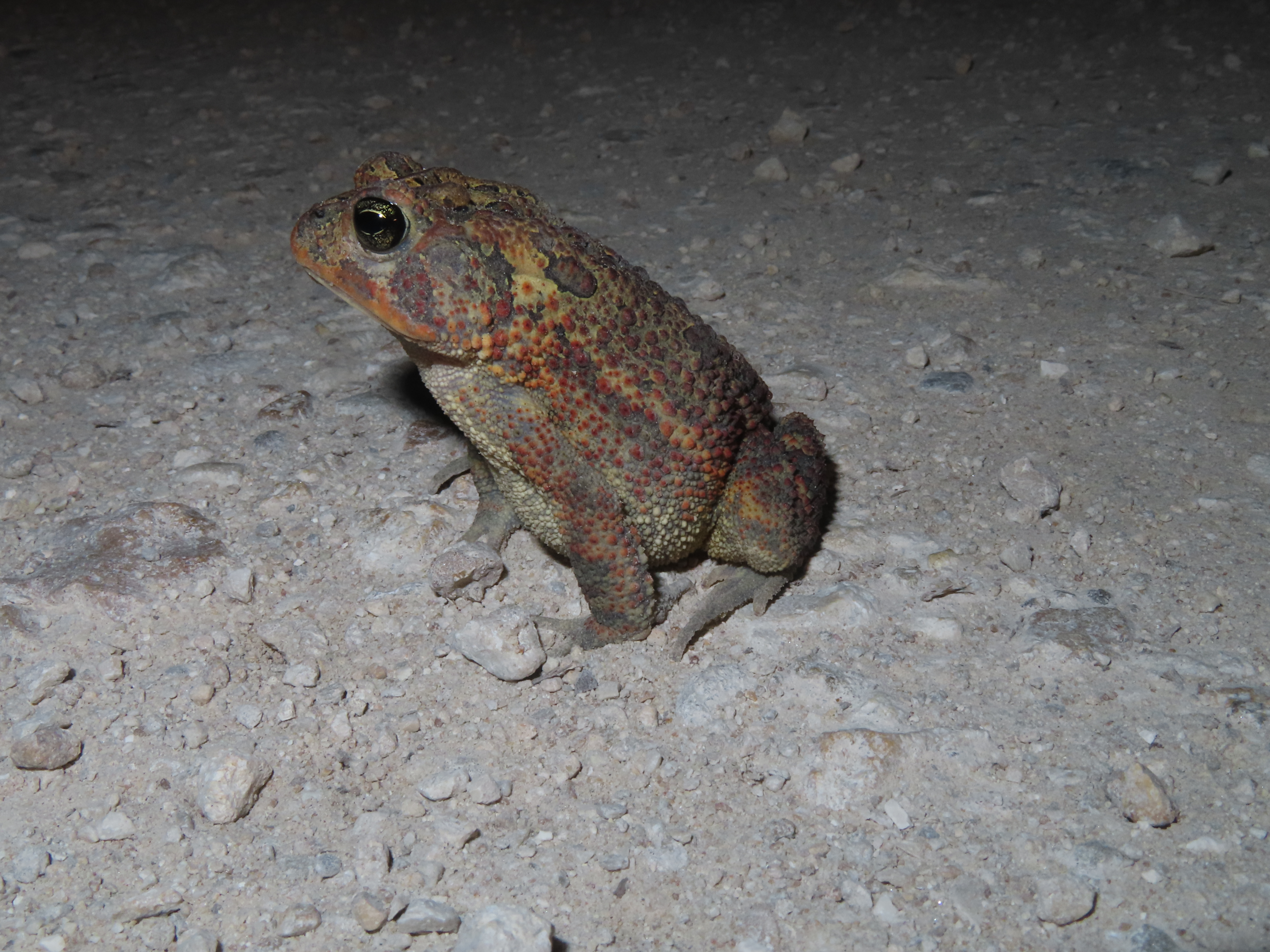
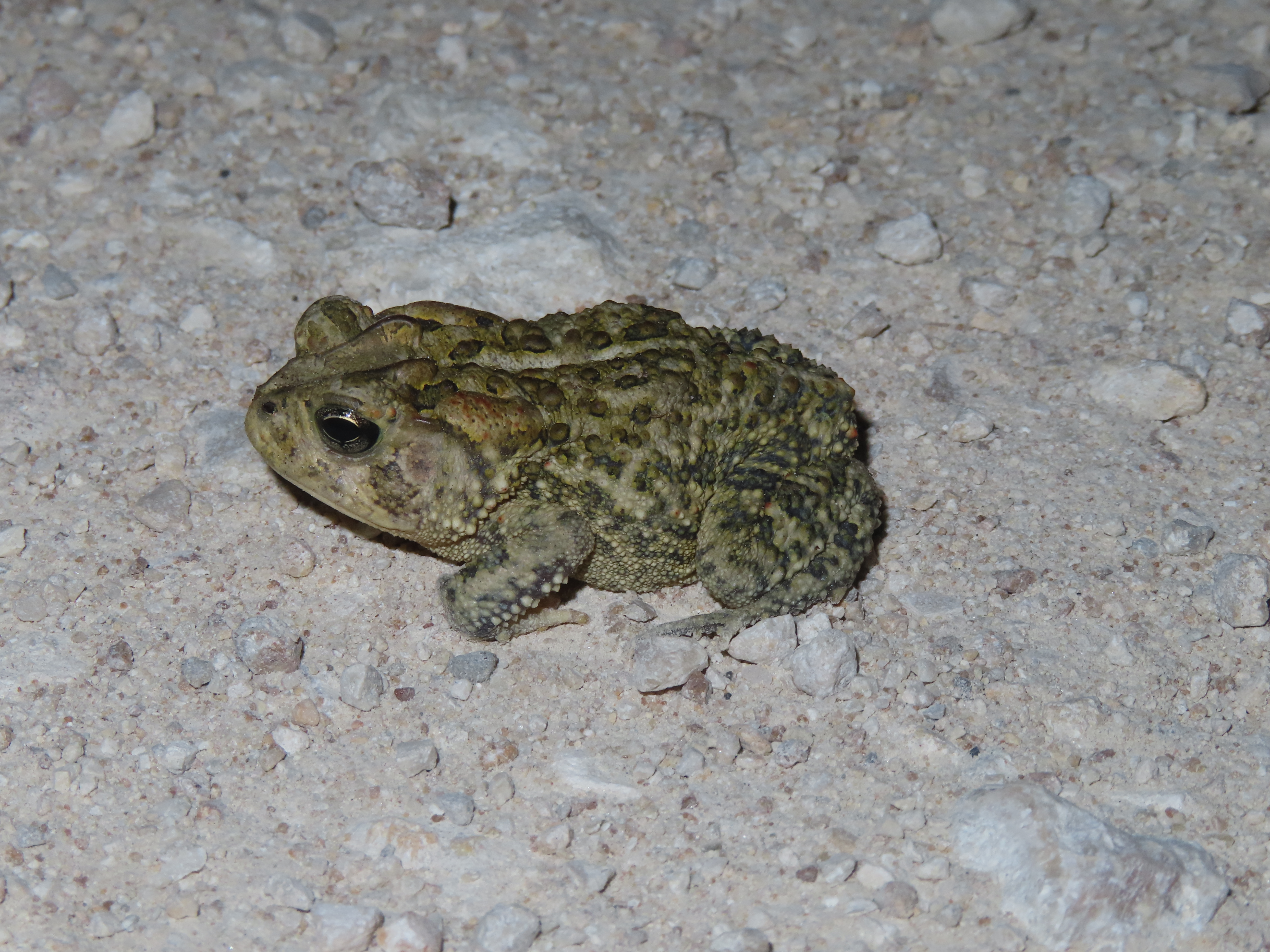
Species observed on or adjacent to the road included numerous American alligators (Alligator mississippiensis) including juveniles, a Yellow rat snake (Pantherophis alleghaniensis) , a Pig frog (Lithobates grylio), and several Southern toads (Anaxyrus terrestris). Click to enlarge photos.
Near the end of the night, a bug – probably a gnat – flew into my eye, likely attracted to the headlamp I was wearing. I instinctively rubbed my eye. My eye then began to be really irritated and was watering uncontrollably. I thought it was from the bug, or maybe I had scratched it with the rub. I was camping and soon retired for the night. The next morning my eye was quite swollen. This is something which had never happened before from a bug. I immediately rinsed my eye with water and took two Benadryl. I began thinking about what could have caused this and remembered that I had briefly held a toad, probably for not more than 10 seconds, and then an hour later I had rubbed my eye. I am now fairly certain that the brief rubbing of my eye must have introduced some latent toad toxin that was on my hand. Over the course of the day my eye became less swollen, and within 48 hours it was back to normal.
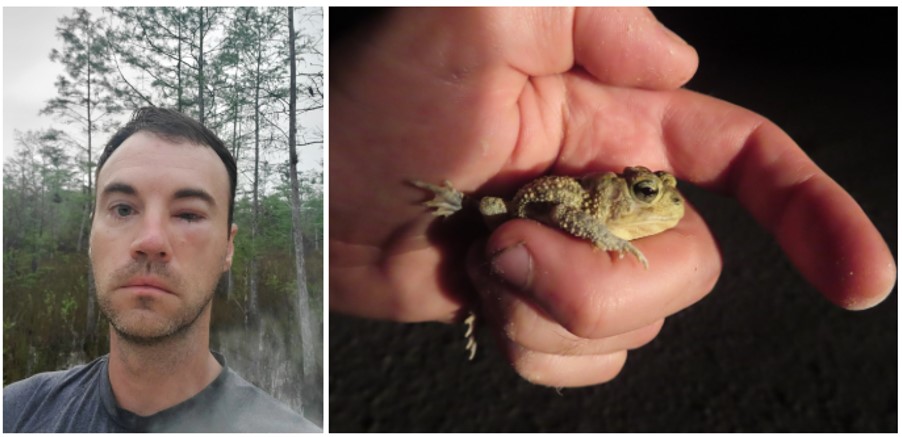
Me with swollen eye, pictured in the morning, and a picture of the culprit from the night before.
I managed to find two articles on ocular toxicity in toads. They are written by the attending physician and describe a similar situation to what I describe above. A patient presents with eye irritation after somehow coming into contact with toad toxin. They end up fine. The part I found most interesting in the articles is the explanation of how the patient got toad toxin into their eye in the first place.
From the article ‘Ocular Toxicity Caused by Toad Venom’
“A previously healthy 31-year-old man came to the emergency unit suffering from acute burning pain, photophobia, and blurred vision in both eyes. He explained that, an hour before, while he was handling a toad (Bufo bufo), the specimen ejected a liquid from its back that splashed on the patient’s face and made him rub his eyes. Immediately afterward, the symptoms appeared.”
I have handled plenty of toads and never had one eject a liquid from its back. I also was unable to find any other information on this phenomenon. To me this explanation sounds a bit suspect.
From the article ‘Ocular Hypotonia and Transient Decrease of Vision as a Consequence of Exposure to a Common Toad Poison‘
“A 67-year-old female patient was admitted to the emergency service because of sudden vision loss and a burning sensation in both eyes after she had been exposed to the poison of a common toad. The patient stated that she had been working in a garden when she noticed something moving under a cabbage leaf. She found a frog under the leaf, got scared, and instinctively stabbed the frog with a knife that she had in her hand. Right after she stabbed the frog, she got a spray of aerosol from the frog’s skin on her face. She immediately felt a burning sensation in her eyes and eyelids, ran away to a washroom, and washed her face with a tap water. She noticed that her eyes were red and that her vision was very blurry.”
I guess the lesson is don’t stab toads (or any herps).
It is common knowledge that toads are toxic. Much of the information available on the internet is geared toward warning pet owners how toads are toxic to dogs who bite or eat them. The first symptom of toad poisoning in dogs is foaming at the mouth. Although all toads apparently produce and excrete toxins from glands on their back (particularly the parotoid gland), the two largest toad species, the Cane toad and the Sonoran desert toad, are the most dangerous because they contain the most toxin. Introduced cane toads are toxic to Australia’s toad-naïve wildlife. Cane toads are a very large species of toad, native to the neotropics. They were introduced to Australia in 1935. They have also, more recently, been introduced to Florida. The effect of toad toxin on different species is highly variable. A review of the effects of Cane toads on Australian wildlife found that some animals such as many birds and rodents have a greater physiological ability to tolerate the toad toxin; other species, for which they are highly toxic, learn to avoid consuming them. There are even specialized toad predators that have evolved resistance to their toxin. In North America, one such species is the Eastern hognose snake.
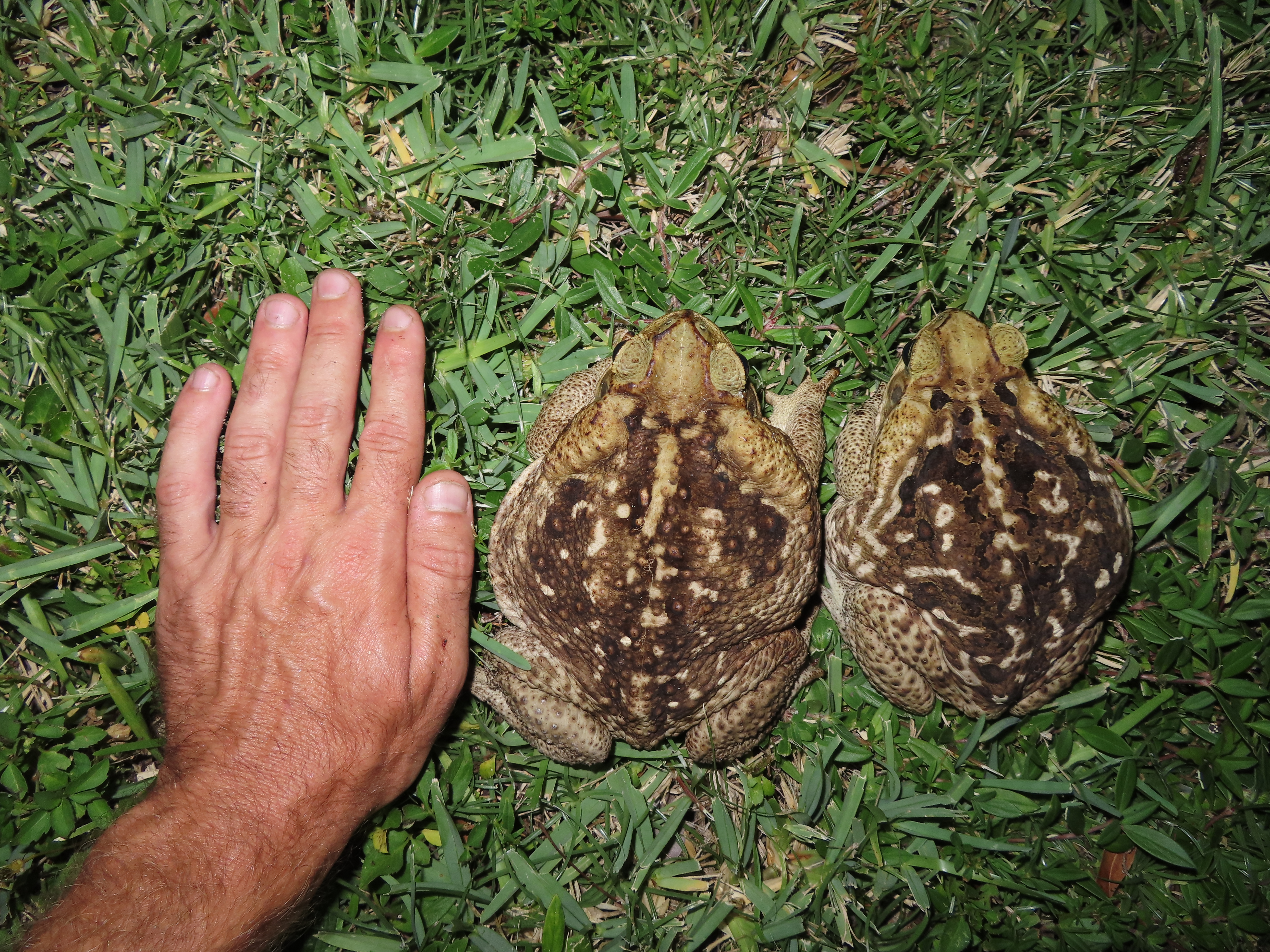
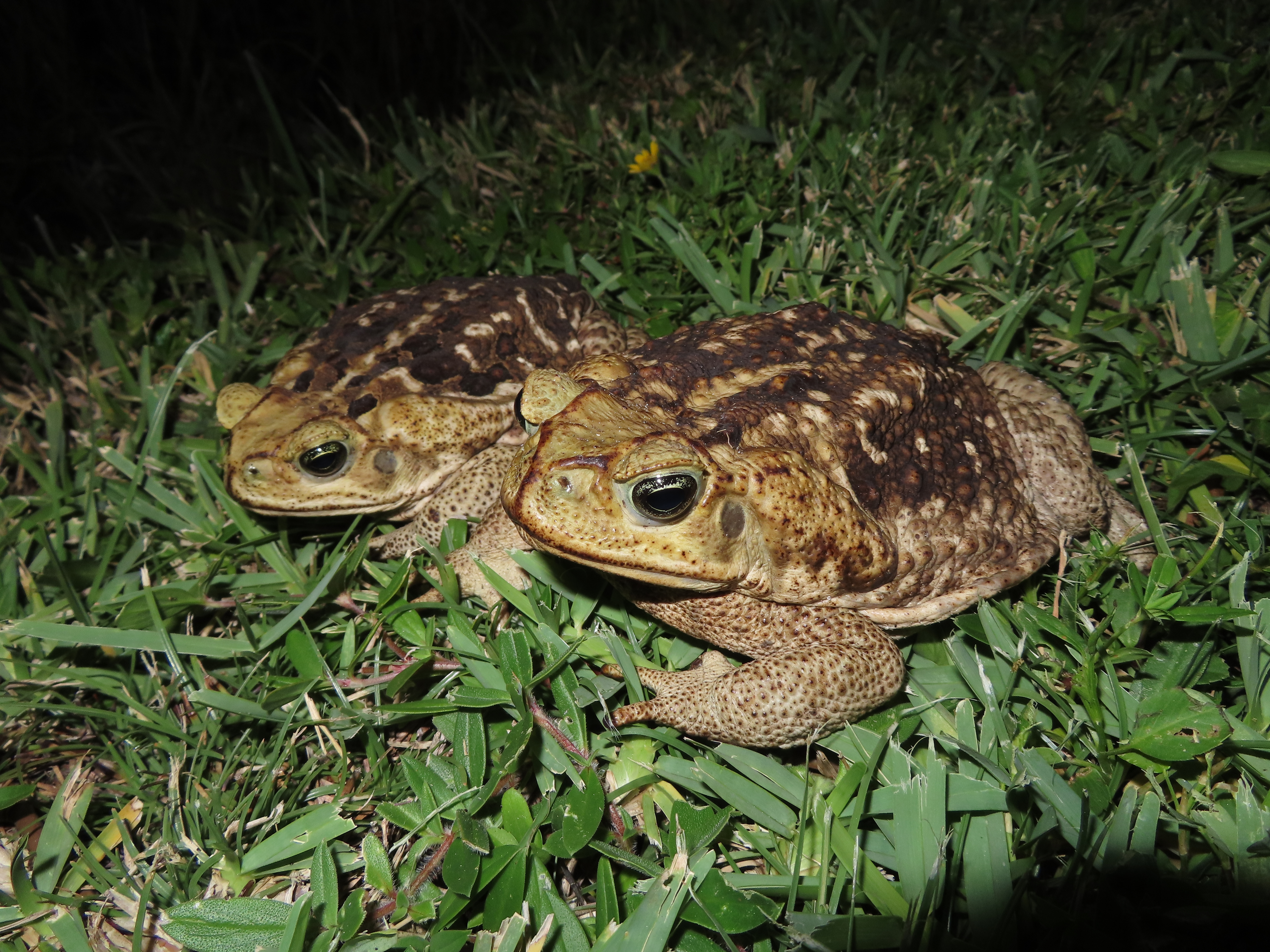
Cane toads (Rhinella marina) in Florida.
The Sonoran desert toad (Incilius alvarius) produces a psychedelic toxin. How this was first found out is rather interesting, as described in a recent news article. “Pharmacologists had known the Sonoran desert toad could make 5-MeO-DMT, but it wasn’t until 1983 that Ken Nelson, a reclusive artist who lived in a decommissioned missile base in North Texas, drove to the Sonoran desert, milked a toad, dried the poison on his van’s windshield and smoked it. A pamphlet he wrote under the pseudonym Albert Most then circulated in the underground scene of psychedelic enthusiasts.” The popularity of this toad hallucinogen is growing and people such as Mike Tyson and Hunter Biden both claim to have smoked toad. Finally, there is promise that some of the toxins from toads may have useful pharmacological properties for the treatment of certain diseases.

Toad tadpoles are very conspicuous. They are jet black, which stands out against almost any natural background, as illustrated in the below photograph. They also school together in a single large mass, which increases their visibility even further. This may be a case of aposematism – where animals advertise their toxicity with bright warning coloration. In perhaps the oddest scientific paper I have seen, scientists working in Costa Rica ate and rated the taste of the tadpoles of 8 different amphibian species. Cane toad tadpoles were rated as the most unpalatable, with their taste being described as bitter. The author of the paper addressed the potential criticism that ‘man is not a natural predator of tadpoles’ by pointing out that there is strong agreement in the preferences of humans and various natural egg predators when consuming the eggs of different bird species. Therefore, it may not be unreasonable to assume that the unpalatability of toad tadpoles holds for other mammalian predators and even for other groups such as birds, reptiles, and fish. There appears to be truth to this as a later study found that in an experimental treatment, fishes and newts consumed only a small percentage of common toad (Bufo bufo) tadpoles, “suggesting that bufadienolides provided protection against vertebrate predators”. However, invertebrate predators seemed to be less affected.

Finally, the toad features prominently in folklore. One tale is that touching a toad will give you warts. This obviously isn’t true but it contains a kernel of truth, in that toads are toxic. And I now have firsthand experience of this!
 Reason and Nature