Magnet fishing consists of throwing or dropping a magnet attached to a rope into a waterbody in search of metal objects. I first became aware of this hobby in 2018. While visiting the Netherlands I saw two guys magnet fishing in the canals of Amsterdam. They had a small but powerful magnet attached to a rope and were tossing it into the canal then slowly retrieving it and seeing what metal they could pull up. I watched for about 10-minutes and it was interesting to see what they found. However, I hadn’t really thought about this much since then. I recently moved to Annapolis and several recent events got me thinking back to this. While walking around Baltimore’s inner harbor I saw a scooter laying on the bottom in the shallow water. This made me wonder what other items are likely to be found in these urban waters. Then, a few days later, in Annapolis, I saw a man standing on shore with a net attached to a very long pole. He was repeatedly reaching as far as he could, scooping the bottom, and then checking his net. I asked what he was doing and he said attempting to retrieve his sunglasses from the murky water after dropping them off the side of his boat. After this, I decided to get the appropriate gear and give magnet fishing a try.
The equipment

My neodymium magnet has 400 pounds of pulling force. This is the amount of force required to pull the magnet free from a steel plate when the magnet and metal have full and direct surface-to-surface contact. Before going fishing I tested out my magnet and was able to pick up a 35-pound kettle bell when it attached to the rounded handle. It is also worth noting that the magnet works only on ferromagenetic objects and thus is unable to pick up gold. I tested how the magnet worked on a number of metal household items and it picked up all tools (hammer, Leatherman, scissors) but not modern coins. The magnet had to be within about an inch in order to attract and attach to the object. In other words, it didn’t attract objects from long distances away.
Fishing location
Annapolis, the capital of Maryland, is known as the home of the U.S. Naval Academy and as ‘America’s sailing capital’. It was founded in 1649 and briefly served as the capitol of the United States in 1783-1784. It is located on the shore of the Chesapeake Bay.
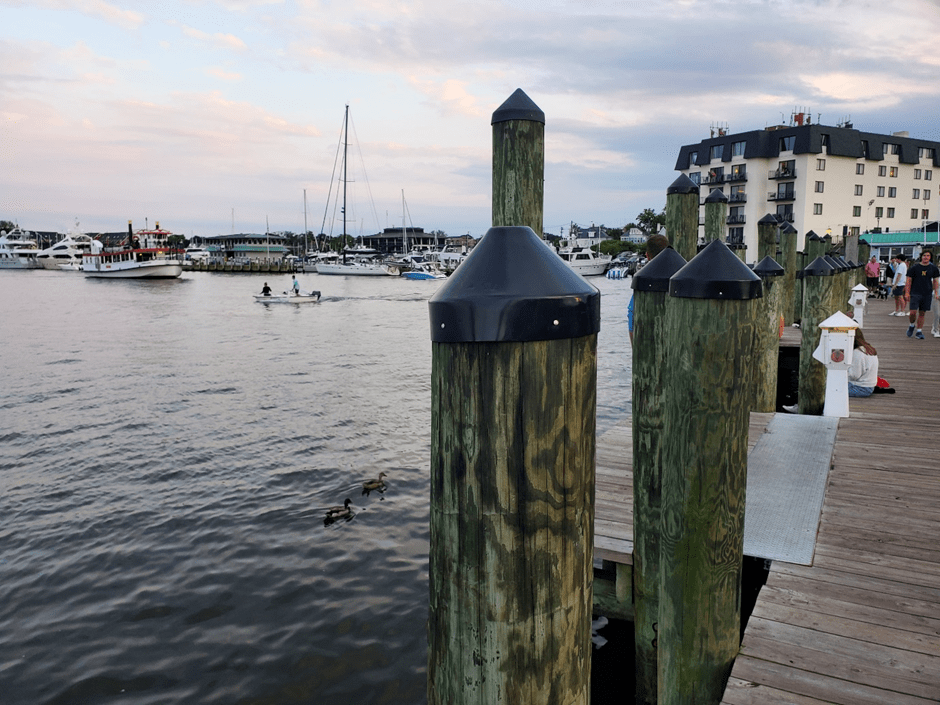
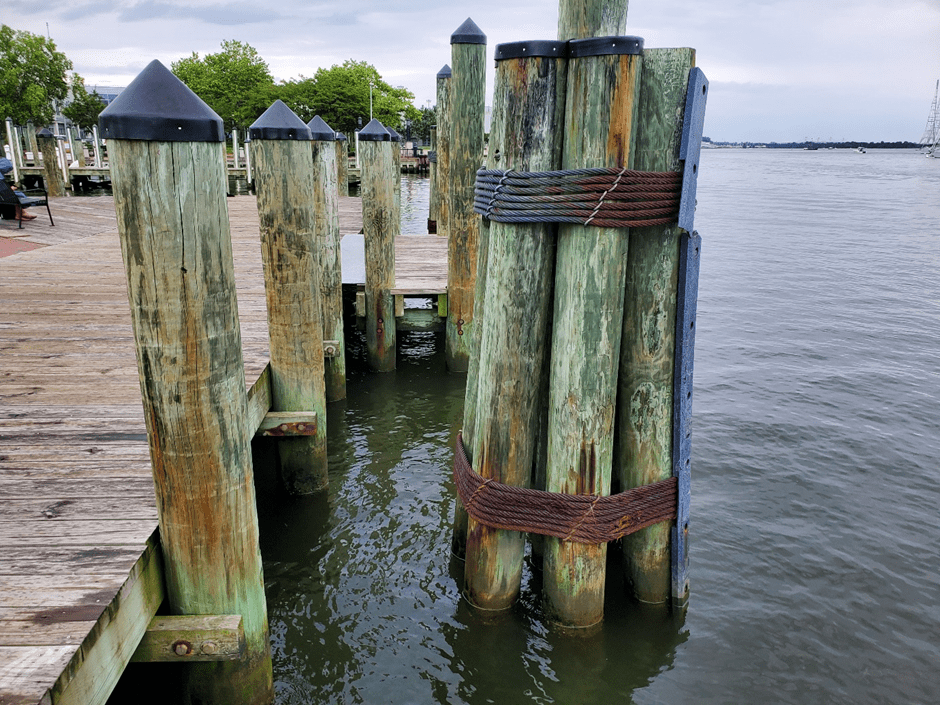
For several reasons, Annapolis city dock seemed like an ideal place to try magnet fishing. The city dock receives a lot of boat and foot traffic, especially in the warmer months. When magnet fishing, my understanding is that the more heavily trafficked the better as the only way metal objects get in the water is when humans put them there (deliberately or accidentally). Thus, there is no real advantage to going magnet fishing in pristine areas! Also, the water is murky so you cannot see the bottom, and in places it is quite deep, to allow larger boats and yachts to pass. Hence anything that is deliberately thrown into or accidentally falls into the water is likely lost.


Fishing day
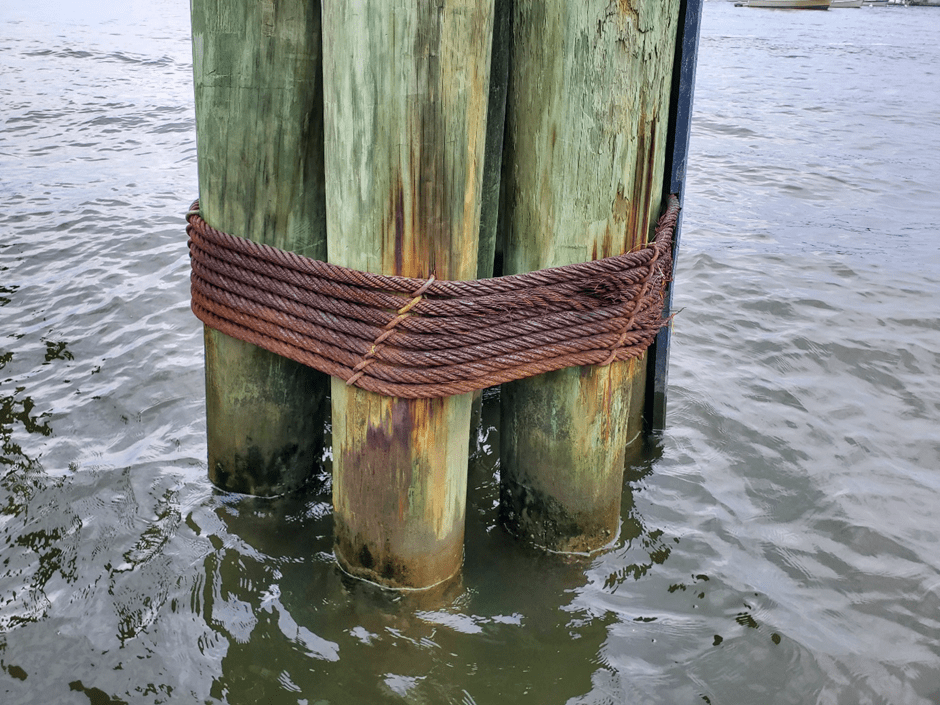
On an overcast Saturday morning in June I set out to see what treasure I could find. I went to the furthest edge of the dock to begin magnet fishing. The water was probably about 10 feet deep with visibility of at most 1 or 2 feet, hence you couldn’t come close to seeing the bottom. The techniques I used were threefold. 1) Dropping the magnet straight-down off the edge of the dock and then lifting up a few inches and feeling if I had ‘caught’ anything. If I felt as if anything was stuck to the magnet I pulled it up immediately to check. Otherwise I just lifted the magnet several inches up off the bottom, moved it several inches to the side and repeated the drop. After a few dozen short lifts and drops I pulled the magnet out of the water to check if anything small was attached. 2) Dropping the magnet straight down and then slowly walking along the edge of the dock while dragging the magnet, before pulling it up. And finally, 3) tossing the magnet outward, away from the dock, and then slowly pulling it in as it dragged along the bottom. I had read that this technique was a bit riskier than the first two in that the magnet could potentially get caught and entangled in underwater debris and become difficult to retrieve.


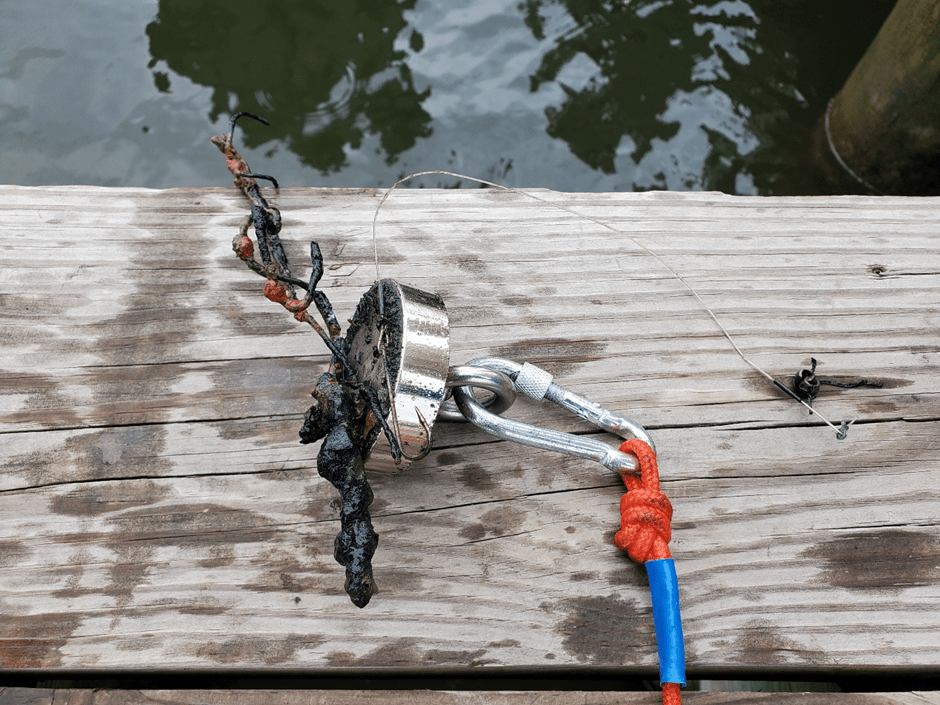

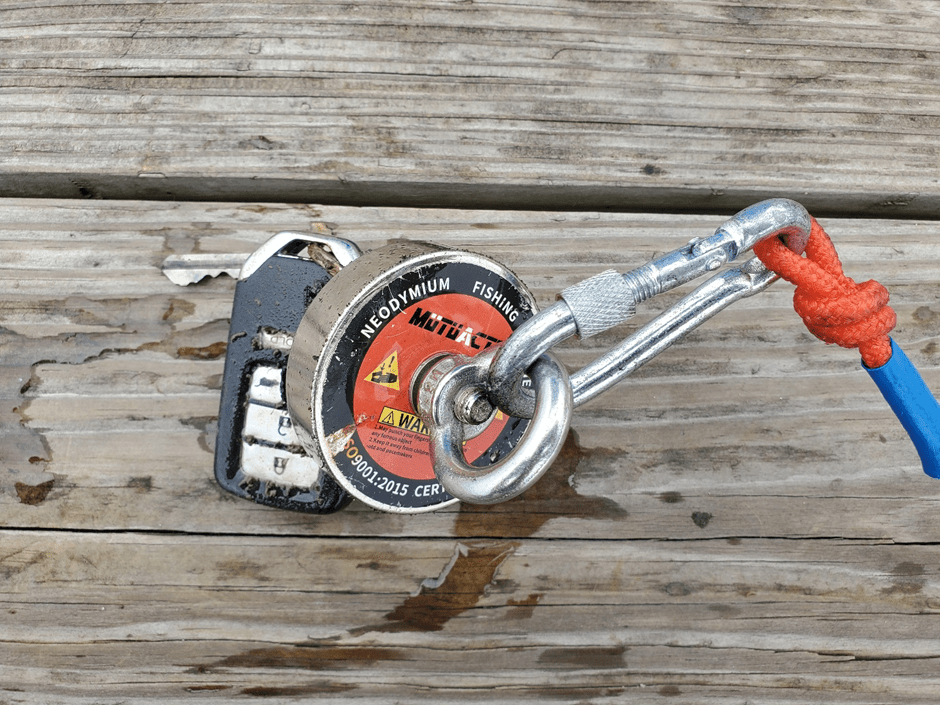
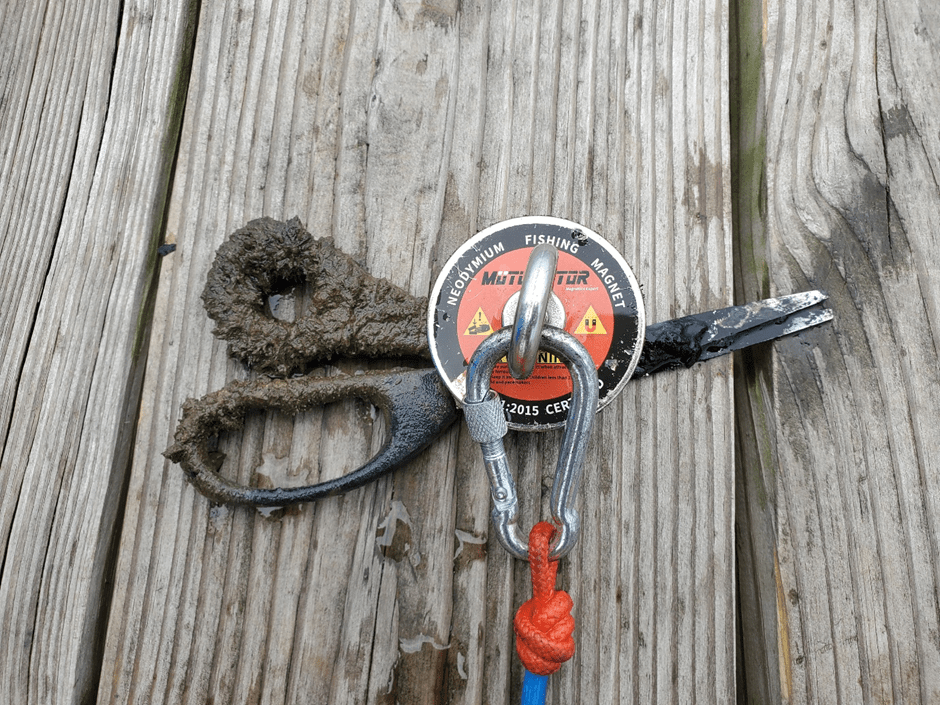
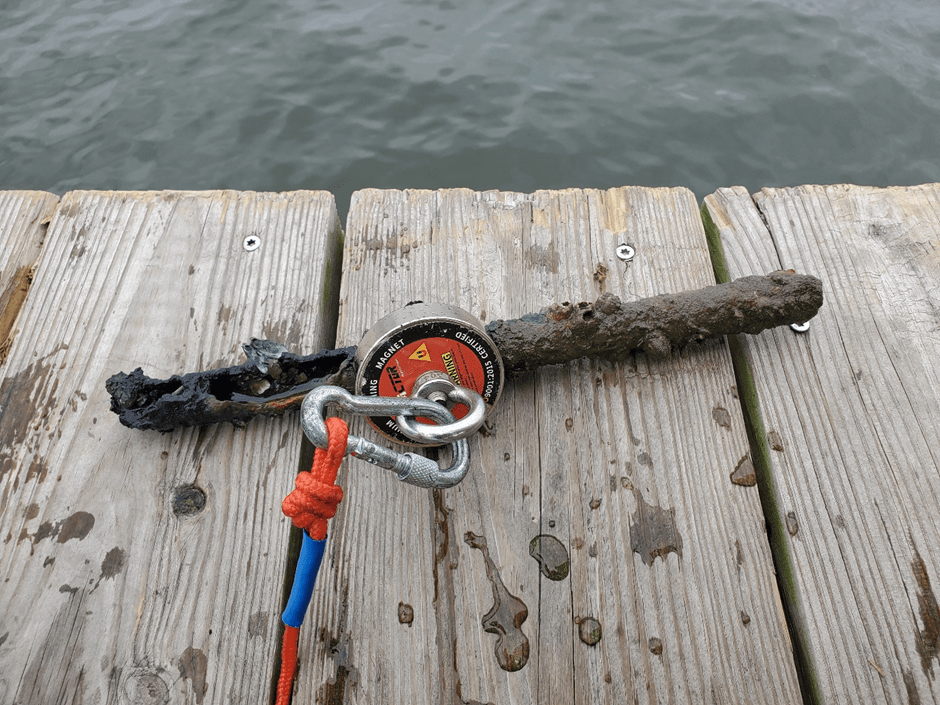
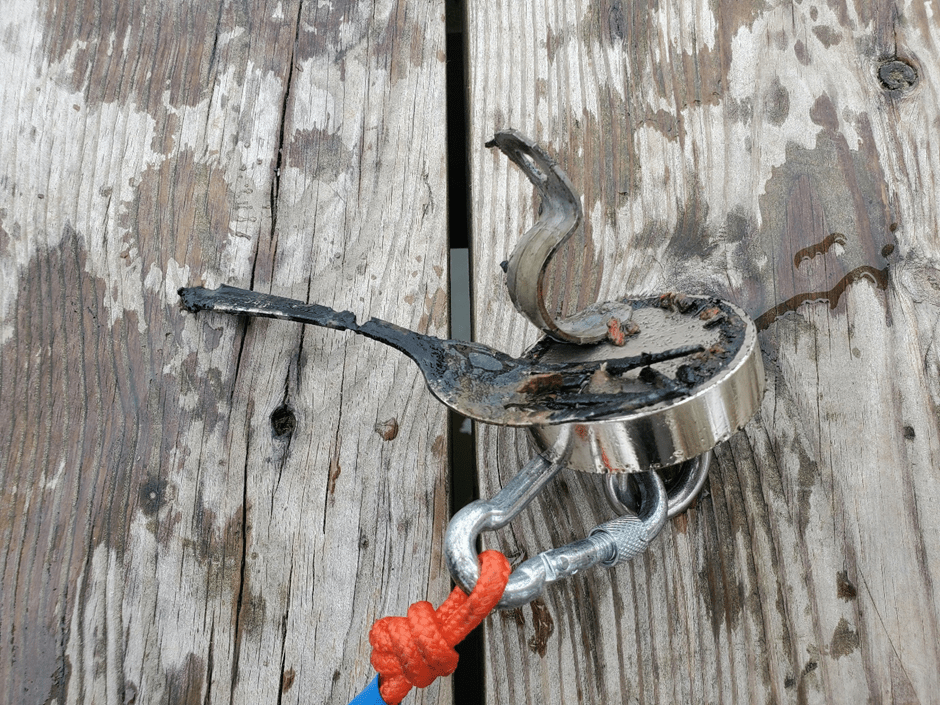
I fished for about 2.5 hours. It was overcast and even drizzling at some points. Given the weather the dock wasn’t particularly crowded, but in general people were quite interested in what I was doing and about a dozen stopped to ask if I was crabbing, if I had caught anything, or if I was magnet fishing.
About a dozen times the magnet became solidly attached to something on the bottom, but when I pulled up with increasing force it invariably broke loose. I am not sure what these items were, but they could have been something like a large pipe or beam. I have read and watched video of people retrieving objects such as bicycles, scooters, shopping carts, road signs, and boat anchors while magnet fishing. Whatever these larger items were my magnet wasn’t powerful enough to retrieve them.
I saved every piece of metal that was found so that it could be sorted and that which was not worth saving could be disposed of properly.

Overall, it was a fun day out and although I didn’t find anything that appears to be valuable, it was quite interesting to see the variety of different items found.
 Reason and Nature
That was fun to read!
LikeLike