Living reptiles include the tuatara, lizards, snakes, turtles (and tortoises), and crocodilians (see below Figure). Reptiles are primarily carnivorous (i.e. preying upon and eating other animals), with some variation amongst the different groups. The tuatara, an ancient lineage represented by a single living species endemic to New Zealand, is carnivorous. All crocodilians (24 species) are carnivorous, as are all species of snakes (~3900 species). Amongst turtles and tortoises (360 species) and lizards (~6000 species) there is some diet variation. Aquatic turtles are mostly carnivorous blending to omnivorous (i.e. eating both meat and vegetation) in some species. Land turtles are generally omnivorous, and tortoises herbivorous (i.e. eating plant material). The vast majority of lizards are carnivorous and only 2% of species are herbivorous. Perhaps the two most well-known groups of reptiles that are (primarily to entirely) herbivorous are tortoises and iguanas. Yet, two recent published observations, accompanied by video, show a tortoise preying on a bird and an iguana on a squirrel.

July 30th 2020, 5 pm. Fregate island (the Seychelles). Seychelles giant tortoise (Aldabrachelys gigantea) preying upon noddy tern (Anous tenuirostris) chick
A female Seychelles giant tortoise was filmed as it slowly but deliberately pursued a noddy tern chick along a log. The tortoise repeatedly lunged and snapped its jaws as the chick, unable to fly, retreated along the log. When the end of the log is reached the chick is hesitant to jump to the ground and the tortoise closes the gap. The tortoise extends its neck and snaps its jaws on the chicks head, killing it. The tortoise proceeds to swallow the bird whole. This is the first documentation of deliberate hunting in any tortoise species. The observation was made and filmed by Anna Zora, a conservation biologist in the Seychelles. A detailed description of this predation event was published in the journal Current Biology, along with co-author Justin Gerlach. Was this a one-off event? The authors of the paper indicate it is not. There have been other reports of tortoises on this island eating birds and several tortoises engaging in what appeared to be hunting behavior, but this was the first that was filmed and fully described. On this island there are 3,000 tortoises and 265,000 noddy terns. Noddy terns nest in trees and when chicks fall to the ground they apparently make suitably helpless prey for very large and slow tortoises – and at least some tortoises have learned to hunt them. How widespread this behavior is amongst tortoises on this island and whether it is found elsewhere (both in this species on other islands, and in other tortoise species) are open questions.

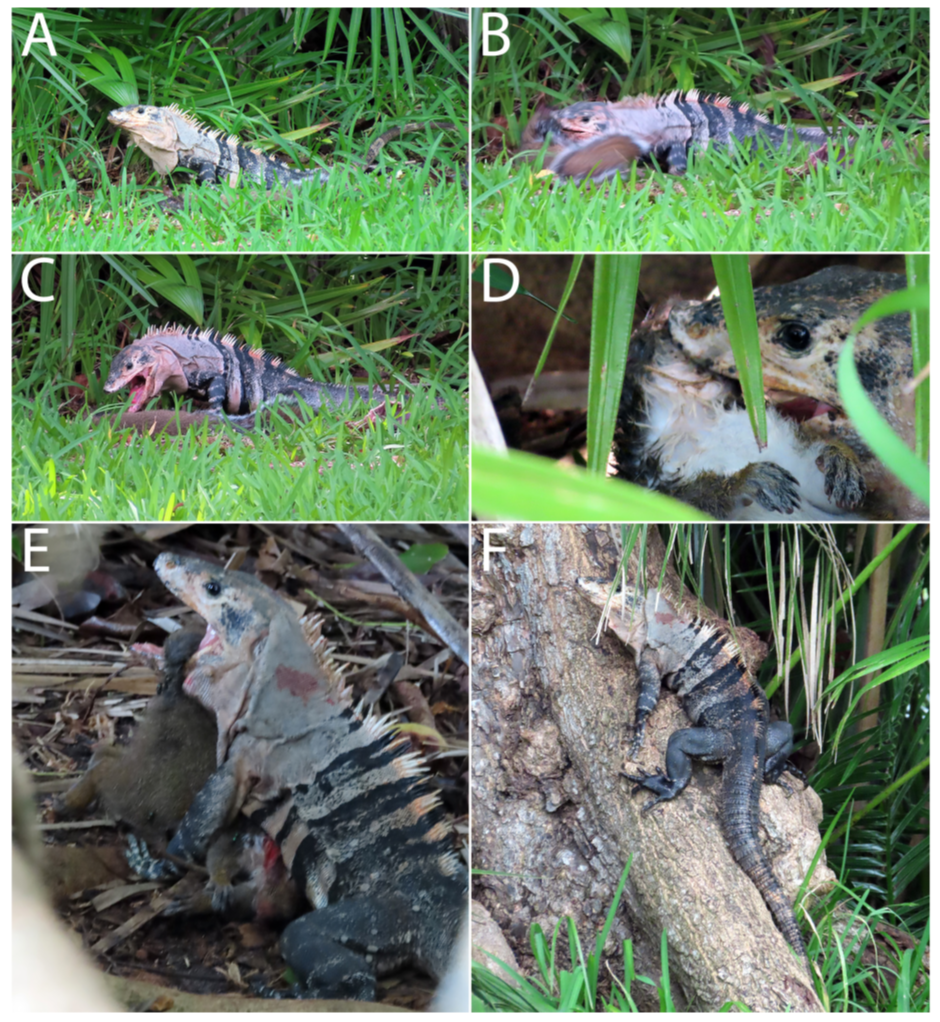
September 4th 2021, 1:25 pm. Key Biscayne (Florida). Black spiny-tailed iguana (Ctenosaura similis) preying upon Eastern gray squirrel (Sciurus carolinensis)
A male black spiny-tailed iguana was found standing over an adult squirrel that was not moving and appeared freshly killed. Very soon after beginning filming, the iguana grabbed the squirrel by the head and shook it like a rag doll before dragging it into the undergrowth where it repeatedly bit the squirrel on the head and attempted to swallow it. After over an hour the iguana gave up on swallowing the squirrel and began territorial behavior. This is the first documentation of a Black Spiny-tailed Iguana preying on and apparently attempting to consume a squirrel. I made this observation and published a description of it, along with accompanying video, in the journal Reptiles & Amphibians. Unlike the closely related Green Iguana, which is thought to be entirely herbivorous, Black Spiny-tailed iguanas are known omnivores. This species reportedly undergoes a diet shift with juveniles primarily insectivorous and adults chiefly herbivorous. In their native Central American range this species consumes leaves, flowers, and fruits, in addition to opportunistically preying on a diversity of invertebrates and small vertebrates. In its introduced Floridian range, this species is known to consume 39 species of plants, 13 species of invertebrates, and four species of vertebrates (three species of lizards and a juvenile Gopher Tortoise). My observation suggests that, under the right circumstances, Black spiny-tailed iguanas could be an underappreciated predator capable of taking larger mammalian prey (i.e. an adult squirrel). After publishing this note I sent it to several park rangers on Key Biscayne as I thought they might find it interesting. One responded that while mist netting birds, as part of a seasonal bird banding station, they observed Black Spiny-tailed iguanas approach the net – apparently attracted by the commotion of the captured birds and the promise of an easy meal!
 Reason and Nature