A remarkable new paper has been published describing 2 lethal attacks by large coalitions of chimpanzees on smaller groups of western lowland gorillas in Loango National Park, Gabon. These are the first observations of their kind. Prior observations of the interactions between these two species of great ape, in regions of their range where they overlap – including 9 other encounters between chimps and gorillas in this very National Park, have been described as peaceful and even involve co-feeding in fruit trees.
Types of interspecific (i.e. between different species) lethal encounters have traditionally been categorized as either predation or competitive killing. Killing of competitor species (either for food or to eliminate competition without immediate nutritional gain) has been well studied in carnivores. Perhaps the best examples are between large carnivores on the African savannah. For me, some of the most memorable nature documentary scenes are those depicting epic battles between lions and hyenas. Lions and hyenas typically aren’t eating each other, so it is thought that competition over food resources is what drives the animosity. This framing may be important for interpreting the lethal interactions between chimpanzees and gorillas (as described later).
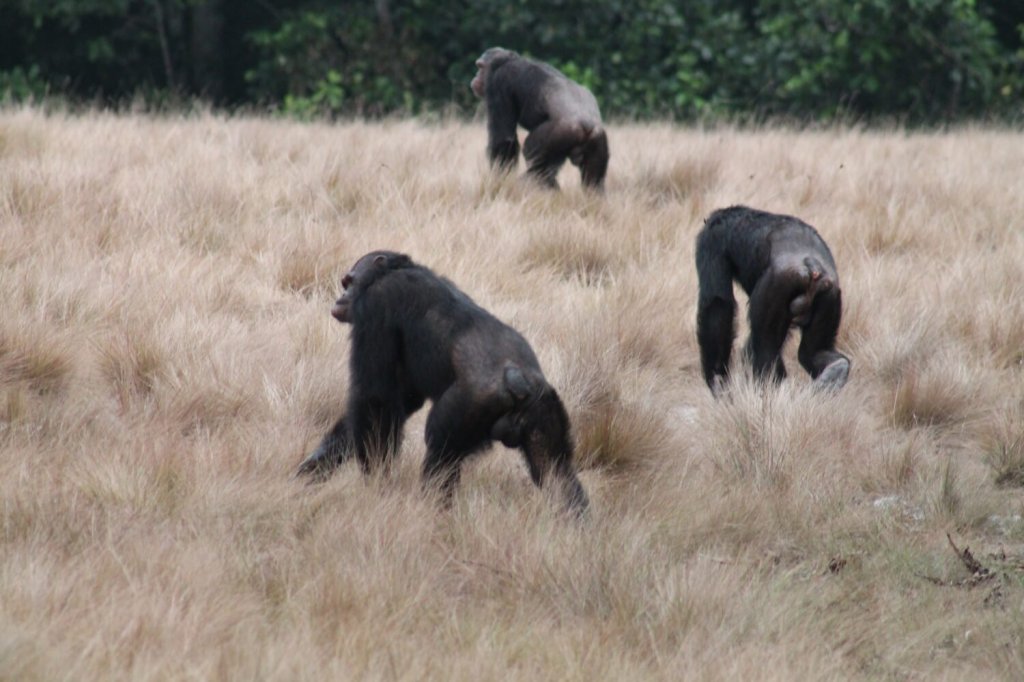
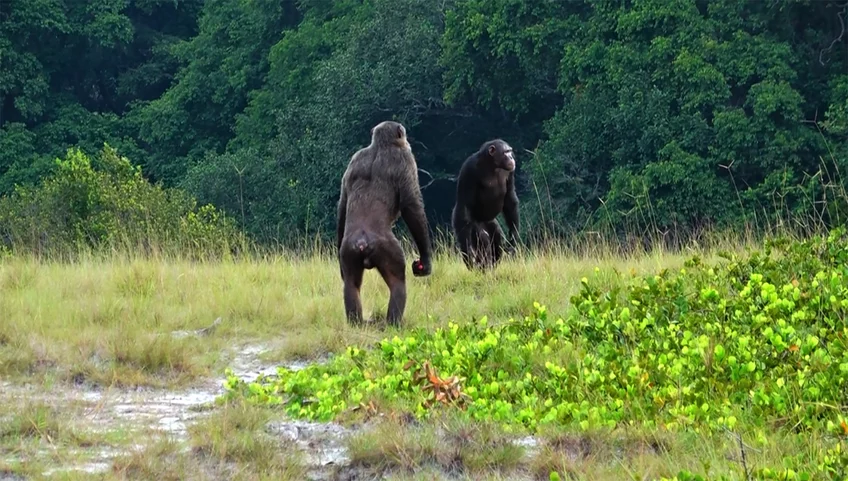
What happened in these 2 encounters? The two events show a high degree of similarity. The first in February 2019, involved 27 chimpanzees and 5 gorillas and lasted 52 minutes. The second in December 2019, involved 27 chimpanzees and 7 gorillas and lasted 79 minutes. The events occurred after or at the suspected beginning of a territorial boundary patrol by male chimpanzees. In both cases, the chimpanzees came upon smaller groups of gorillas and attacked them. In both cases, male chimpanzees were the aggressors. In both cases, the gorillas defended themselves while retreating. And finally, in both cases a gorilla infant was forcibly taken from its mother’s arms and killed by the chimpanzees.
“At 17:15, a group of approximately nine male chimpanzees (adults and adolescents), and at least one adult female chimpanzee surrounded the silverback, and repeatedly jumped down on and hit him whilst screaming and barking. The silverback retreated to a distance of approximately 30 m with all other members of his group.”

How were chimpanzees able to kill much larger and stronger gorillas? For chimpanzees there is clearly strength in numbers. Furthermore, they killed gorilla infants after separating them from the mother, rather than killing adult gorillas. It is also noteworthy that the silverback was present for only 14 minutes and 10 minutes, respectively, in each of the two encounters. The chimpanzee group being followed and observed was habituated to the presence of the researchers, while the gorillas were not. Near the beginning of the second lethal encounter the authors note “At 12:33, the silverback discovered the human observers on the ground in a distance of approximately 30 m to the base of the tree and started barking. In response, the two observer teams increased their distance to the tree from 30 to 60 m.” It is possible that the silverback retreated, at least in part, due to the presence of humans. As the authors acknowledge: “Lastly, we cannot rule out that the presence of human observers, in both events, may have had an effect on the unhabituated silverback’s departure and may have tilted the imbalance of power in favor of the habituated chimpanzees.” However, it is also possible that, given the superior numbers of male chimpanzees, the silverbacks life was in danger and he made a rational decision to hastily retreat. One silverback against 9 male chimpanzees (see above quote) seems very lop-sided, despite the clearly superior strength of a silverback in a one-on-one encounter.
© LCP, Lara M. Southern
The authors discuss potential explanations for these observations (i.e. predation versus competitive killing). Chimpanzees are known group hunters, including of other smaller primates. However, the encounters differed from typical chimpanzee hunting: “The chimpanzees were noisy, emitted alarm barks and screams and performed displays long before the infants were killed. The excitement levels dropped immediately following the death of the infant gorillas. In addition, the observed feeding behaviours during the two events also differed from patterns expected during conventional hunting for the purpose of gaining nutritional benefits through the consumption of prey.” Only one of the infants was partially consumed, and there was no competition between chimpanzees over the body – as there typically is during chimpanzee hunting behavior. The authors then consider interspecific competition and note that the degree of diet overlap between these two species in Loango is 60-80% and the two “encounters we observed occurred at times characterized by food scarcity and a period of high dietary overlap (for fruit resources)—February and December 2019. In contrast, the two previously observed peaceful co-feeding events took place in April, a month characterized by relatively low dietary overlap between the two species.” The authors then describe the similarity between these lethal encounters between chimpanzees and gorillas and those observed between chimpanzee groups (i.e. territorial patrols primarily by males in which they target and kill, often infants, from smaller neighboring groups after making incursions into their territory). They state: “Thus, it may be possible that at Loango, which is characterized by relatively high dietary food overlap in specific months, gorillas are perceived as competitors, for both space and resource use, similar to members of other chimpanzee communities.”

© LCP, Tobias Deschner
“We also observed behaviours before and during the encounters characteristic to coalitionary intercommunity encounters such as aggression (e.g., charges, chases, threatening displays, contact aggression), high levels of arousal and the use of loud vocalizations.” This is clearly evident in the two short videos of the chimpanzees attacking a gorilla mother with her infant contained in the paper’s supplementary information. The continuous chimpanzee screaming makes your hairs stand on edge! Finally, as the author’s briefly mention, these observations are thought provoking in terms of their potential implications for violence between other groups of extinct hominins with overlapping ranges, including our own direct ancestors.
 Reason and Nature