I recently published a short ‘natural history note’ describing an unexpected cleaning interaction between sailfin mollies (Poecilia latipinna) and humans in a Greek lake. In this lake I observed these normally skittish fish approach and graze on the exposed skin of bathing humans (myself and others), presumably removing dead skin cells in what amounts to an exfoliating process. Here, I’ll briefly describe the paper and give a behind-the-scenes look at how it came about. I will add that the paper is relatively short, and I think understandable to a general audience, so you may be interested in reading it in full (download link below). I also think it’s a fairly unique paper describing an interesting piece of natural history.
In the spring of 2018, while a postdoc at the University of Hull, I visited Greece to attend the wedding of two friends and University colleagues (Yannis Dimopoulos and Kelly Roussi). While in Greece, I took a day trip to Lake Vouliagmeni, a small brackish lake just outside Athens, renowned for its natural beauty and used as a natural spa. Upon entering the lake, I was approached by shoals of small fish which began nibbling my arms and legs. The sensation felt like light pinching, and occurred whenever I remained motionless in the shallows. I had my mask and snorkel (as I nearly always do when traveling) and so was able to spend the morning observing this interesting and entirely unexpected interaction. It was clear that the fish species doing the nibbling was a molly, which made this doubly interesting as a member of the group of species which I happen to study (the live-bearing fish family Poeciliidae)!

A while later, back at the University of Hull and while talking with a colleague, Stephanie McLean, I realized this was a natural history observation that might be worth describing to a wider community because of what it could potentially tell us about the development of cleaning interactions. So I set about reviewing the literature on cleaning interactions and Lake Vouliagmeni. Perhaps the most iconic cleaning symbiosis is that of small cleaner fish systematically removing ectoparasites from cooperative larger client fish who remain stationary at specific cleaning stations on coral reefs. In the case of mollies and humans in Lake Vouliagmeni, I did not observe any display behavior prior to commencing cleaning, and the skin-nibbling seemed to be rather indiscriminate grazing, rather than targeted ectoparasite removal. Therefore, this likely represents what has been referred to as an incidental cleaning interaction rather than a cleaning symbiosis, where there is communication between the client and cleaner as a catalyst to cooperation. What makes this cleaning interaction noteworthy, besides involving humans, is that it apparently developed naturally over a relatively short time frame (given that P. latipinna was likely first introduced to this lake around the mid-twentieth century from aquarium stock) without being coerced under artificial circumstances (i.e., with captive animals in a confined tank or spa).
In the paper I discuss several reasons why I think this interaction may have developed here, specifically. I think it is due to a confluence of factors. P. latipinna was introduced to this particular lake (the only place in Europe where this species is found), and is a suitable species with small body size, omnivorous diet, and natural grazing tendencies. The lake is biologically depauperate and without natural predators P. latipinna has achieved high population density. The lake is a protected natural area without fishing pressure, so P. latipinna are able to safely approach humans without being captured or harmed. And finally, the lake is used as a sort of natural spa with people coming to relax and remain relatively motionless in the shallow waters for long periods. In most contexts, a fish nibbling one’s body may be alarming and undesirable, but given that people travel to the lake to bathe in its mineral rich waters as a natural spa, fish nibbling has become part of the experience, and is seemingly tolerated or evenly positively received.
In reviewing the literature on cleaning interactions, I learned a lot of interesting things. Certain species of fish, shrimp, and birds can act as cleaners to a variety of vertebrate clients including fish, reptiles, and mammals. Examples involving humans (in nature) are mostly undescribed in the scientific literature. The only other cases I am aware of are the report of two species of juvenile angelfish cleaning a human’s wounded legs in Florida’s inshore marine waters, and a similar cleaning phenomenon (i.e., nipping at damaged tissue around human wounds or gently nibbling skin or tugging body hairs) by several other marine fish species in the Gulf of California. In captivity, a small literature has developed describing the use of fish as a treatment for human skin disease, so-called ichthyotherapy. Garra rufa, or the doctor fish, is the species most commonly used for this purpose in commercial spa treatments or pedicures. Taking a broader perspective, I found three other cases of cleaning interactions between fish and mammals. These involved topsmelt removing parastitic barnacles from gray whales, introduced suckermouth catfish (and bluegill) grazing on Florida manatees, and barbell removing food debris and parasites from hippos skin and mouths.

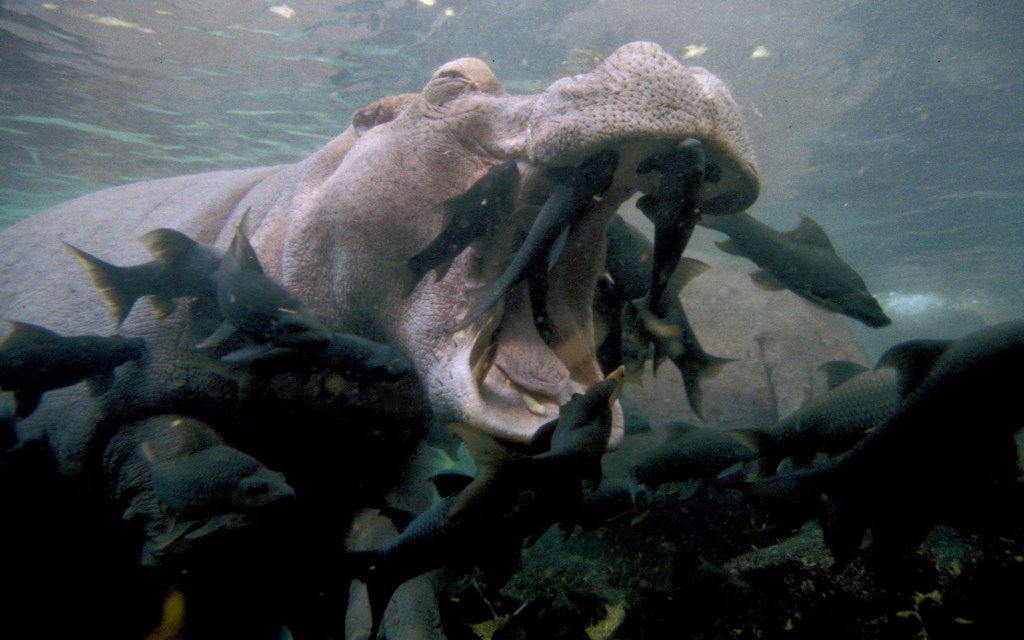
https://www.pbs.org/wnet/nature/perfect-partners-hippos-get-clean/14200/
After the paper was written I had a challenging time getting it published. I think the paper describes a fairly novel and interesting phenomenon in nature, and is a solid behavioral observation. What I mean by solid behavioral observation, is that there was absolutely no ambiguity about what was going on – the fish were physically nibbling my arms and legs – and it doesn’t get more concrete and visceral than that! And what’s more, in my research on Lake Vouliagmeni, I found hundreds of written testimonials documented by photographic evidence on the travel website TripAdvisor documenting the same thing – these mollies nibbling on people. So it is clear that this ‘cleaning interaction’ is a normalized phenomenon in this lake and not something which only happened to occur on the particular day that I visited. Yet, the paper was passed over by several journals before being accepted in Environmental Biology of Fishes. I think part of the difficulty the paper faced in getting published was that it didn’t quite fit the traditional mold of a scientific paper. Nonetheless, eventually it was published and I am very happy with that. Perhaps it can inspire similar observations in other contexts and parts of the world.
 Reason and Nature